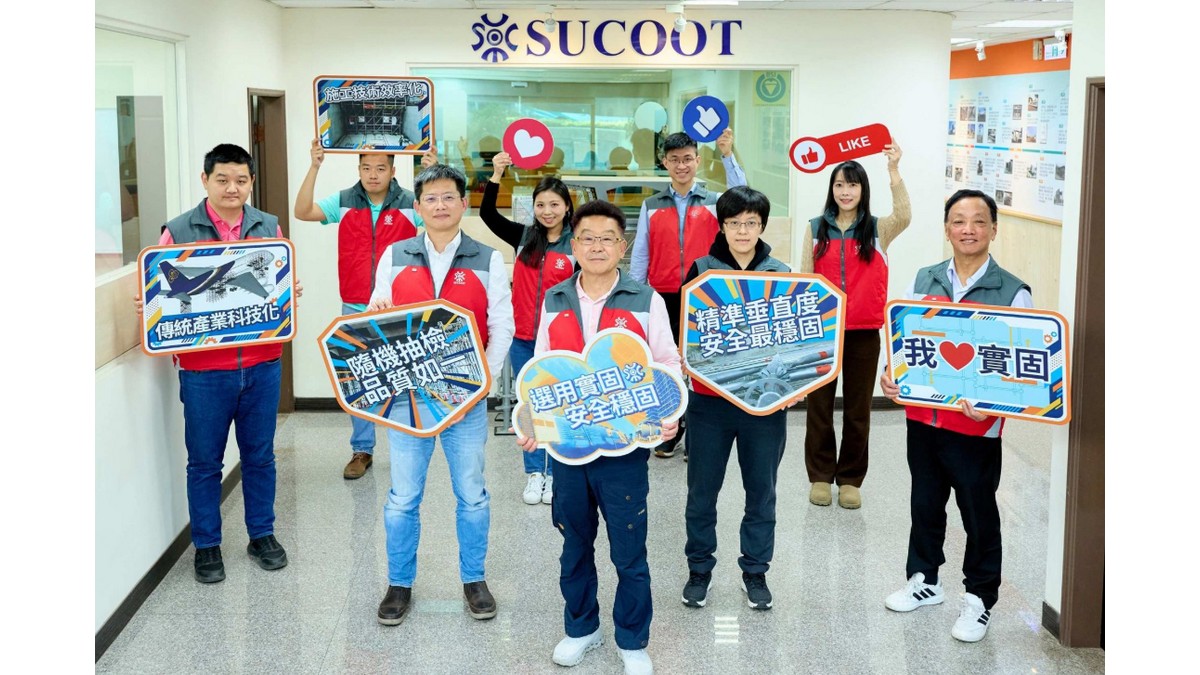
For project owners, procurement teams, contractors, and engineering managers, scaffolding and temporary support systems are no longer evaluated as material purchases alone. In public infrastructure, high-tech facilities, industrial projects, and specialized restoration works, supplier selection is often influenced by structural stability, load-bearing reliability, installation consistency, site safety, construction efficiency, and the ability to support project schedules under varying site conditions. When system precision and support capability are insufficient, the result may include rework, higher execution risk, increased coordination burden, and pressure on both schedule and quality control. _Business Weekly_ recently featured Taiwan-based scaffolding and formwork systems company SUCOOT CO., LTD., focusing on its development in high-precision Ring Lock scaffolding, engineering design, and integrated service capability, as well as its application experience across public infrastructure, high-tech industries, and heritage restoration projects. Based on the report, market attention toward SUCOOT is not limited to its products alone, but also to how the company supports project teams through system precision and engineering services that help reduce on-site uncertainty and improve execution stability.
Why are construction safety and system precision receiving greater attention?
According to the Business Weekly report, SUCOOT controls the spigot joint tolerance of its Ring Lock standards within 1.8 mm. The report further states that when tolerance increases to 3.0 mm, actual load-bearing capacity may fall to 50% of the design value, while keeping tolerance within 1.8 mm allows the system to retain more than 94% of its original design performance.
For procurement and engineering decision-makers, this highlights that scaffolding precision is not merely a manufacturing detail. It is directly connected to load performance, structural stability, and jobsite safety. This is especially relevant in demanding project environments such as public infrastructure, semiconductor-related facilities, industrial plants, and heritage restoration, where temporary support conditions are more complex and margins for error are smaller.
Why is engineering integration becoming a key market consideration?
In construction projects, scaffolding and formwork systems are rarely viewed as standalone materials. In addition to product specifications, owners, procurement teams, and contractors are increasingly evaluating whether a supplier can provide design support, construction planning, site coordination, and broader problem-solving capability.
This is because temporary support systems affect more than access and structural support alone. They also influence work sequencing, labor efficiency, interface management across trades, and the overall controllability of project execution. For project teams that must balance safety, schedule, and quality, suppliers with stronger engineering integration capability are often better positioned to reduce uncertainty and support smoother project delivery.
Key capabilities highlighted in the report and their market relevance
Based on the Business Weekly feature and SUCOOT’s public information, several capabilities stand out as particularly relevant to the market.
Long-term engineering experience and project accumulation
The report notes that SUCOOT has more than 40 years of industry experience, with applications spanning public works, high-tech industrial environments, and heritage restoration. For the market, long-term experience often indicates stronger engineering understanding, site responsiveness, and project execution maturity.
International market presence and service expansion
According to the report, SUCOOT exports to 65 countries and has established service hubs in Thailand and Indonesia. For regional buyers and cross-border project teams, this suggests broader international application experience and localized service capability.
A shift from product supply to engineering support
Based on the report, SUCOOT’s role is evolving beyond that of a scaffolding supplier toward broader engineering support and solution-oriented service. For procurement and project management teams, this type of supplier model is often more relevant to execution needs, risk control, and efficiency management on-site.
Experience across representative project categories
The report references projects such as the Taoyuan Airport MRT and the Luce Chapel restoration, and notes that SUCOOT supported the completion of 300 spans in two years on the Taoyuan Airport MRT project while maintaining a zero-accident record. For the market, such examples provide more practical context for assessing supplier stability and execution capability across different engineering conditions.
Conclusion: Scaffolding evaluation is shifting from material purchase to total project value
The Business Weekly report on SUCOOT suggests that market expectations for scaffolding and temporary support suppliers are gradually moving beyond product supply and price comparison toward construction safety, system precision, engineering support, and total execution value.
For owners, procurement teams, contractors, and engineering decision-makers, supplier selection is increasingly shaped not only by catalog specifications or unit cost, but by whether a supplier can support structural reliability, reduce site risk, improve execution stability, and perform consistently under real project conditions. This also indicates that as projects face stricter safety requirements and more complex site challenges, suppliers with systemized capability and integrated service foundations are likely to play a more important role in the market.