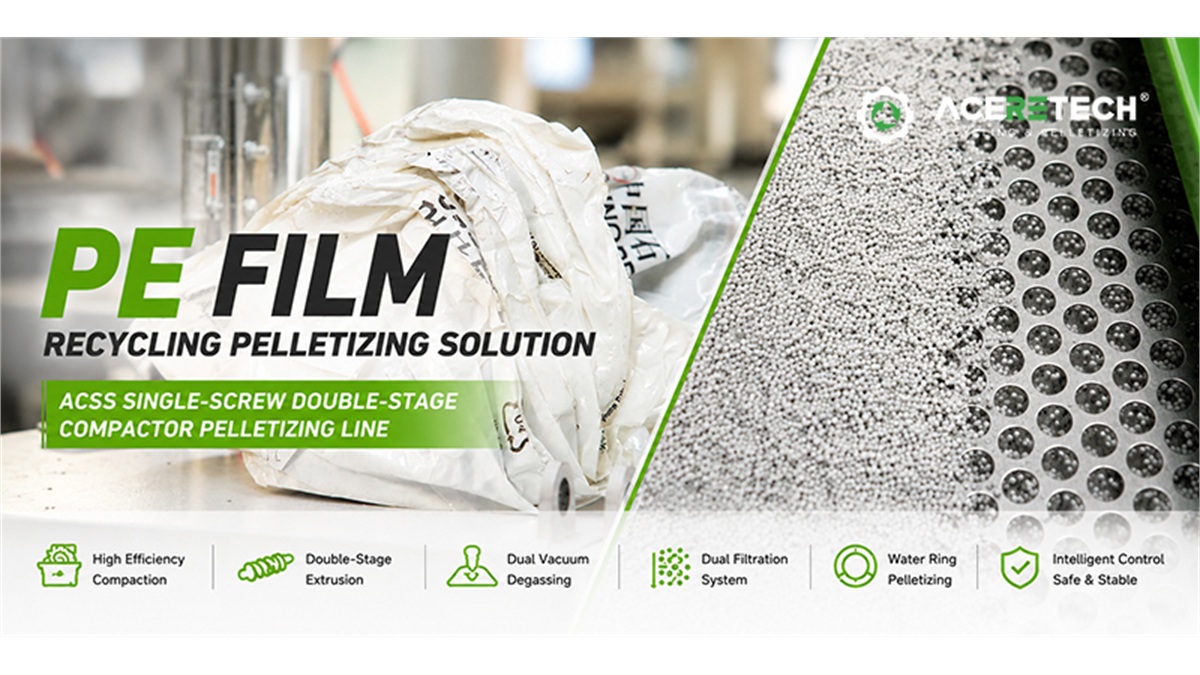
Integrated compaction, two-stage extrusion, vacuum degassing, and dual filtration address feeding and contamination challenges in PE film recycling.
ACERETECH’s ACSS compacting and pelletizing system combines material preparation, two-stage extrusion, vacuum degassing, and melt filtration to address feeding instability and contamination in PE film recycling.
Polyethylene film recycling presents a practical challenge: lightweight, flexible material must be converted into a consistent feedstock for extrusion. Industrial film scrap and recovered packaging films can differ considerably in moisture, printing residues, and cleanliness, making process selection essential to recycled pellet quality.
ACERETECH addresses these processing requirements with its ACSS two-stage compacting and pelletizing system. Designed for PE film applications, the line connects material preparation with melt processing and pellet production in a continuous workflow. The system accommodates LDPE, LLDPE, and HDPE films, including industrial scrap, printed films, and agricultural films.
ACERETECH’s PE film application overview
Preparing Lightweight Film for Consistent Feeding
The ACSS cutter compactor combines cutting, preheating, drying, and compaction before extrusion. Rotating and stationary blades reduce film size, while frictional heat helps prepare the material for subsequent processing. Increasing bulk density makes lightweight film easier to feed consistently.
The feeding system coordinates material delivery with conditions inside the compaction chamber. A metal detector can also be integrated with the conveyor and control system to identify incoming metal contamination and protect equipment. Together, these functions address feeding interruptions at the beginning of the recycling process.
ACSS system configuration
Two Extrusion Stages for Controlled Melt Processing
The ACSS uses two single-screw extrusion stages. The first melts and plasticizes the compacted material; the second further homogenizes the melt and prepares it for pelletizing.
Natural venting and dual-zone vacuum degassing help remove residual moisture and volatile substances during processing. This combination is particularly relevant to printed films and materials retaining moisture after preparation. By distributing melt processing across two stages, the system provides additional scope for degassing, filtration, and melt conditioning before the material reaches the pelletizer.
ACSS extrusion and degassing design
Dual Filtration and Automated Pellet Production
The PE film configuration described in ACERETECH’s application article features a 1,200-liter compacting chamber, a 160 mm first-stage screw, and a 180 mm second-stage screw. These specifications describe that particular configuration; equipment selection should reflect the project’s feedstock and output requirements.
Its filtration arrangement combines an SCF 500D self-cleaning melt filter with a continuous piston-type screen changer. The first filtration stage removes contaminants from the melt, while the second provides further filtration before pelletizing. The arrangement is intended to maintain melt cleanliness while reducing interruptions associated with screen maintenance.
A water-ring pelletizer cuts the filtered melt into pellets, which pass through a vibrating dewatering screen before collection. PLC controls coordinate line operation, with monitoring, alarms, motor overload protection, and screw over-pressure protection supporting production management.
Details of the featured PE film line
Matching the Recycling Line to the Intended Application
Potential applications for recycled PE pellets include bags, agricultural and packaging films, pipes, and molded products. Suitability depends on the incoming material and the required finished-product properties. Where contamination requires additional preparation, washing and drying can precede pelletizing.
PE film materials and downstream applications
For buyers, a useful starting point is to define the material type, input form, moisture and contamination conditions, target capacity, and intended pellet application. These details help establish which preparation, filtration, and extrusion configuration the project needs.
ACERETECH provides plastic recycling equipment and integrated line solutions covering size reduction, washing, drying, extrusion, filtration, and pelletizing. Its project support includes material evaluation, process design, installation, commissioning, operator training, and after-sales service.
Companies evaluating PE film recycling equipment can
discuss their material and production requirements with ACERETECH
to identify a suitable line configuration.