A practical framework for improving technician workflow, safety and service-bay utilization
Automotive workshops are handling a broader range of tools, diagnostic equipment, consumables and specialized repair tasks than ever before. As service offerings expand and workshop space remains limited, tool storage is becoming more than a matter of tidiness. It is increasingly part of how workshops manage technician productivity, safety and service-bay utilization.
In many workshops, however, tool storage is still treated as a simple purchasing decision: choose a cabinet, add drawers and move on. In practice, it is part of the workshop’s operating system. When storage is planned around real repair workflows, it can reduce unnecessary movement, improve safety and make better use of limited service-bay space.
Why Storage Affects Workshop Performance
Automotive workshops handle a wide mix of tasks: routine servicing, diagnostics, mechanical repair, tyre work, bodywork and increasingly EV-related maintenance. Each task requires different tools, consumables and working positions.
When tools are scattered across benches, cabinets and shared areas, technicians spend time locating equipment rather than diagnosing and repairing vehicles. They may also make repeated trips between the vehicle, tool cabinet, parts area and consumables station.
These movements may seem minor in isolation. Across a full working day, however, they add up to interrupted workflow, longer job cycles and reduced service-bay utilization.
Poor storage also creates safety risks. Tools left on benches, floors or vehicle surfaces can contribute to trips, falls and damage to vehicles or equipment. Automotive safety guidance highlights the importance of proper storage, organized work areas and suitable equipment for the task being performed.
Storage Is a Workflow Issue
A common mistake is to treat tool storage as a furniture purchase. A workshop may invest in a large tool cabinet, yet still experience lost tools, congested workstations and repeated interruptions.
The real question is not “How many drawers do we need?” It is:
Which tools need to be available at which point in the repair process, and who needs access to them?
Effective storage starts with workflow. A technician working on brakes needs different tools and consumables from one carrying out diagnostics, electrical repairs or bodywork. A mobile tool cart may support the first scenario, while a fixed workstation may be better suited to precision measurement or heavy equipment.
Organizing tools by function and frequency of use improves accessibility and helps technicians retrieve what they need more quickly. In a well-run workshop, storage should therefore reflect how work actually happens—not simply how equipment is displayed or catalogued.
Start With a Workflow Audit
Before selecting tool carts, cabinets or wall systems, workshop managers should observe how technicians move through a typical job.
A practical starting point is to map the journey of a repair order:
- Vehicle check-in and initial inspection
- Diagnosis and parts identification
- Repair or replacement work
- Testing and quality checks
- Cleaning, handover and next-job preparation
At each stage, identify:
- Which tools are used most frequently?
- Which tools must remain close to the technician?
- Which items are shared across multiple bays?
- Which consumables run out most often?
- Which equipment creates safety or access risks?
- Where do technicians repeatedly leave their work area?
This review often reveals that the issue is not a lack of storage, but a mismatch between storage location and actual use. For example, a technician may repeatedly walk to a central cabinet for commonly used sockets, while rarely used specialty tools occupy prime drawer space.
Industry guidance recommends observing technicians’ daily movements and identifying unnecessary trips for tools or parts as a first step in improving turnaround times.
Use Four Storage Levels
Once the workflow is understood, tools and consumables can be assigned to different storage levels. This prevents the workshop from relying on a single type of storage for every need.
| Storage level |
Best suited for |
Primary benefit |
| Mobile tool trolley |
High-frequency hand tools, sockets, wrenches and small diagnostic equipment |
Keeps essential tools close to the vehicle and technician |
| Fixed workstation |
Heavy equipment, precision tools, test equipment and dedicated repair tasks |
Provides a stable, organized base for specialist work |
| Wall storage |
Extension cords, hoses, cleaning supplies and low-frequency equipment |
Frees up floor and bench space |
| Modular storage |
Consumables, spare parts and supplementary tools |
Supports different services and future expansion |
| Shared tool zone |
High-value, low-frequency or controlled equipment |
Improves traceability and reduces duplicate purchases |
The objective is not to store everything in one place. It is to place each item where it supports the work being performed.
For example, a technician may keep commonly used hand tools in a mobile trolley beside the vehicle, while torque wrenches, diagnostic equipment and specialty tools remain in a controlled workstation. Consumables can be stored nearby in modular drawers or cabinets, with replenishment triggered before stock runs out.
Match the Configuration to the Task
Tool carts, workstations and modular storage systems solve different problems. Choosing between them should therefore begin with the task, not the product catalogue.
Mobile tool trolleys

Mobile tool trolleys are most valuable when technicians need to bring tools directly to the vehicle. They reduce walking distance and help keep frequently used equipment within reach.
For workshops handling premium vehicles or complex repairs, the quality of the trolley matters. Collision protection, smooth drawer operation, load capacity, side trays and power integration can all affect both safety and workflow.
Machan’s high-end tool trolley concept, for example, was developed around real workshop needs: corner guards to reduce accidental impacts, soft-close drawers to reduce noise, heavy-duty load capacity, angled bottle racks, side trays for frequently used tools and power-strip integration for electric tools.
These details matter because a tool trolley is not simply a container. It is a mobile workstation that travels with the technician.
Fixed workstations
Fixed workstations are appropriate for tasks that require stability, precision or specialized equipment. They can support measurement, calibration, electrical testing, parts preparation and heavier repair work.
A workstation should be positioned where it can serve multiple technicians without interrupting vehicle movement or creating congestion. It should also provide enough surface area, storage and power access for the tasks assigned to it.
Wall and modular storage
Wall storage is useful for items that do not need to occupy valuable bench or floor space. Hoses, cables, cleaning equipment and low-frequency tools can be stored vertically, keeping work areas clearer.
Modular storage adds flexibility. As a workshop adds services, equipment or technicians, modular cabinets, drawers and accessories can be reconfigured rather than replaced entirely.
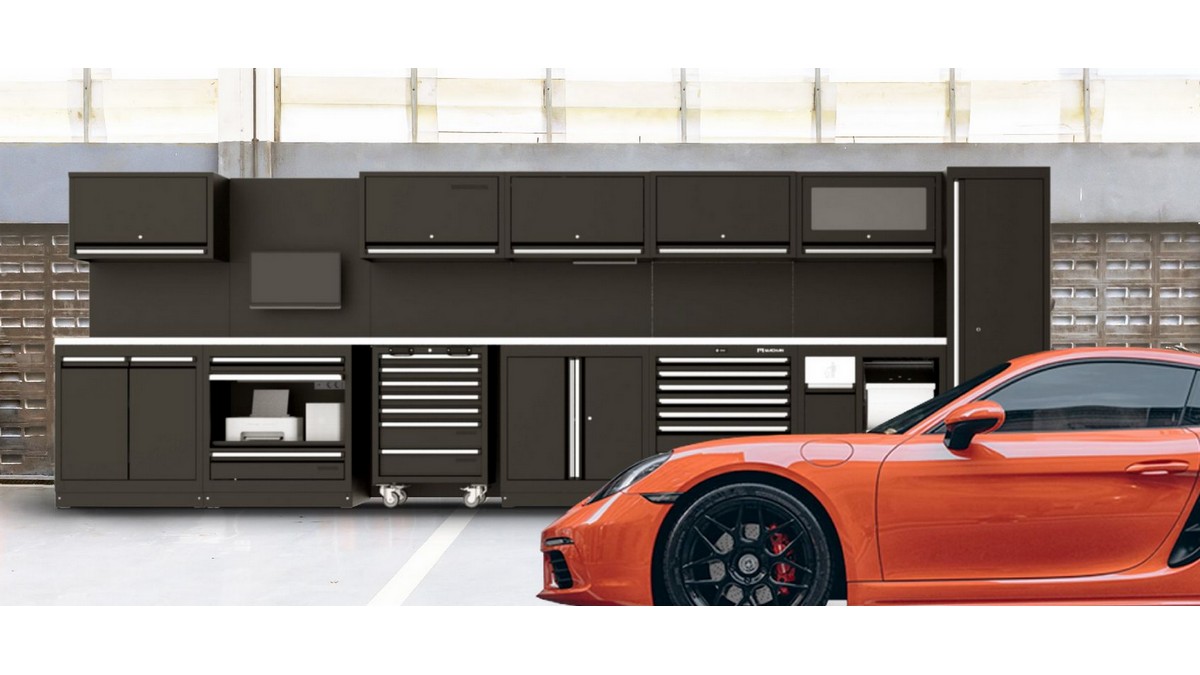
Machan’s modular storage approach is designed around this principle: workshops can combine individual components to create a system suited to their space and operational needs.
Design for Safety and Ergonomics
Storage planning should also consider how technicians physically interact with tools throughout the day. Repeated bending, reaching, lifting and carrying can contribute to discomfort and injury risk, particularly when tools are poorly positioned or excessively heavy.
SafeWork SA recommends consulting workers before purchasing new equipment or tools, and ensuring equipment matches both the worker and the task. Worker input is especially valuable when redesigning workstations or introducing new storage systems, because technicians understand which tools they use most often and which movements create difficulty.
Practical design considerations include:
- Keeping frequently used tools between waist and shoulder height where practical
- Avoiding overloaded drawers that become difficult to open or move
- Providing stable castors, brakes and handles for mobile equipment
- Using drawer dividers, foam inserts and labels to support correct tool return
- Separating hazardous materials and ensuring safe storage practices
- Providing sufficient clearance around workstations and vehicle lifts
Safe storage, clear labelling and defined locations help reduce trip hazards and make it easier for technicians to maintain order.
Make the System Sustainable
A well-designed storage system can lose its value if technicians do not know where tools belong or cannot easily return them after use.
Workshops should therefore establish simple rules for tool ownership, placement and replenishment. Visual management—such as labels, colour coding, shadow boards and clearly defined drawer layouts—makes it easier for technicians to identify missing tools and return equipment to the correct location.
A practical implementation process may look like this:
-
Pilot one service bay. Reorganize tools based on observed technician movements and measure the effect on workflow.
-
Standardize placement. Assign every frequently used tool a defined location, supported by labels or foam inserts.
-
Assign ownership. Clarify who is responsible for shared equipment, consumables and end-of-day checks.
-
Review regularly. Adjust storage as services, equipment and repair demands change.
The goal is not perfect organization on day one. It is a system that remains usable as the workshop grows and changes.
When Customization Adds Value
Standard tool storage works well for many general-purpose applications. However, some workshops face requirements that standard products cannot fully address.
Customization becomes valuable when a workshop needs to accommodate:
- Unusual bay dimensions or constrained layouts
- Heavy or specialized equipment
- Specific tool sets and drawer configurations
- Higher load requirements
- Integrated power, lighting or cable management
- Brand-specific colours, finishes or product identity
- Regional differences in technician habits and workspace dimensions
- Future expansion into EV, diagnostics or specialist repair services
Machan’s experience developing a next-generation automotive repair tool cart illustrates this point. Working with a long-term hand-tool manufacturing partner, the company adjusted overall height and drawer layout for ergonomic compliance, redesigned the lid for dust protection and versatility, and re-engineered moulds for more consistent plastic-metal integration.
The project also produced separate North American and European versions, reflecting differences in technician habits, workspace dimensions and ergonomic preferences. This demonstrates why storage should not be treated as a one-size-fits-all purchase.
From Storage Products to Workshop Systems
The most effective tool storage strategy begins with the workshop, not the cabinet.
By understanding how technicians move, which tools they use most often and where delays occur, workshop managers can create a storage system that supports the work rather than interrupting it. Mobile trolleys keep essential tools close to the vehicle; workstations provide stability for specialist tasks; wall and modular storage improve space utilization and flexibility.
Machan supports this approach through customizable tool trolleys, workstations and modular storage systems. With more than 50 years of OEM manufacturing and sheet-metal fabrication experience, the company works with customers to translate workshop requirements into practical, durable and scalable storage solutions.
For workshops seeking to improve technician workflow, safety and service-bay utilization, the starting point is simple: observe the work, map the movement and design storage around the way repairs actually happen.