EV manufacturers need lightweight designs, durable materials, and repeatable precision. CNC Swiss lathes can help produce small, slender, high-tolerance turned parts, but success depends on matching the machine configuration and cutting process to each component.
Electric vehicles bring together battery systems, electric motors, power electronics, sensors, connectors, and thermal-management components. Each system contains parts with different size, material, and quality requirements. A large structural component may be formed, cast, or milled, while a small connector body, sensor pin, actuator shaft, or precision sleeve may be turned in high volumes.
The scale of this manufacturing shift is significant. The International Energy Agency reports that global electric car sales exceeded 20 million in 2025, representing about one-quarter of new cars sold worldwide. That figure describes vehicle demand, not machine-tool demand, but it helps explain why suppliers are investing in repeatable production processes across a wider range of EV components. IEA, Global EV Outlook 2026.
Short answer: A CNC Swiss lathe is most useful when an EV part is small in diameter, long or slender, and requires stable accuracy across many pieces. Its sliding headstock and guide bushing can support bar stock close to the cutting area, reducing deflection. Multi-axis, live-tool, and sub-spindle functions can combine operations, depending on the machine configuration. Stainless steel and special alloys can be machined successfully, but they require material-specific tooling, chip control, coolant, and cutting data.
Where Swiss turning fits in EV component manufacturing
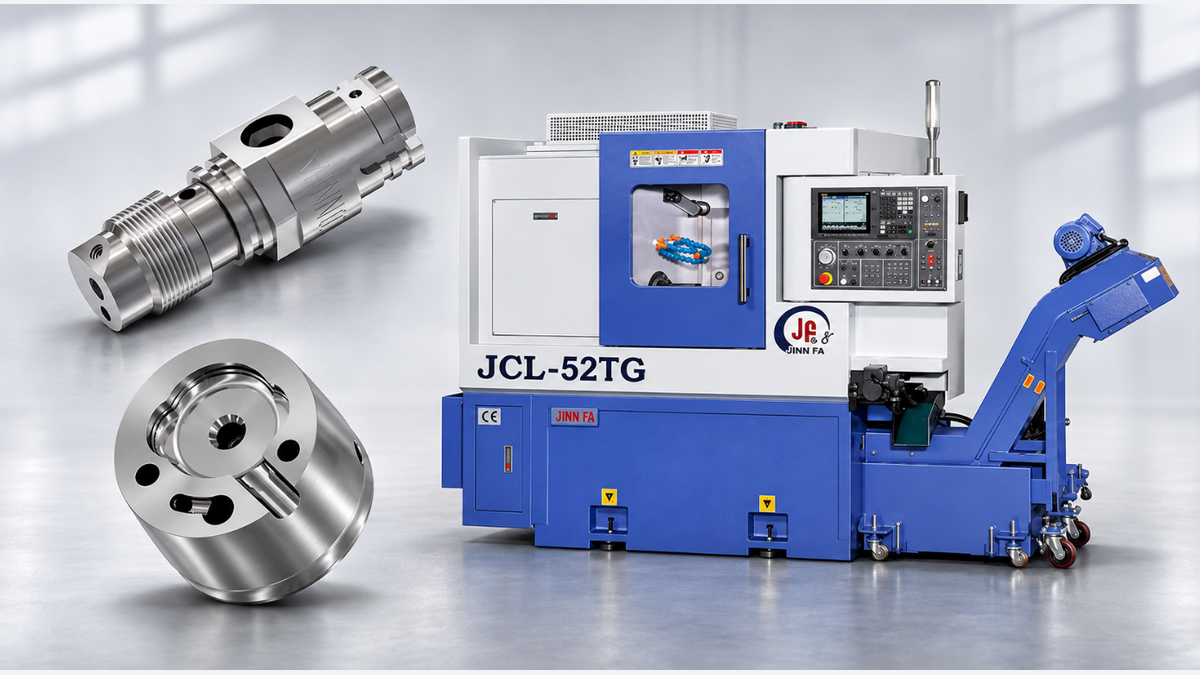
A Swiss-type CNC lathe feeds bar stock through a guide bushing while the headstock moves the material past the cutting tools. Supporting the stock close to the cutting point helps limit bending, which can be a problem when conventional turning machines work on long, small-diameter parts. Depending on the model, a Swiss lathe may also perform turning, drilling, milling, tapping, grooving, and back-working in one setup.
This makes Swiss turning relevant to selected EV parts, not every component in an electric vehicle. Battery trays, large motor housings, and structural parts generally require other manufacturing processes. Swiss lathes are better suited to precision turned features such as pins, shafts, small fittings, sleeves, and connector or sensor components. The final choice depends on the part drawing, stock size, tolerance, and production volume.
The table below gives examples of part families and the questions production engineers should resolve before assigning them to a Swiss lathe.
| EV part family |
Typical machining need |
Why Swiss turning may fit |
Key check before production |
| Sensor pins and actuator shafts |
Small diameters, concentric features, threads, or cross-holes |
Close support can reduce deflection on slender parts; live tools may complete cross features |
Confirm part length, tolerance stack, bar straightness, and required cross-feature access |
| Connector bodies, sleeves, and terminals |
Repeatable diameters, shoulders, grooves, and threads |
Turning and secondary features may be combined in one cycle on a suitably equipped model |
Confirm the specified material, surface finish, electrical interface, and burr limits |
| Precision fittings and retainers |
Small turned profiles, internal or external threads, and sealing surfaces |
Bar-fed production can support repeatable batches with fewer manual transfers |
Review chip shape, thread quality, sealing requirements, and inspection method |
| Compact drivetrain or coupling features |
Concentric turned diameters and faces, sometimes with drilling or milling |
A Swiss lathe can fit smaller parts; larger or shorter components may be better suited to a fixed-headstock lathe |
Compare the part envelope and operation plan against both machine types |
These are application examples, not a blanket list of components that should be made on a Swiss lathe. The part drawing, stock size, tolerance, and production volume should guide the choice.
Lightweighting and precision create a process trade-off
Vehicle lightweighting is a system-level goal. Engineers balance mass with strength, fatigue life, corrosion resistance, manufacturability, and cost. It does not mean every EV part should use the lightest material available: a connector, fastener, sensor component, or fluid fitting may need stainless steel or another alloy because of its operating environment.
Turned parts still need to hold critical features consistently in a compact design. A connector may require a precise mating diameter and thread; a sensor pin may need concentricity and a stable finish; a shaft may need aligned diameters and cross-holes. The drawing defines acceptance criteria. Swiss turning can reduce bar deflection and the number of re-clamping steps, but accuracy still depends on tool wear, bar quality, machine condition, coolant, and inspection. Validate the process on representative production material before treating a machine specification as proof of capability.
Machining stainless steel on a Swiss lathe
Stainless steel is used in automotive parts where strength, corrosion resistance, or cleanliness requirements matter. “Stainless” covers many grades with different machinability. Some austenitic grades are ductile and can work-harden if the tool rubs or takes a very light cut. Long chips can wrap around tools or parts, interrupt automatic production, damage a surface, or require operator intervention.
To improve stability when turning stainless steel:
- Start with the exact grade and use a sharp, suitable edge. Material condition, insert geometry, and grade all affect cutting data, force, heat, and finish.
- Avoid rubbing and unplanned dwell. A tool that presses against the surface without cutting effectively can create a work-hardened layer for the next pass.
- Plan chip breaking. Select a feed, depth of cut, and chip-breaker geometry that form manageable chips for the operation. Test internal and external threading separately because their chip paths differ.
- Direct coolant where it can reach the cut. Coolant can support temperature control and chip evacuation, but the appropriate pressure and delivery method depend on the machine and feature.
Sandvik Coromant’s threading guidance notes that stainless steel can form built-up edge if cooled excessively, and advises avoiding very small cuts in work-hardening materials that would cut into a hardened surface layer. It also emphasizes chip control and tool wear as factors in thread quality and tool life. These recommendations are starting points; the machinist should validate cutting data for the specific stainless grade, insert, machine, and part geometry. Sandvik Coromant, thread turning application tips.
Working with special alloys
"Special alloy" is a broad label, not one machinability category. It can include titanium, precipitation-hardening stainless, nickel-based heat-resistant alloys, and other grades chosen for strength, temperature, fatigue, or corrosion requirements. Cutting behavior varies by composition, heat treatment, and material condition.
Some nickel-based heat-resistant alloys retain strength at high temperatures, while cutting forces and heat concentrate near the tool edge. Depending on the grade and operation, tool wear, notching, surface integrity, and work hardening can become concerns. Sandvik Coromant’s application guide describes stage-specific strategies and identifies notch wear and plastic deformation as common wear mechanisms. For Swiss turning, qualify the whole system: machine rigidity, spindle capability, bar support, toolholder, coolant access, cutting data, and inspection. Run a controlled trial on the specified alloy and record cycle time, tool life, dimensions, and surface results. Sandvik Coromant, heat-resistant superalloy application guide.
Practical ways to improve EV part production efficiency
Higher output does not come from spindle speed alone. Connect the part design, machine configuration, cutting process, automation, and quality checks:
- Group parts by geometry and material. Classify by bar diameter, part length, material grade, tolerance, and operations. Similar families can share tooling and inspection plans, while unsuitable parts can stay on another process.
- Choose guide-bushing mode for the part. A guide bushing supports long, slender stock near the tool. Non-guide-bushing operation may reduce remnant waste on shorter parts. Some Jinn Fa JSL models support both; compare length, bar consumption, tolerance, and setup time. Jinn Fa Swiss-type CNC lathe range.
- Combine operations when the cycle supports it. Live tools, Y-axis functions, and a sub-spindle can combine turning, drilling, milling, and back-working, depending on model. Simulate the actual sequence and measure synchronized cycle time before projecting a gain.
- Stabilize cutting and chip removal. Record speed, feed, depth of cut, insert, coolant, chip shape, tool life, and surface results by material and operation. Test changes systematically and plan chip evacuation from cross-holes, grooves, and threads.
- Automate material flow and monitor quality. A bar feeder, parts catcher, or chip conveyor can reduce manual handling when the mix and volume justify them. Combine automation with first-article approval and in-process checks for critical diameters or runout.
Compare the revised process with a measured baseline: cycle and setup time, scrap, tool life, and operator attention. This helps reveal whether a faster programmed cycle also improves actual production.
How Jinn Fa’s Swiss lathes relate to EV applications
Jinn Fa Machine’s automotive page presents its CNC sliding-head machines for precision automotive machining and lists the JSL-20RB/20RBY for small-diameter shafts, pins, and automotive electronics. It describes the JSL family as suitable for smaller, long parts; its Swiss-lathe range also lists multi-axis and sub-spindle capabilities on selected models. These are manufacturer-stated application and configuration details, not a guarantee that a model will meet every EV part drawing.
The right selection depends on bar diameter, part length, material, tolerance, required features, batch size, and annual demand. Buyers should ask for a review of representative drawings, a proposed tool layout, cycle-time assumptions, chip and coolant strategy, and sample-part validation. They should also confirm which functions are standard and which depend on model or options. This turns a broad “EV machining” claim into a checkable production plan. Explore Jinn Fa’s automotive parts and EV machining applications.
Frequently asked questions
Which EV components are best suited to a CNC Swiss lathe?
Small-diameter, long, slender, or complex turned parts are the strongest candidates. Examples include precision shafts, sensor pins, connector bodies, sleeves, fittings, and actuator components. Large housings, battery trays, and structural components usually need other processes. The drawing and production volume should guide the decision.
Can a CNC Swiss lathe machine stainless steel and special alloys?
Yes, when the machine configuration, tooling, coolant, and cutting data suit the exact material and part. Stainless grades can create work-hardening and chip-control issues; nickel-based heat-resistant alloys may increase heat, cutting forces, and tool wear. Trial machining should confirm surface quality, dimensions, chip behavior, and tool life before full production.
How does a Swiss lathe help with long, small-diameter parts?
Its sliding headstock feeds bar stock through a guide bushing that supports the material close to the cutting tool. This can reduce deflection and vibration compared with supporting a slender bar farther from the cutting point. The actual benefit depends on the part length, guide-bushing setup, material, and machine condition.
What should a buyer provide when requesting an EV part machining proposal?
Share the part drawing and revision, material grade and condition, critical tolerances, surface requirements, annual volume, batch size, expected cycle time, and inspection plan. These details allow the machine builder to assess bar capacity, axes, tooling, guide-bushing mode, automation, and sample validation against the real production requirement.
Explore Jinn Fa's EV Machining Solutions Now
For EV component suppliers evaluating precision turning, the next step is to compare the part drawing and production target with the machine’s actual configuration. Contact Jinn Fa to discuss a suitable machine configuration based on the material, part geometry, and production target. Explore Jinn Fa's EV Machining Solutions Now.