Choose for Proven Part Performance, Not the Biggest Specification or Lowest Price
Buying a CNC cylindrical grinder machine is rarely just a question of choosing the largest capacity or the lowest quoted price. For a purchasing manager, plant owner, or production engineer, the real risk is buying a machine that looks capable on paper but cannot hold the required size, surface finish, and cycle time once real parts, operators, coolant, and wheel wear enter the process.
The right choice begins with the finished part—not with the machine catalogue. A grinder must suit the workpiece geometry, material, batch size, datum strategy, tolerance, and future product mix. It must also be practical to set up, verify, maintain, and run safely. This guide turns those requirements into a clear selection process, so buyers can compare proposals on the factors that actually protect precision and return on investment.
Quick answer: Choose a CNC cylindrical grinder machine by first defining the part family and measurable acceptance criteria. Then verify capacity, workholding, machine rigidity, thermal control, wheel and dressing strategy, control capability, automation, service, and safety. Require a documented test cut on a representative part before signing off.
Start With the Part: Define the Job Before Comparing Machines
“Precision” is not a single specification. A shaft may need a tight outside diameter, while a hydraulic component may also require roundness, taper control, shoulder squareness, and a specific surface texture. A long roll may need crown or profile control across its full length. If those needs are not written down, suppliers can quote technically different machines and every comparison becomes misleading.
Create a one-page part-and-process brief for the parts that will occupy most of the machine’s time. Include the maximum and typical workpiece diameter, overall length, weight, material and hardness, stock allowance, and annual quantity. Add the drawing tolerances and identify which dimensions are critical to function. Also state the required surface finish, production shift pattern, target cycle time, and whether the part must be ground between centers, in a chuck, on a mandrel, or with steady-rest support.
The most useful brief includes a real part drawing, a sample part, and the current process problems. For example: “the existing process holds size but produces taper after a long run,” or “setup time makes small batches unprofitable.” Those statements give a machine builder a problem to solve, not merely a dimension to fit.
Match Machine Capacity to the Full Workpiece Envelope
Capacity is the first screening step, but it should be assessed with margin. The relevant figures are not only maximum swing and distance between centers. Buyers should check usable grinding length, maximum supported workpiece weight, wheel clearance near shoulders, the range of grinding diameters, and access for loading and gauging.
A machine that just fits a workpiece may leave no room for a larger wheel, a steady rest, a chuck, a dressing device, or a future revision to the part. Conversely, a much larger machine can impose unnecessary floor-space, energy, and handling costs. The goal is a stable working envelope, not maximum size for its own sake.
The table below helps turn commonly quoted specifications into buying questions. Ask every supplier to answer these questions against the same representative part, wheel, fixture, and process route.
| Selection factor |
What to confirm |
Why it affects precision or cost |
| Work envelope |
Usable length, swing, grinding diameter range, wheel clearance, and machine travel |
Prevents interference and avoids buying a machine with capacity that cannot be used in the required setup. |
| Workpiece mass and stiffness |
Maximum weight between centers or in chuck; need for steady rests |
A long or heavy part can deflect, vibrate, or overload support systems even when its dimensions fit. |
| Part geometry |
Straight OD, steps, tapers, faces, radii, threads, camber, or crowned profile |
Determines the needed axes, dressing method, software cycles, and gauging approach. |
| Material and stock removal |
Material grade, hardness, stock allowance, and required removal rate |
Drives wheel specification, spindle power, coolant delivery, and the risk of thermal damage. |
| Tolerance and finish |
Size, roundness, cylindricity, taper, runout, and surface-finish requirements |
Defines the process capability that must be demonstrated at acceptance, not merely claimed. |
| Production model |
Batch size, changeover frequency, shifts, operator availability, and target cycle time |
Determines whether simple CNC, in-process gauging, loaders, or automation create real value. |
| Future mix |
Likely next-generation parts, materials, and volumes |
Helps buyers invest in useful flexibility without paying for options that will remain unused. |
Evaluate Accuracy as a System, Not a Brochure Number
Machine positioning accuracy matters, but a finished part reflects the entire grinding system. Wheel balance, spindle condition, guideway behavior, workholding concentricity, dressing consistency, coolant temperature, room conditions, and the measuring method can all affect the result. A very small axis-resolution number does not guarantee equally small variation in production.
Ask for the supplier’s method for proving size control, roundness, cylindricity, taper, and surface finish. The acceptance plan should state the material and dimensions of the test workpiece; whether it is a short test bar or your actual part; the number of parts to be ground; the warm-up procedure; wheel specification; dressing interval; measuring instruments; and allowable results. If a tolerance is critical, it should be measured at several positions and repeated after a realistic production run.
This approach is especially important for long, slender, or interrupted parts. Deflection can create a part that measures correctly at one location but is not truly cylindrical. A purchaser should therefore request a process-capability discussion, not a single “best part” result. Where a supplier uses terms such as repeatability or runout, ask which component or finished-part characteristic is being described and under what conditions.
Thermal Stability Is Part of the Precision Budget
Grinding converts energy into heat. If heat changes the size of the machine, wheel, workpiece, or coolant, the process may drift even though the program never changes. For stable production, assess the machine base and guideways, wheelhead design, lubrication, coolant filtration and temperature management, warm-up routine, and compensation options. An independent review published in CIRP Annals and listed by the U.S. National Institute of Standards and Technology (NIST) describes the use of measurement methods to detect machine-tool thermal errors and NC compensation to reduce them. For buyers, the practical point is simple: thermal behavior belongs in the process review, not only in a maintenance discussion.
This is also where a cheap quote can become expensive. Poor filtration can accelerate wheel loading and surface defects. Inadequate coolant delivery may contribute to burn or metallurgical damage. A buyer should ask how the proposed configuration manages swarf, filters coolant, and keeps a dressed wheel cutting consistently for the intended material.
Choose Workholding and Support Before Finalizing the Grinder
The same CNC cylindrical grinder machine can perform very differently with a different workholding strategy. Between-centers grinding is often appropriate for shafts that require consistent concentricity relative to center holes. Chucking may be necessary when centers are unavailable or when a datum must be held from an existing feature. Mandrels, drive dogs, special fixtures, and steady rests can be essential for thin-walled, long, heavy, or flexible parts.
Ask four practical questions:
- What datum does the finished diameter need to relate to?
- How will the part be driven without creating distortion or slip?
- Where will the part be supported during roughing and finishing?
- How quickly can an operator change from one part family to the next?
The answers may change the preferred machine layout and accessory list. They can also reveal costs that are missing from an initial quotation, such as fixture design, a tailstock option, steady rests, lifting equipment, or safety guarding for a large rotating workpiece.
Specify the Wheel, Dressing, and Coolant Strategy Together
Grinding-wheel selection is a process decision, not an afterthought. Abrasive type, grit size, bond, structure, wheel width, and wheel speed must match the material, contact area, stock removal, finish, and part geometry. The dressing method must restore the wheel shape and cutting ability often enough to control size and finish without consuming excessive cycle time or wheel life.
For a stepped shaft, wheel width and shoulder clearance may be as important as diameter. For a profiled roll, the dressing system and CNC interpolation must reproduce the required shape reliably. For hard materials or high removal rates, the supplier should explain the proposed wheel, dressing interval, coolant method, and expected signs of wheel loading or burn. Avoid accepting a generic wheel recommendation without a test on similar material.
In-process gauging can reduce manual checking and compensate for wheel wear in suitable high-value or repeat jobs. It is not automatically the right choice for every shop. The business case is strongest when scrap risk, inspection time, or unattended production is costly enough to justify the extra complexity. Ask how the gauge is protected from coolant and swarf, how it is calibrated, and what happens when it detects an out-of-tolerance condition.
Select CNC, Automation, and Data Features That Operators Will Actually Use
Modern controls can make common operations easier through stored programs, wheel compensation, diagnostic messages, profile cycles, and connectivity. Yet a feature only adds value if the team can program, verify, and maintain it. The right level of CNC depends on whether the shop runs repeated shaft families, frequent low-volume changes, complex profiles, or long unattended cycles.
For every software or automation option, connect it to a measurable outcome. A loader may reduce labor and stabilize throughput for high-volume parts, but it may not pay back for frequent one-off setups. A probing or measuring system may shorten inspection time, but it needs a clear reaction plan. Remote monitoring can help maintenance teams, but it does not replace preventive maintenance or trained operators.
Ask to see the actual operator screens for setup, offsets, dressing, alarms, and program recovery. Confirm the control language, backup method, local training plan, and availability of spare parts. Also ask who owns and can export the programs and machine data. These details determine whether the machine remains productive after the installation team leaves.
Include Safety, Ergonomics, and Service in the Buying Decision
Safety belongs in the original specification. Grinding wheels operate at high speed, and guarding must be appropriate for the wheel and application. For cylindrical grinding machines, OSHA’s abrasive-wheel rule states that the maximum angular exposure of the wheel periphery and sides for the safety guard must not exceed 180°, with the opening beginning no more than 65° above the horizontal plane of the wheel spindle. Local laws and the machine’s destination market may require additional or different measures, so the buyer should confirm compliance requirements before purchase.
Ergonomics also affects quality. Operators need safe access to load parts, change wheels, dress the wheel, inspect the work zone, and clean the machine. Consider door opening, crane access, chip handling, visibility, noise, mist extraction, and the physical effort required to reposition a tailstock or steady rest. A machine that is difficult to service will eventually be serviced less often.
Service capability should be evaluated with the same discipline as machine capacity. Request a written response-time expectation, commissioning scope, preventive-maintenance schedule, recommended spare parts, documentation, remote-support process, and local or regional technical support. If the machine is production-critical, discuss contingency planning for controls, spindle components, and wheelhead service before placing the order.
A Neutral Look at PROMA MACHINERY CO., LTD.
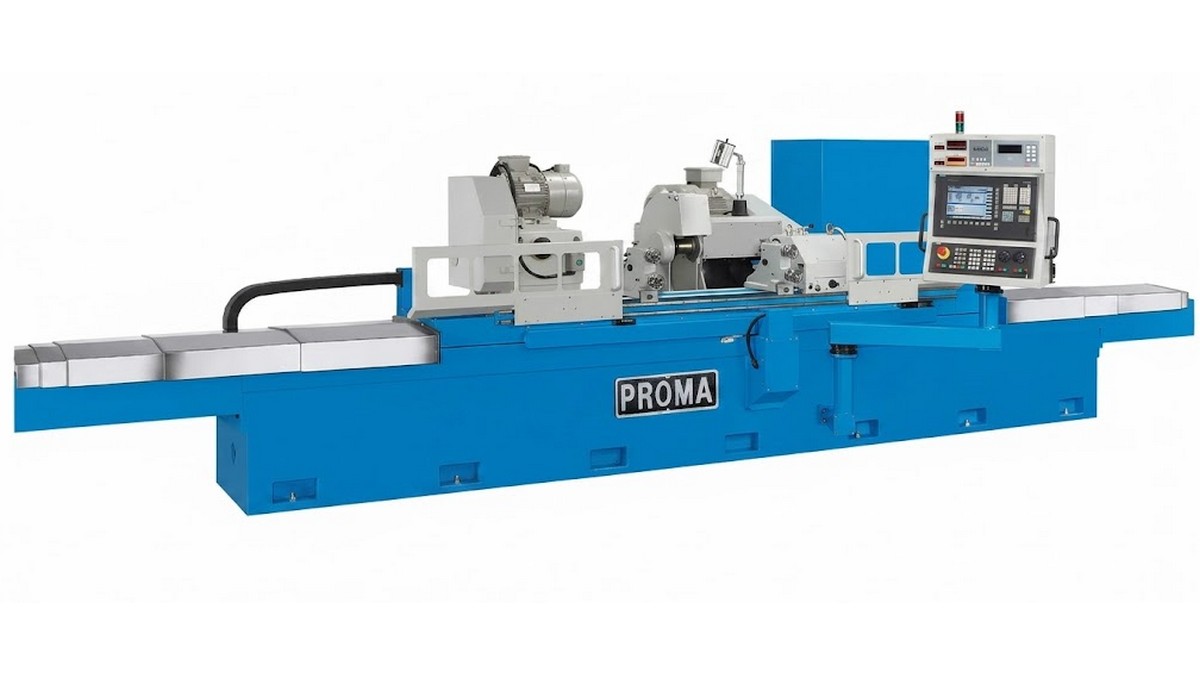
When comparing suppliers for roll and cylindrical applications, PROMA MACHINERY CO., LTD. is one manufacturer worth evaluating against the same acceptance criteria used for every bidder. Its public product information focuses on CNC cylindrical roll grinders and describes S-, M-, L-, and H-type configurations. The published envelope ranges from 1.5 to 12 m between centers and from 400 to 2,000 mm swing over table, depending on the type.
PROMA also lists hydrodynamic/hydrostatic lubrication for key machine components, a hydrodynamic wheelhead spindle, variable headstock speed, FANUC CNC control, profile options for crown grinding, and accessories such as paper filtration, online balancing, OD sizing, steady rests, and dressing equipment. These features may be relevant for long rolls, profile work, or a shop seeking a configured solution rather than a bare machine. They should still be validated for the buyer’s specific workpiece, tolerance, safety rules, and service location. Readers can review the manufacturer’s CNC roll and cylindrical grinder range and published feature descriptions before requesting a technical proposal.
Use a Weighted Scorecard Instead of Choosing by Purchase Price
Purchase price is visible; poor capability is often discovered later. A weighted scorecard makes trade-offs explicit and keeps a buying team aligned. The sample below is a starting point. Adjust the weights to the financial impact of your own part family.
| Evaluation area |
Example weight |
Evidence to request |
| Finished-part capability and acceptance test |
30% |
Documented test plan and measured results on a representative part or equivalent. |
| Capacity, workholding, and rigidity |
20% |
Layout, loading concept, support method, weight limits, and interference check. |
| Process stability |
15% |
Wheel/dressing/coolant proposal, thermal approach, and capability plan. |
| Productivity and changeover |
15% |
Cycle-time assumptions, setup steps, automation scope, and operator requirement. |
| Service, training, and spares |
10% |
Written commissioning, training, support, maintenance, and spare-parts plan. |
| Safety and compliance |
10% |
Guarding concept, applicable certifications, risk assessment, and site requirements. |
Score each supplier only after it has supplied evidence. A proposal with the lowest capital cost may still lose when it requires more manual inspection, produces more scrap risk, or lacks timely support. The scorecard also gives finance and operations teams a shared record of why the selected machine is the better long-term choice.
Final Pre-Purchase Checklist
Before issuing a purchase order, make sure the following points are agreed in writing:
- The exact part family, drawings, tolerances, material, and expected volume.
- The selected workholding, wheel package, dressing method, coolant and filtration configuration, and any steady rests or gauges.
- A factory acceptance test and, where appropriate, a site acceptance test using agreed measuring methods.
- Cycle-time assumptions, setup sequence, operator training, and program handover.
- Delivery scope, installation requirements, utilities, foundation, lifting, guarding, and compliance responsibilities.
- Documentation, warranty, service response, spare-parts list, and maintenance plan.
FAQ: Choosing a CNC Cylindrical Grinder Machine
What is the most important specification when buying a CNC cylindrical grinder machine?
The most important specification is not a single number. Start with the finished-part requirements: workpiece geometry, weight, datum, tolerance, surface finish, and expected volume. Then require the supplier to demonstrate that the complete machine-and-process system can meet those requirements repeatedly.
How much extra capacity should a cylindrical grinder have?
Allow enough room for the actual wheel, fixture, steady rest, loading method, and normal future part variation. A small practical margin is useful; an oversized machine is not automatically more accurate or economical. The correct amount depends on the next-largest credible part and the planned setup.
Should every shop buy in-process gauging and automation?
No. These options are most valuable when they reduce a clear cost: inspection time, scrap risk, labor dependence, or downtime in repeat production. For low-volume or frequently changing jobs, easy setup, reliable manual gauging, and operator training may provide a better return.
How should a buyer verify a grinder’s accuracy claim?
Use an agreed acceptance test. Define the part or test piece, warm-up conditions, wheel and dressing method, number of parts, measurement tools, and pass/fail limits for the characteristics that matter. Review results over a realistic run, not only the best single sample.
When should a buyer request a CNC roll grinder rather than a standard cylindrical grinder?
Request a roll-grinding proposal when the workpiece is long, heavy, large in diameter, or requires crown, camber, or other controlled profiles. The supplier should confirm support, profile software, wheel/dressing approach, and measurement strategy for the full roll length.
Conclusion: Buy Proven Process Capability, Not Just Machine Specifications
The best CNC cylindrical grinder machine is the one that produces your required part reliably, safely, and profitably over its working life. Define the part first, compare the full process rather than isolated specifications, and make acceptance testing a condition of the purchase. This gives procurement teams a defensible basis for selection and gives production teams a machine they can actually run with confidence.
For roll or specialized cylindrical applications, use the same checklist to request a technically specific proposal from qualified manufacturers, including PROMA MACHINERY CO., LTD.. A useful proposal should explain not only what the machine includes, but also how it will hold your part’s critical requirements in daily production.



.jpg)