As manufacturers pursue energy efficiency and carbon reduction, hydraulic systems are being re-engineered to meet green manufacturing standards. Modern Hydraulic Power Units (HPUs), enabled by servo pumps and intelligent control, now deliver on-demand power with significantly lower energy loss, noise, and heat generation.
Green manufacturing is now a global imperative as industries face rising energy costs, stricter carbon regulations, and sustainability targets. Among the many systems powering industrial machines, Hydraulic Power Units (HPUs) play a critical role. HPUs convert electrical energy into hydraulic pressure to drive actuators in CNC machines, presses, injection molding, and die-casting equipment.
However, conventional hydraulic systems are notorious for energy waste, noise, and heat generation. Modern engineering advancements—particularly in servo pump design, variable-frequency drives, and intelligent control—are reshaping HPUs into energy-efficient, environmentally responsible power sources for green factories.
2. The Fundamentals of Hydraulic Power Units
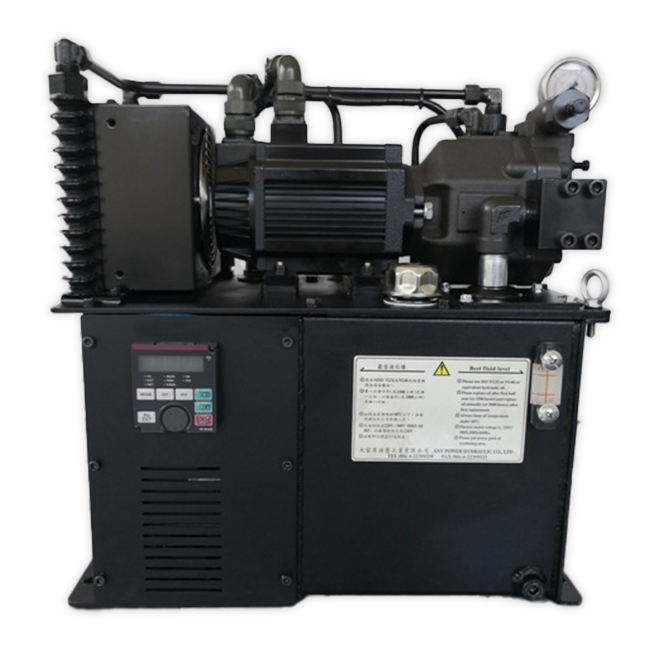
A typical Hydraulic Power Unit consists of:
- Electric motor or drive – converts electrical to mechanical energy.
- Pump – pressurizes hydraulic fluid (gear, vane, or piston type).
- Reservoir/tank – stores and cools hydraulic oil.
- Valves and manifolds – regulate flow and pressure.
- Sensors, filters, and coolers – maintain cleanliness and thermal stability.
The HPU delivers hydraulic power on demand to cylinders or motors, enabling precise motion and high force density.
Traditional HPUs often operate with a fixed-speed motor and constant-displacement pump, continuously circulating oil even when the machine is idle. This leads to wasted energy, excessive heat, and frequent maintenance—contradictory to green manufacturing principles.
3. Technical Challenges in Conventional Hydraulic Systems
- Constant energy draw: The pump runs at full speed regardless of load, causing idle energy consumption up to 70 % of total power.
- Thermal losses: Over-pressurization and throttling convert excess energy into heat, requiring additional cooling.
- Noise and vibration: Unbalanced mechanical loads and pulsation create acoustic pollution and component wear.
- Oil degradation: High temperature accelerates oxidation, increasing disposal frequency and environmental risk.
To align with sustainability goals, engineers have developed next-generation hydraulic technologies that minimize energy use while improving controllability and reliability.
4. Key Energy-Saving Technologies
4.1 Servo Pump and Variable-Speed Drive Systems
The most impactful advancement in HPUs is the adoption of servo-driven pumps combined with Variable-Frequency Drives (VFDs).
Instead of maintaining constant flow, the motor speed automatically adjusts to meet real-time demand—supplying pressure only when needed.
This “on-demand power supply” drastically reduces standby energy use. For instance, Bosch Rexroth’s Sytronix variable-speed hydraulic drive reports up to 80 % lower energy consumption compared with traditional constant-speed systems.
4.2 Dual Closed-Loop Control (Pressure + Flow)
Integrating sensors for both pressure and flow allows intelligent feedback control. The system monitors load conditions and dynamically adjusts output, avoiding overshoot and minimizing throttling losses.
Advanced digital controllers can even predict pressure transients to optimize motor torque and pump displacement, enhancing both efficiency and precision.
4.3 High-Efficiency Permanent-Magnet Motors
Replacing induction motors with Permanent-Magnet Synchronous Motors (PMSM) improves electrical-to-mechanical conversion efficiency, especially under partial load.
Lower losses mean less heat, smaller cooling units, and reduced secondary energy consumption.
4.4 Thermal Management and Cooling Optimization
Heat is a direct by-product of inefficiency. Optimized tank geometry, efficient coolers, and heat-resistant materials help maintain oil within the optimal 40–55 °C range. Smart temperature control prevents unnecessary chiller operation, saving both electricity and maintenance costs.
4.5 Noise and Vibration Reduction
Modern pump designs use helical gears, balanced pistons, and acoustic dampers to minimize pulsation. Quieter operation not only enhances workplace comfort but also signifies mechanical efficiency and lower frictional losses.
4.6 Smart Energy Management Systems
With IoT-enabled HPUs, sensors continuously monitor energy consumption, oil temperature, pressure stability, and maintenance cycles.
Through data analytics and machine learning, the system identifies inefficiencies—such as leaks or idle runs—and suggests corrective actions. Integration with factory EMS platforms enables predictive maintenance and lifecycle energy tracking.
4.7 Eco-friendly Fluids and Materials
Adoption of biodegradable hydraulic oils (e.g., synthetic esters) and lightweight corrosion-resistant alloys reduces environmental impact and improves long-term sustainability. These materials maintain stable viscosity, reducing pumping losses at varying temperatures.
5. Emerging Innovations and Research Directions
5.1 Electro-Hydraulic Hybrid Systems
Combining electrical actuation with hydraulic transmission allows designers to retain hydraulic power density while achieving electric-like efficiency. Electro-hydraulic servo units are increasingly replacing traditional HPUs in precision applications such as CNC and robotics.
5.2 Digitalization and Predictive Maintenance
Smart sensors (pressure, vibration, temperature) connected through industrial Ethernet (OPC-UA, MQTT) transmit data to cloud dashboards.
Predictive algorithms identify early signs of component fatigue or oil contamination, ensuring continuous operation with minimal downtime—supporting the “green through reliability” concept.
5.3 Compact Modular HPUs
Manufacturers now design modular HPUs with integrated servo drives, micro-cooling, and plug-and-play controls. These compact units reduce oil volume and footprint, making them suitable for retrofitting existing machines.
6. Global Manufacturers Driving Innovation
Several global and Taiwanese manufacturers are pioneering energy-saving hydraulic technologies:
- ANY POWER Hydraulic Industry Co., Ltd. (Taiwan) – Offers servo hydraulic units for CNC, die-casting, and injection molding machines. Their patented servo pump design reduces oil temperature and eliminates external cooling needs (anypower-mit.com).
- ANSON Hydraulics Industrial Co., Ltd. (Taiwan) – Specializes in high-efficiency pump design and compact HPU modules (AP/EAP series) for tool machines (anson-hyd.com).
- Bosch Rexroth (Germany) – Sytronix energy-efficient variable-speed systems for industrial hydraulics. (boschrexroth.com)
- Hydronit Srl (Italy) – Modular micro-power packs emphasizing environmental sustainability. (hydronit.com)
- HANSA-FLEX AG (Germany) – Custom-engineered HPUs with optimized component selection for energy and performance balance.
7. Case Insight: Servo HPU in CNC Machines
A servo HPU integrated into a CNC lathe (as implemented by ANY POWER) demonstrates tangible energy benefits.
By matching motor speed to actual cutting load, the system minimizes idle energy consumption and maintains constant oil temperature without an external chiller. The result:
- 50–70 % power reduction during standby,
- Smaller cooling units,
- Quieter operation (<60 dB), and
- Extended oil life due to stable temperature.
This showcases how hydraulic systems—traditionally seen as inefficient—can meet modern sustainability benchmarks through engineering innovation.
8. Conclusion and Outlook
Hydraulic Power Units are transitioning from static, energy-intensive systems to intelligent, adaptive, and efficient energy converters.
By integrating servo control, variable-speed drives, smart sensors, and eco-friendly materials, HPUs now contribute directly to green manufacturing and lifecycle energy optimization.
Future HPUs will be fully digitalized and connected, allowing engineers to monitor energy flow, predict wear, and automate efficiency tuning. Supported by government sustainability policies and industrial standards, these systems will continue to bridge the gap between hydraulic power density and green performance—proving that even heavy-duty machinery can operate efficiently and responsibly.


(4059)(20260924)(原).jpg)
(2367)(20260924)(原).jpg)