Explore how plastic injection molding is used in agriculture, from irrigation and machinery parts to storage, livestock equipment, drones, and smart farming applications.
Agricultural equipment and components must operate in demanding environments. Exposure to sunlight, moisture, dust, chemicals, temperature changes, impact, and repeated use can quickly damage materials that are not designed for outdoor or industrial conditions.
For this reason, plastics have become widely used in many agricultural applications. When combined with injection molding, manufacturers can produce durable, repeatable, and cost-efficient parts ranging from small machine components to storage containers, irrigation parts, equipment covers, and livestock-related products.
Understanding how injection molding supports agriculture can help manufacturers evaluate material selection, part design, production volume, and the performance requirements of agricultural plastic components.
Why Is Plastic Injection Molding Suitable for Agriculture?
Agricultural products often need to combine durability, low weight, moisture resistance, and ease of cleaning.
Injection molding is particularly suitable for these requirements because it can produce large quantities of plastic parts with consistent dimensions and repeatable quality.
Compared with manufacturing each component individually, injection molding allows manufacturers to use one mold to repeatedly produce the same part, making it well suited for agricultural equipment that requires replacement parts, spare components, or large-volume production.
Key advantages include:
- High repeatability
- Efficient mass production
- Ability to produce complex shapes
- Consistent dimensions
- Low part weight
- Material flexibility
- Reduced secondary processing
- Easy production of replacement parts
These characteristics are especially valuable in agriculture, where equipment reliability and parts availability can directly affect farm operations.
What Properties Do Agricultural Plastic Parts Need?
Agricultural components are exposed to challenging operating conditions that differ from many indoor consumer applications.
Depending on the application, plastic parts may need to withstand:
- Impact and mechanical stress
- Moisture and water exposure
- Dust and dirt
- Outdoor temperature variation
- UV exposure
- Fertilizers and agricultural chemicals
- Repeated cleaning
- Contact with food, feed, or livestock
The original B2B Molding article emphasizes toughness, impact resistance, low weight, ease of cleaning, moisture resistance, and outdoor durability as important advantages of plastics used in agriculture.
Material selection should therefore be based on the actual operating environment rather than on cost alone.
What Agricultural Products Can Be Injection Molded?
Injection-molded plastic components are used across farming, livestock management, irrigation, storage, machinery, and agricultural automation.
Crates, Pallets, and Bulk Containers
Plastic crates and pallets are widely used for transporting and storing agricultural products.
Injection molding allows these components to be produced with repeatable dimensions and integrated structural features such as ribs, handles, stacking surfaces, and drainage openings.
Compared with some traditional materials, molded plastics can offer advantages such as:
- Lower weight
- Moisture resistance
- Ease of cleaning
- Repeatable dimensions
- Resistance to corrosion
These characteristics are useful in crop harvesting, food handling, storage, and logistics.
Tubs, Baskets, and Bins
Agricultural operations require containers for harvesting, sorting, storing, feeding, and transporting materials.
Injection molding can create containers in a wide range of sizes and shapes while integrating handles, reinforced walls, drainage features, and stacking structures directly into the product design.
This reduces the need for multiple assembly operations.
Animal Feeding and Watering Equipment
Plastic injection molding can also be used to manufacture products such as animal troughs, feeders, watering components, and related livestock equipment.
In these applications, ease of cleaning and resistance to moisture are particularly important.
Plastic surfaces can also be designed to reduce corrosion problems associated with repeated contact with water and cleaning agents.
Irrigation System Components
Irrigation is one of the most important areas for agricultural plastic components.
Injection-molded parts can be used in:
- Connectors
- Fittings
- Valve components
- Sprinkler parts
- Drip irrigation components
- Pipe accessories
- Filter housings
These parts often require consistent dimensions because small dimensional variations can affect assembly, sealing, or water flow.
Injection molding provides the repeatability needed for large quantities of interchangeable irrigation components.
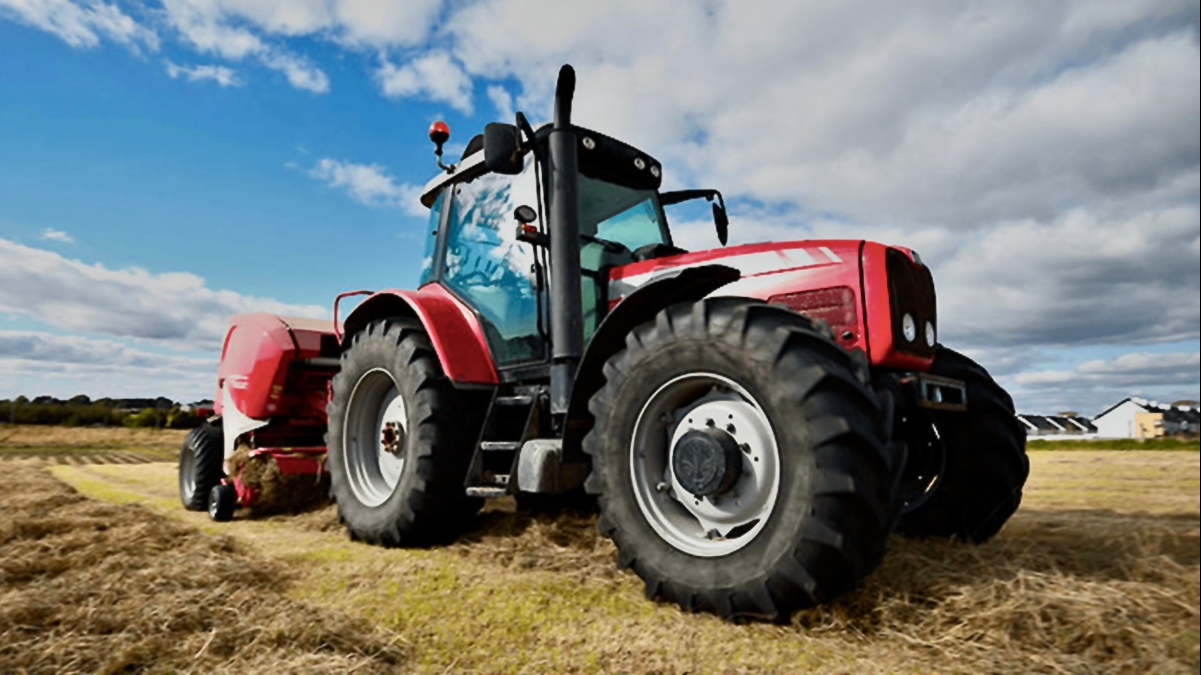
How Is Injection Molding Used in Agricultural Machinery?
Agricultural machinery contains many components that do not need to be made from metal.
Plastic injection molding can be used for:
- Equipment covers
- Protective guards
- Handles
- Knobs
- Housings
- Control components
- Interior panels
- Clips and fasteners
- Small mechanical components
- Replacement parts
Using plastic can reduce component weight and eliminate corrosion in suitable applications.
Injection molding also allows several functional features to be integrated into one molded part, potentially reducing the number of components required for assembly.
Why Are Replacement Parts Important in Agriculture?
Agricultural equipment frequently operates during time-sensitive periods such as planting and harvesting.
When a small component fails, machine downtime can interrupt the entire operation.
Injection molding makes it possible to manufacture large numbers of identical parts with consistent dimensions. This supports the production of standardized replacement components that can be stocked and supplied when needed.
For manufacturers, this repeatability can also simplify:
- Inventory management
- Maintenance
- Repair
- Product standardization
- After-sales parts supply
The ability to reproduce the same component over long production runs is therefore an important advantage of injection molding for agricultural machinery.
How Is Injection Molding Used in Agricultural Drones and Automation?
Modern agriculture increasingly uses drones, sensors, automated irrigation, and other smart technologies.
Agricultural drones, for example, may require lightweight plastic parts for:
- Protective housings
- Covers
- Structural components
- Spray-system parts
- Battery or electronics enclosures
- Connectors
The original article specifically identifies pesticide sprayer drone parts as one application of injection-molded plastics.
Market Prospects also notes that agricultural IoT increasingly includes drone technology and automated irrigation systems, which creates additional demand for durable housings, connectors, covers, and other molded components.
As agricultural automation expands, plastic injection molding can support mass production of the physical components required to protect and connect electronic systems in outdoor environments.
What Materials Are Commonly Considered for Agricultural Injection Molding?
The appropriate plastic depends on the final application.
Rather than selecting a material only by price, manufacturers should evaluate properties such as:
- Impact resistance
- UV resistance
- Moisture resistance
- Chemical resistance
- Temperature resistance
- Flexibility or stiffness
- Food-contact requirements
- Dimensional stability
Common thermoplastics used in molded industrial components may include polypropylene, polyethylene, ABS, nylon, and other engineering plastics depending on the performance requirements.
For outdoor agricultural applications, UV stabilization and long-term weather resistance can be particularly important.
For components exposed to chemicals, the selected polymer must also be compatible with fertilizers, cleaning agents, pesticides, or other substances used in the operating environment.
How Should Agricultural Plastic Parts Be Designed?
Good agricultural injection-molded part design should consider both product function and molding performance.
Important design considerations include:
Wall Thickness
Large variations in wall thickness can create uneven cooling, shrinkage, and deformation.
Maintaining more uniform wall thickness can improve molding stability and reduce dimensional problems.
Ribs and Reinforcement
Instead of increasing wall thickness throughout a component, ribs can be added to improve stiffness while limiting excess material use.
This can be particularly useful for crates, bins, covers, and structural plastic components.
Drainage and Cleaning
Agricultural products may frequently come into contact with water, soil, food, crops, or livestock.
Drainage openings, smooth surfaces, and easy-to-clean geometries can improve hygiene and usability.
Assembly Features
Injection molding allows clips, holes, locating features, threads, and other assembly elements to be incorporated into the molded component.
Integrating these features can reduce secondary operations and simplify final assembly.
Injection Molding vs. Other Manufacturing Methods for Agricultural Parts
Injection molding is not the only process used in agriculture.
Metal casting, machining, fabrication, rotational molding, blow molding, thermoforming, and additive manufacturing can all be appropriate depending on the part.
Injection molding is generally strongest when the application requires:
- Large production quantities
- Repeatable dimensions
- Complex molded geometry
- Relatively small to medium-sized components
- Integrated features
- Consistent replacement parts
For very large hollow products, other processes such as rotational molding or blow molding may be more suitable.
For high-load structural components, metal manufacturing processes may still be required.
The best manufacturing method therefore depends on part size, material, production volume, load requirements, and operating environment.
How Can Injection Molding Support More Efficient Agricultural Manufacturing?
Agricultural manufacturers often need to balance durability, cost, production volume, and product availability.
Injection molding can support these goals in several ways.
Part consolidation:
Multiple features can sometimes be integrated into one molded component, reducing assembly requirements.
Mass production:
Once the mold is completed, large quantities of identical parts can be produced efficiently.
Material optimization:
Part geometry can be designed to provide strength only where needed, helping reduce unnecessary material use.
Standardization:
Repeatable dimensions allow components to be interchangeable across products and replacement-part inventories.
Automation compatibility:
Injection molding machines can be integrated with robotic handling, inspection, and downstream assembly systems.
Market Prospects' broader injection molding coverage also shows that modern injection manufacturing increasingly combines mold design, automated production, and integrated processing services.
How Is Agricultural Plastic Manufacturing Changing?
Agricultural products are increasingly connected with automation, smart irrigation, drones, sensors, and data-driven farming.
This means plastic components are no longer limited to simple buckets, containers, or covers.
They may also need to support:
- Electronic systems
- Sensors
- Wiring
- Fluid control
- Automated machinery
- Communication equipment
- Smart irrigation
At the same time, manufacturers face growing pressure to consider product durability, resource use, recyclability, and manufacturing efficiency.
As a result, agricultural plastic manufacturing is gradually moving toward more engineered materials, integrated product design, automation, and longer product life cycles.
Injection Molding as a Practical Manufacturing Solution for Agriculture
Agriculture places demanding requirements on equipment and components.
Products must often withstand moisture, dust, temperature changes, impact, chemicals, outdoor exposure, and repeated use while remaining affordable and easy to replace.
Plastic injection molding provides a practical solution for many of these applications because it combines repeatable production, flexible product design, material selection, and high-volume manufacturing.
From crates, pallets, bins, and animal equipment to irrigation parts, agricultural machinery components, and drone housings, injection-molded plastics can support both traditional farming operations and increasingly automated agricultural systems.
The key is to match the material, mold design, product geometry, and production process to the actual agricultural environment.
When these factors are considered together, injection molding can provide durable, consistent, and scalable plastic components for modern agricultural manufacturing.