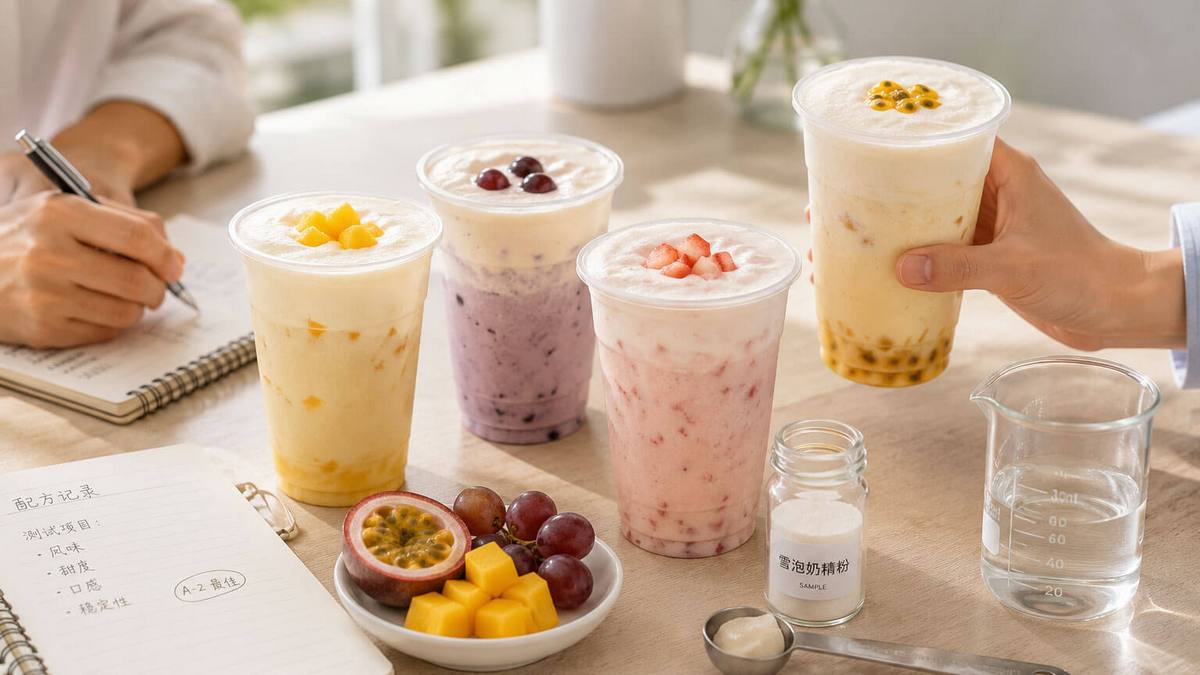
A successful bubble tea menu needs more than a long list of flavors. New drinks have to stand out while still being practical to develop and prepare consistently.
Familiar flavors such as taro, matcha, and tropical fruit offer useful starting points for menu innovation. Each has a recognizable taste and visual identity, but can also be paired with different tea bases, toppings, textures, and serving formats.
The key question is therefore not simply “Which flavor is popular?” but “How can a familiar flavor become a distinctive new drink?”
Why Flavor Powders Support Menu Innovation
Flavor powders provide a practical way to test new beverage concepts because the same flavor can be adjusted across different recipes and serving formats.
Instead of developing every drink from the beginning, one flavor direction can be tested with different sweetness levels, tea bases, dairy components, toppings, or textures. This makes it possible to explore several menu ideas before deciding which combination works best.
For taro, matcha, and fruit flavors in particular, the opportunity lies in using a recognizable base flavor while changing how it is presented.
Taro: Turning a Taiwanese Classic Into a Visual Signature
Taro milk tea is closely associated with Taiwanese-style beverages. Its creamy profile works naturally with milk-based drinks, while its purple appearance gives it a recognizable visual identity.
Rather than limiting taro to traditional milk tea, it can be paired with milk foam, tapioca pearls, pudding, coconut, or other creamy components. It can also serve as the base for smoothies and layered beverages.
The main development challenge is balance. Excessive sweetness can cover the characteristic taro aroma, while too much creamer can make the drink heavy. Testing the ratio between taro flavor, sweetness, dairy components, and toppings helps keep the main flavor recognizable.
Matcha: Adding Contrast Through Tea Character
Matcha offers a different direction from creamy taro or sweeter fruit flavors. Its tea aroma, earthy character, and mild bitterness can create contrast with milk, cream, and sweet toppings.
This makes matcha suitable for lattes, milk teas, smoothies, and layered drinks. Pairings such as red bean, brown sugar pearls, or milk foam can add texture and sweetness while allowing the tea character to remain central.
When developing a matcha drink, the key is balancing tea intensity with sweetness and milk. Too much sweetness can weaken the recognizable matcha profile, while too much matcha can make the finished drink more bitter than intended.
Fruit Flavors: Creating Seasonal and Tropical Menu Extensions
Fruit flavors provide a broader route for moving beyond conventional milk tea. Mango, passion fruit, peach, grape, lychee, and other profiles can be developed into fruit teas, smoothies, frozen drinks, and mixed-flavor beverages.
Tropical flavors such as mango and passion fruit work particularly well for bright, refreshing concepts, while peach, grape, and lychee can be paired with tea bases for lighter options.
One fruit flavor can also support several menu ideas. Mango, for example, could be developed as mango tea, a mango smoothie, or a milk-based drink. This makes it possible to create several concepts around one recognizable flavor instead of introducing unrelated ingredients for every new beverage.
Comparing Taro, Matcha, and Fruit Powder Applications
The three flavor directions serve different roles in menu development:
| Flavor Direction |
Main Character |
Visual Identity |
Suitable Applications |
Development Focus |
| Taro |
Creamy and mellow |
Purple tones |
Milk tea, smoothies, dessert drinks |
Sweetness and creaminess |
| Matcha |
Earthy and mildly bitter |
Green tones |
Lattes, milk tea, smoothies |
Tea intensity and milk balance |
| Tropical Fruit |
Bright and refreshing |
Varied vivid colors |
Fruit tea, smoothies, iced drinks |
Sweetness and acidity |
Taro is useful when the goal is a creamy or dessert-inspired drink, while matcha provides a stronger tea identity. Fruit flavors are better suited to refreshing, seasonal, or colorful menu extensions.
A menu can therefore use these flavor families for different purposes rather than treating them as interchangeable choices.
How to Turn Familiar Flavors Into Distinctive Drinks
Once a flavor direction has been selected, differentiation can come from more than the flavor itself.
For taro, texture and visual layering can create variation through pudding, pearls, milk foam, or coconut components. For matcha, contrast between tea bitterness and sweeter or creamier ingredients can define the drink. For fruit flavors, combining fruit profiles with tea bases, toppings, or contrasting fruits can create seasonal variations.
Before introducing a new concept, check whether the main flavor remains recognizable after all ingredients are combined. A drink may contain multiple components, but the intended taro, matcha, or fruit identity should still be clear.
This keeps menu innovation focused on creating a distinctive finished drink rather than simply adding more ingredients.
Expanding Bubble Tea Flavor Concepts With San Hsing
San Hsing Food Enterprise Company offers beverage powders across taro, matcha, fruit, milk tea, and other flavor categories. Its Taro Flavor Powder contains real taro powder, while its Matcha Flavor Powder uses matcha powder. Its fruit powder range includes mango, passion fruit, peach, grape, coconut, strawberry, and other options.
For concepts requiring different flavor profiles or formulations, San Hsing also provides OEM/ODM development and sample testing. Its manufacturing system includes ISO 22000 and HACCP certification.
These product categories and development capabilities can support the process of turning familiar flavors into different beverage concepts for menu expansion.
From Familiar Flavors to New Menu Ideas
Menu innovation does not always require an unfamiliar flavor. Taro, matcha, and fruit powders can provide recognizable starting points, while different pairings, textures, tea bases, and serving formats create room for differentiation.
The opportunity is to take a flavor people already know and give them a new reason to order it.