Understanding overload causes, sizing mistakes, and protection planning in UPS backed environments.
Uninterruptible power supply systems play an essential role in maintaining power continuity when utility power is interrupted or becomes unstable. They are widely used in data rooms, industrial facilities, healthcare environments, telecommunications infrastructure, and other settings where even a brief power disturbance can interrupt operations. However, the reliability of a UPS depends not only on its backup function, but also on whether it is properly sized, maintained, and protected.
UPS overload is one of the most common problems in power continuity planning. When the connected load exceeds the unit's designed output capacity, the system may issue alarms, reduce backup time, transfer to bypass, shut down, or experience increased thermal stress. In practical terms, overload is not only a performance issue. It is also an electrical safety issue that deserves careful attention.
What a UPS Does and Why Overload Matters
A UPS provides near instantaneous emergency power to connected equipment when the main power source fails. Unlike a standby generator, which requires startup time, a UPS responds immediately. Depending on the system design, it may also help regulate voltage and reduce the effect of certain power disturbances.
Because a UPS sits between the utility supply and critical equipment, overload can affect the entire protected system rather than the UPS alone. If electrical demand rises beyond the unit's output capability, the expected level of power protection may no longer be available. In critical applications, this can increase operational risk at the moment protection is needed most.
Common Causes of UPS Overload
Incomplete Load Calculation
One of the most frequent causes of overload is underestimating total demand. Planning may focus only on the main equipment while overlooking secondary devices such as storage equipment, network hardware, monitoring systems, and other supporting loads. As a result, the installed UPS may appear sufficient during specification but prove inadequate during actual operation.
Confusion Between Normal Load and Peak Demand
A UPS can appear to operate within a safe range during routine conditions and still become overloaded during startup or switching events. Some devices draw higher current when they are first powered on. When several loads start at the same time, short term demand can exceed the UPS rating even if average operating load remains within expectations.
Lack of Capacity for Future Expansion
Power infrastructure rarely remains unchanged. Additional servers, control equipment, communications devices, or other electrical loads may be introduced over time. If a UPS is selected only for present demand, it can become undersized as the installation grows.
Misunderstanding VA, Watts, and Power Factor
UPS selection should not rely on wattage alone. Real power, apparent power, and power factor all influence how a system should be sized. If these values are not interpreted correctly, the selected UPS may not match the actual electrical characteristics of the connected load.
What Happens When a UPS Is Overloaded
Reduced Backup Performance
When a UPS operates beyond its intended range, it may not provide the expected runtime during a power event. This weakens its ability to support continuity or provide enough time for an orderly shutdown.
Greater Stress on Internal Components
Overload can increase internal heat and place additional stress on batteries, power electronics, and other components. Over time, this may shorten service life and reduce overall reliability.
Bypass or Shutdown Events
Many UPS systems are designed to protect themselves by transferring to bypass mode or shutting down when overload becomes excessive. In critical environments, this can expose connected equipment to unstable conditions or unexpected interruption.
Increased Safety Concern
Electrical safety depends on sound design, regular maintenance, and proper protection throughout the system. Persistent overload, elevated heat, inadequate maintenance, or poor coordination between equipment and protective devices can increase the seriousness of an electrical event. Not every overload condition leads to fire or severe failure, but recurring overload should always be treated as a sign that the system requires review.
How to Reduce UPS Overload Risk
Assess the Full Connected Load
A reliable load assessment should include every device that may draw power from the UPS, including supporting equipment and actual operating conditions. Nameplate ratings alone do not always reflect real system behavior.
Size the System for Real Conditions
UPS selection should account for both steady state demand and temporary peak demand. This is particularly important in applications involving inrush current, simultaneous startup, or changing usage patterns.
Allow for Future Growth
A UPS selected only for current needs may not remain suitable as the installation expands. Including reserve capacity helps reduce the risk of overload as additional equipment is introduced.
Choose the Appropriate UPS Type
UPS systems are commonly grouped into standby, line interactive, and online designs. Each type is suited to different operating conditions. In more demanding environments, selecting the right topology is as important as selecting the right capacity.
Review Protection Coordination
A UPS supports uptime, but it does not replace the need for properly coordinated circuit protection. Protective devices still play an important role in responding to overload and abnormal current conditions within the broader electrical system.
Why Circuit Protection Also Matters
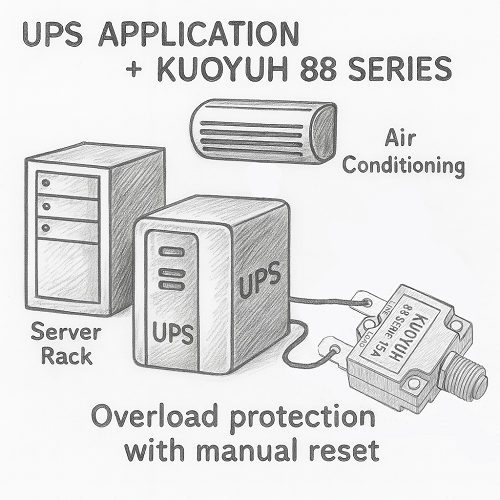
UPS overload should not be considered only as a battery backup issue. In real world applications, overload prevention also depends on how circuits are protected and how abnormal conditions are isolated before they affect connected equipment. For this reason, circuit protection should be considered alongside UPS capacity, load planning, and system design.
In applications where overload protection needs to be integrated into the broader power design, circuit protection components may also need to be evaluated alongside UPS capacity and system layout. Manufacturers such as KUOYUH provide circuit protection solutions for related applications, and technical consultation may be useful when project teams need to review protection requirements in more detail.
Conclusion
UPS overload is rarely caused by a single mistake. In most cases, it develops from a combination of underestimated load, ignored peak demand, limited growth planning, or incomplete protection design. A stronger approach includes accurate load assessment, realistic sizing, appropriate UPS selection, regular maintenance, and coordinated circuit protection.
For industrial, commercial, and infrastructure users, the main takeaway is straightforward. A UPS should be treated as part of a wider electrical safety and continuity strategy rather than as a standalone backup device. This broader perspective can help reduce downtime, improve reliability, and lower operational risk.

(4059)(20260924)(原).jpg)
(2367)(20260924)(原).jpg)