A practical guide to the specifications that determine monitoring, control, integration and security.
When access control panels are compared, door capacity is usually the first specification people notice. A one-door, two-door or four-door rating is easy to understand, but it does not reveal how effectively a panel can monitor real conditions, control connected equipment or communicate with the wider security system. Two panels with the same door count may behave very differently once door contacts, exit devices, alarm sensors, readers, locks and management software are connected.
A better evaluation looks beyond capacity and examines three areas: inputs, outputs and network protocols. Together, they determine what the controller can detect, what actions it can perform and how securely it can exchange information.
What Inputs Actually Tell the Controller
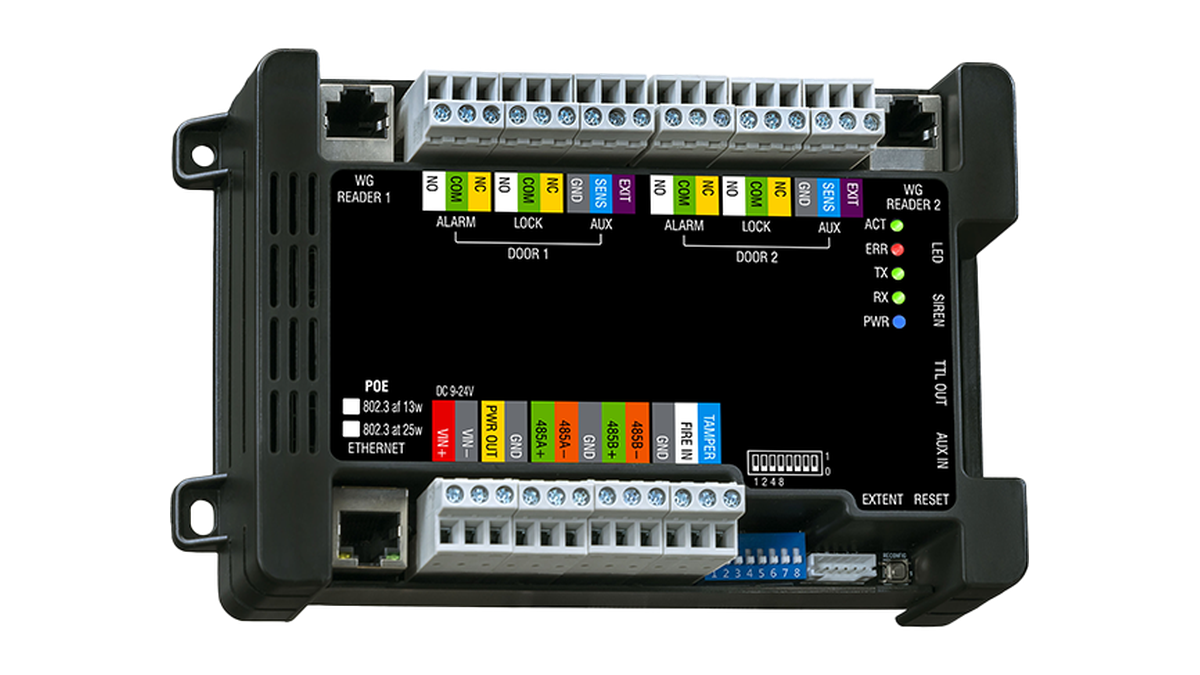
Inputs bring field conditions into the panel. Typical examples include door-position contacts, request-to-exit buttons, fire-alarm signals, enclosure tamper switches and auxiliary sensors such as motion detectors. Their practical value depends on both quantity and type.
A basic digital input generally reports two states, such as open or closed. A supervised input can provide more diagnostic information by monitoring the electrical condition of the circuit, commonly through end-of-line resistance. Depending on the design, the panel may distinguish a normal state from an alarm, open circuit, short circuit or tamper condition. This matters because a cut cable should not appear identical to a safely closed door.
Input allocation is equally important. A specification listing six inputs may sound generous, but installers need to know whether some are permanently assigned to door contacts and exit buttons or can be programmed for other events. Dedicated fire inputs can simplify emergency-release logic, while flexible auxiliary inputs make it easier to integrate intrusion, environmental or building-management signals.
Outputs Define What the Panel Can Do
Outputs convert decisions into physical actions. The most familiar output is the door-lock relay, which switches power or a control circuit for an electric strike, magnetic lock or related interface. Other outputs may activate a siren, strobe, elevator interface, alarm input or building-management system. UL describes control units, indicating devices and output components as core elements of modern access control systems.
Relay specifications deserve attention. Form-C dry contacts provide common, normally open and normally closed terminals, giving installers flexibility for fail-safe or fail-secure arrangements. Contact ratings indicate the voltage and current the relay is designed to switch, although local codes, lock requirements and life-safety design still determine the final wiring approach.
Extra outputs also increase automation options. A panel with only one relay per door may unlock doors reliably but offer limited responses to forced-door events. Additional event relays can support separate alarms, camera triggers or indicators. Expansion modules may solve a shortage, but they add cost, enclosure space, wiring and configuration work.
Reader Protocols Change Security and Scalability
The reader-to-panel connection is one of the most consequential protocol choices. Wiegand remains widely encountered and has a defined 26-bit interface standard, but it is generally a one-way connection in which the reader transmits credential data with limited controller supervision.
OSDP, developed by the Security Industry Association and published internationally as IEC 60839-11-5, supports bidirectional communication, device supervision and multi-drop wiring. OSDP Secure Channel can add AES-128 encryption and authentication between compatible devices. These features can improve tamper awareness, reader management and interoperability, particularly in modern or higher-security installations.
Protocol support should still be evaluated in context. A facility with functioning Wiegand readers may prioritize migration flexibility, while a new project may prefer OSDP from the outset. Panels supporting both can reduce replacement pressure, but buyers should verify reader limits, Secure Channel implementation and device conformance rather than relying on the protocol name alone.
Ethernet, Encryption and Power Matter Too
The panel’s upstream network connection determines how it communicates with servers, cloud platforms or management software. Ethernet enables centralized administration and event reporting, but an IP connection also makes network design part of physical-security design. Relevant features may include static and DHCP addressing, HTTPS administration, encrypted software communication, time synchronization and domain-name support.
Power over Ethernet can simplify deployment by carrying data and power over structured cabling. IEEE 802.3af established optional powering of compatible Ethernet devices over the link, but the available power budget must still be checked against the controller, readers, locks and accessories. In many systems, locks require a separate, properly sized and backed-up supply.
Cybersecurity should be assessed as a system property rather than a single checkbox. Encryption versions, account management, firmware updates, network segmentation, logging and secure configuration all influence exposure. Product certification may also matter: UL 294 provides a framework for evaluating access-control system units for construction, performance and operation.
A Practical Comparison Framework
| Area |
Questions to Ask |
Why It Changes the Design |
| Inputs |
Dedicated, programmable or supervised? |
Determines monitoring depth and fault detection |
| Outputs |
How many relays, and what contact type and rating? |
Defines lock control, alarms and automation |
| Reader links |
Wiegand, OSDP or both? Secure Channel? |
Affects migration, supervision and reader security |
| Network |
Ethernet, encryption, addressing and PoE? |
Shapes integration, cabling and cyber risk |
| Expansion |
Are extra I/O modules supported? |
Influences future capacity and installed cost |
FAQ
1. Is door count still important?
Yes. It remains the starting point for sizing a controller, but it should be considered with reader count, entry/exit configuration, spare I/O and future expansion.
2. What is the difference between an input and an output?
An input reports a condition to the panel, such as a door opening. An output lets the panel act, such as energizing a lock relay or activating an alarm.
3. Why are supervised inputs useful?
They can help distinguish normal operation from wiring faults or tampering, provided the panel and field circuit are correctly designed and configured.
4. Does OSDP automatically make a system secure?
No. OSDP offers stronger capabilities, including supervision and Secure Channel, but security also depends on configuration, key management, compatible devices, firmware and network practices.
5. Can PoE power the entire door?
Sometimes, but not always. The power budget must include the panel, reader, lock and accessories, while life-safety or backup-power requirements may call for separate supplies.
6. Should an existing Wiegand system be replaced immediately?
Not necessarily. Replacement should be risk-based. Higher-security openings may justify earlier migration, while lower-risk areas can transition during reader or controller refresh cycles. NIST guidance likewise emphasizes risk-based selection for physical-access authentication.
Conclusion
Door count answers how many openings a panel can control; inputs, outputs and protocols explain how well it can understand, operate and integrate those openings. Evaluating supervision, relay flexibility, reader communications, encryption, networking and expansion gives a more realistic picture of installation quality and lifecycle value.
For a practical example, review the Chiyu SEMAC CP202 access control panel and compare its published I/O, reader-interface, Ethernet, encryption and optional PoE features with your project requirements.

(4059)(20260924)(原).jpg)
(2367)(20260924)(原).jpg)