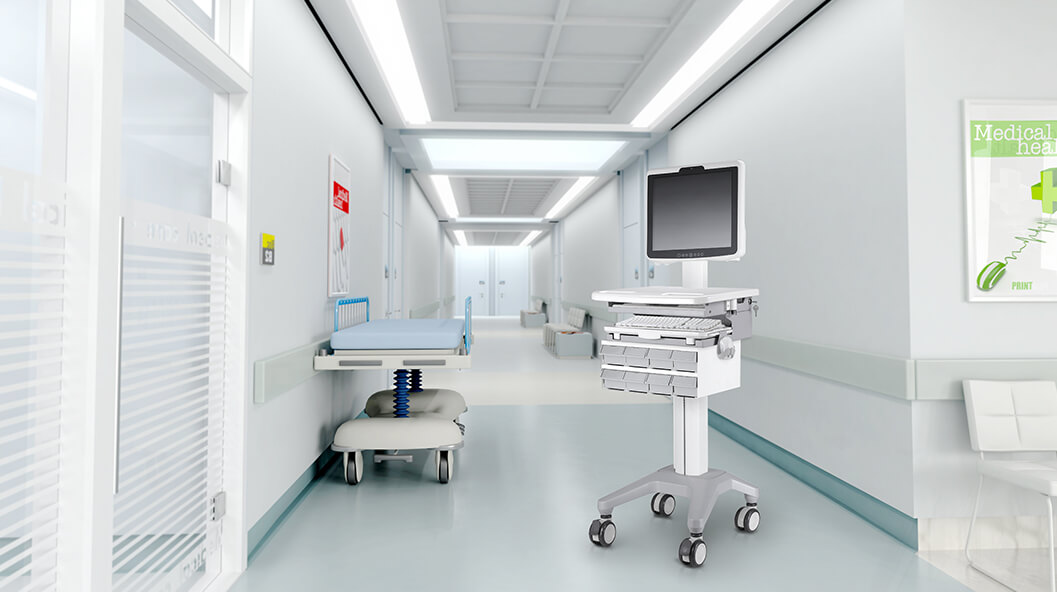
Bedside arms and computing carts are wiped down more often than almost any other equipment on the ward. Research on environmental stress cracking shows why the chemistry of the wipe deserves as much attention as the load rating of the arm.
A medical cart can meet its load rating and maneuverability requirements yet develop cracks around a handle or a monitor-arm joint after repeated cleaning. The damage may not be visible when the equipment is delivered. It can emerge as plastic covers are wiped, coatings are exposed to cleaning products, and assembled components remain under stress.
Hospital procurement teams routinely compare reach, adjustment range, casters, battery options, and monitor compatibility. Disinfectant compatibility deserves a place on the same specification sheet. A statement that a surface is "easy to clean" does not establish which disinfectants it tolerates, how the claim was tested, or whether the result applies to a finished cart or arm.
Why Cleaning Requirements Affect Equipment Selection
The CDC's disinfection guidance recommends cleaning and disinfecting noncritical patient-care equipment at appropriate intervals, including when visibly soiled, while following the disinfectant label and the device manufacturer's directions. Its environmental infection-control guidance also emphasizes frequent attention to high-touch surfaces and material compatibility.
An overbed monitor arm or shared computing cart can have several frequently handled areas: adjustment handles, worktops, keyboard trays, cable covers, and display mounts. The applicable cleaning frequency depends on how the equipment is used and the hospital's infection-prevention procedures. Equipment that moves between patients may face a different routine from a fixed arm dedicated to one room.
The distinction matters when writing a tender. Infection-control effectiveness and material durability are two separate requirements. A hospital cannot assume that a milder cleaning product is an acceptable substitute for its approved disinfection procedure. If a device and the facility's required disinfectant are incompatible, the purchasing and infection-prevention teams need to resolve that conflict before approval.
What Environmental Stress Cracking Can Do to Plastics
Environmental stress cracking (ESC) occurs when a susceptible polymer is exposed to a chemical agent while mechanical or residual stress is present. Parts can develop crazing, fine cracks, or a loss of mechanical performance without obvious damage after the first wipe. Molded-in stresses, screw fastening, snap fits, bending, and sustained loads may change how the material behaves.
A 2024 study in the _Journal of Hospital Infection evaluated eight ready-to-use cleaning-and-disinfection wipes against 13 healthcare plastics. Following a bent-strip approach based on BS EN ISO 22088-3, the researchers exposed strained specimens to fluid extracted from the wipes at 0.5% strain for seven days. The study found visibly cracked specimens in 22 of 39 reported plastic samples; products with pH above 8 accounted for 74% of observed failures in that experimental comparison. Formulations containing certain amines or alcohol were more likely to produce cracking in the tested materials.
These figures describe a controlled laboratory experiment. They are not the failure rate of medical carts in hospitals, and they do not establish that every disinfectant with a particular active ingredient will damage every polymer. The finished formulation, concentration, exposure, material grade, and mechanical stress all matter.
Material manufacturer SABIC has likewise documented chemical-resistance concerns with common housing polymers and developed specialized grades for harsh healthcare cleaning environments. This supports the need for grade-specific evidence, rather than a general assertion that a component is made of "medical-grade plastic."
Which Parts of a Cart or Monitor Arm Need Checking?
Different materials may fail in different ways. ESC is primarily a concern for susceptible plastics; paints, metal finishes, elastomers, labels, and adhesives need their own appropriate evaluations.
| Component or surface | Potential concern after repeated cleaning | Evidence to request |
| Plastic joint covers and handle housings | Crazing or cracking near screws, snap fits, or loaded areas | Strained-polymer compatibility data and finished-part inspection |
| Worktops and keyboard trays | Staining, softening, surface damage, or loss of coating integrity | Test results for the actual surface grade and approved disinfectants |
| Powder-coated or painted metal | Discoloration, coating softening, loss of adhesion, or exposed base material | Coating-system test data and inspection of edges and fastener areas |
| Cable clips, channels, and grommets | Cracking, embrittlement, swelling, or deterioration of flexible parts | Results for the relevant plastics or elastomers, including installed configuration |
| Labels, controls, and printed markings | Fading, lifting, or reduced legibility | Repeated-wipe and legibility checks using intended products |
| Caster surfaces and grips | Material degradation or reduced function in frequently cleaned contact areas | Compatibility information and function checks after exposure |
The point is to define the surfaces staff will actually clean. A flat material coupon may provide useful screening data, but it cannot establish how every assembled component will behave under clamping stress, repeated movement, and the hospital's cleaning protocol.
How to Read Disinfectant Compatibility Test Evidence
Two standards are useful references, but neither is a blanket certification of long-term resistance to every hospital disinfectant.
ISO 22088-3:2006 specifies a bent-strip method for assessing thermoplastics under fixed flexural strain in the presence of a chemical agent. ISO describes it primarily as a ranking test, not a direct method for predicting the field lifetime of a finished part. The edition remains published while a revision is under development.
ASTM D543-21 provides practices for evaluating plastics exposed to chemical reagents. ASTM notes that the relevant practices and ISO 22088-3 differ technically and that their test results cannot be directly compared. A supplier's statement that a polymer "passed ASTM D543" therefore needs supporting information: the specific procedure, chemical, concentration, exposure, stress conditions where applicable, and defined pass criteria.
When reviewing test reports, check five details:
- Disinfectant identity. Ask for the actual products or formulations, active ingredients, concentration, and intended use conditions. A statement such as "alcohol resistant" is too broad for a hospital-wide approval.
- Test conditions. Confirm the method, specimen material and grade, temperature, strain or load, exposure duration, and number of repeats or wipe cycles, if applicable.
- Measured outcome. Look for cracking, discoloration, swelling, tensile-property changes, coating adhesion, or another stated endpoint. "Pass" is meaningful only alongside its acceptance criterion.
- Component coverage. Establish whether the results apply to a molded test bar, flat sheet, coated panel, or the exact finished cart and arm parts.
- Limits of the claim. Identify disinfectants or practices the manufacturer excludes and whether the testing covers assembled components after installation.
For a heavily used product, a combination of materials screening and finished-product evaluation is more convincing than a single chemical-soak certificate. Tests should reflect the equipment's intended service conditions without being presented as a guaranteed number of years of use.
Five Requirements to Put in a Medical Equipment Tender
| Tender requirement | What the supplier should provide |
| Approved cleaning products | A compatibility list naming disinfectants or relevant formulations, concentrations, and any restrictions |
| Material and finish coverage | Identification of the patient-area surfaces and whether each material, coating, seal, and marking is included |
| Testing and acceptance | Methods, exposure conditions, actual results, pass criteria, and any finished-part validation |
| Instructions for use | Cleaning steps consistent with the facility's approved procedures, including products to avoid and precautions for electronics and joints |
| Service and warranty | Written treatment of damage arising when approved products are used according to the stated instructions, plus replacement-part availability |
The tender should be reviewed jointly by procurement, biomedical engineering, environmental services, and infection prevention. This avoids approving equipment that meets the purchasing specification but conflicts with the products used on the ward.
A Manufacturer Example: Modernsolid
Taiwan-based Modernsolid, established in 1989, manufactures medical monitor arms and mobile computing carts. Its medical monitor arm range describes gas-spring adjustment, concealed cable management, and a medical-grade coating with an antiseptic finish. Its HC-361 medical workstation cart lists an antibacterial, easy-to-clean desktop and materials including aluminum alloy, stainless steel, and ABS.
These are relevant product-design features for healthcare environments. An antibacterial or antiseptic surface description does not establish compatibility with every hospital wipe, and it does not replace a material-specific cleaning instruction. The company's quality and compliance page describes development and manufacturing aligned with ISO 13485 quality-management requirements; that statement should not be treated as proof that a particular coating has passed an ESC or repeated-disinfection test.
A hospital evaluating a Modernsolid model can use the same tender checklist it would apply to any supplier. Request the approved disinfectant list, relevant test records, model-specific instructions, and any certification documents whose scope matters to the procurement. The correct evidence must match the actual model and finish being ordered.
Frequently Asked Questions
Q: Does a "medical-grade" coating resist all hospital disinfectants?
A: No. The term alone does not establish compatibility. Ask which disinfectants and concentrations were tested on the actual finish and what the results showed.
Q: Can ISO 13485 certification replace disinfectant compatibility testing?
A: No. ISO 13485 concerns a medical-device quality-management system, not universal chemical resistance of plastics, coatings, or finished products.
Q: Is an ISO 22088-3 test enough to predict the cart's service life?
A: No. It is mainly a materials-screening and ranking method. The assembled equipment may need additional testing under its intended cleaning and loading conditions.
Q: Should the hospital change disinfectants if a new cart is not compatible?
A: Not without infection-prevention review. The facility must follow applicable disinfectant labels and clinical protocols. Resolve incompatibility with the supplier before procurement or use.
Q: What should an RFQ include besides load rating and monitor compatibility?
A: Include the approved cleaning products, exposed materials and finishes, compatibility evidence, cleaning instructions, and warranty terms alongside the mechanical specifications.
Final Considerations
Repeated cleaning is part of a medical cart or bedside monitor arm's operating environment. Procurement documents should therefore describe the disinfectants the equipment must tolerate with the same care used to specify its load capacity, reach, and adjustability.
A credible bid identifies the tested products and materials, explains how compatibility was assessed, and tells the hospital how to clean and maintain the assembled equipment. Manufacturers such as Modernsolid offer medical carts and mounting systems with features intended for clinical use; final supplier approval should still depend on model-specific documentation matched to the facility's cleaning routine.