How enclosure builders and cabinet lock manufacturers align access control, duty cycles, and total cost of ownership across four real-world applications.
![Mechanical vs. Electronic Cabinet Locks: An OEM Selection Guide]()
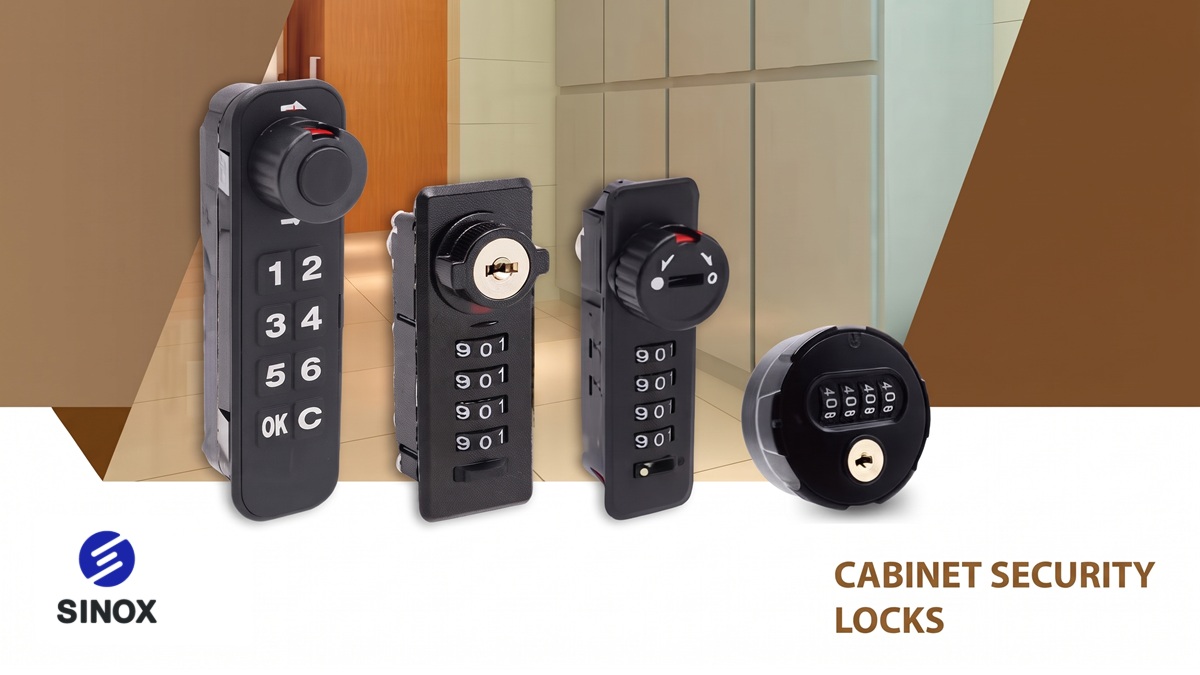
Photo by https://www.sinoxlock.com/en/downloads-detail/cabinet/
As shared workspaces, unattended retail, automated logistics, and connected healthcare facilities expand, cabinets and lockers are shifting from passive storage boxes into active access-control touchpoints. For OEM/ODM enclosure builders, system integrators, and cabinet lock manufacturers, selecting between mechanical and electronic locks is rarely about chasing novelty—it is about matching locking architecture to duty cycles, user turnover, management complexity, and failure modes.
Core Architectural Differences: Power Independence vs. Access Intelligence
-
Mechanical Cabinet Locks: Keyed and mechanical combination locks rely purely on physical mechanisms with zero dependency on batteries, wiring, or networks. Their strength lies in straightforward installation, low upfront unit cost, and predictable maintenance in low-complexity or power-free environments.
-
Electronic Cabinet Locks: Electronic locks introduce digital authentication—such as RFID, NFC, access cards, or PINs—and, when paired with management software, can support access logging, remote permissions, and centralized administration. Importantly, an NFC-capable lock does not automatically open with any smartphone; actual capabilities depend on power architecture, communication protocols, and system integration.
Four Application Scenarios Through an OEM/ODM Lens
1. Fitness Centers: High-Frequency Cycles and User Turnover
Gym lockers endure constant opening and closing alongside rapid shifts between short-term and recurring users. Mechanical combination locks eliminate physical keys and operate without power, which works well for fixed assignments or simple workflows. However, in shared or temporary-use lockers, forgotten codes and manual resets can add recurring staff overhead. Electronic credentials such as RFID or NFC help streamline locker assignment and turnover, though hardware durability and serviceability remain critical under high daily cycles.
2. Public and Workplace Lockers: Scaling Beyond Unit Price
Offices, schools, transit hubs, and public venues often deploy large locker banks across diverse user groups. When users are assigned and administrative needs are light, mechanical locks keep initial installation costs contained. As deployments scale, lost keys, staff or student turnover, temporary access, and auditability create friction. Electronic systems can centralize credential control, but OEMs and buyers must weigh power sourcing, hardware compatibility, and ongoing maintenance to evaluate true total cost of ownership (TCO) rather than unit price alone.
3. Smart Parcel Lockers: System Integration and Fault Resilience
Driven by e-commerce and self-service pickup, the global smart parcel locker market is projected to expand substantially over the coming decade—for example, SNS Insider's 2026 forecast estimates growth from USD 1.92 billion in 2025 to USD 5.94 billion by 2035 at a 11.96% CAGR. In these systems, the lock is only one link in a connected chain spanning delivery platforms, mobile apps, notifications, and access logs. Integration unlocks automation, yet connectivity introduces risks around power loss, network drops, hardware faults, and device compatibility—making close collaboration with an experienced cabinet lock manufacturer essential for latch tolerances, power management, and fail-safe workflows.
4. Medical and Controlled-Access Cabinets: Accountability and Fail-Safe Continuity
Cabinets storing medical supplies, pharmaceuticals, or restricted assets demand stricter accountability than general storage. While mechanical locks offer proven, electronics-free operation for basic needs, multi-user environments often require role-based permissions and access audit trails. Electronic locks can log who accessed a compartment and when, while tracking specific item removal requires integration with inventory or specialized management systems. Equally vital in healthcare is controlled emergency and backup access so authorized staff are never locked out during power or system disruptions.
Quick Comparison: Mechanical vs. Electronic Cabinet Locks
| Evaluation Factor |
Mechanical Cabinet Locks |
Electronic Cabinet Locks |
| Power & Wiring |
Zero power or network required |
Requires battery or wired power supply |
| Access Credentials |
Physical keys or mechanical dials/codes |
RFID, NFC, PIN codes, or mobile credentials |
| Management & Audit |
Manual key/code management; no access logs |
Centralized user permissions and audit trails |
| Upfront vs. Lifecycle Cost |
Lower initial unit and installation cost |
Higher upfront cost; lower admin overhead at scale |
| Best-Fit Applications |
Assigned lockers, low-turnover or power-free sites |
Shared lockers, smart parcel systems, medical storage |
Five Selection Criteria for Cabinet Manufacturers and Integrators
-
User Profile: Will access serve assigned individuals or rotating, temporary users?
-
Duty Cycle: How many times per day will the cabinet operate, and how much wear will the mechanism face?
-
Management & Audit Needs: Are access logs, user permissions, or centralized control required?
-
System Integration: Must the lock interface with membership databases, logistics software, or building platforms?
-
Fallback & Lifecycle Support: How will the system handle lost keys, forgotten combinations, dead batteries, or outages over years of operation?
Working with an OEM/ODM cabinet lock manufacturer such as SINOX helps align mechanical reliability, electronic access features, and enclosure engineering with how the end product is actually operated day to day.