FSC Is More Than a Label: What B2B Buyers Need to Verify Before Sourcing
For yoga brands, retailers, studios, and procurement teams, “FSC-certified” may appear to be a simple sustainability label. In reality, it raises several important sourcing questions.
Does the claim apply to the natural rubber in the mat? Can the supplier prove the material’s chain of custody? Is the finished product eligible to carry an FSC label? Does FSC certification cover every environmental claim a brand may wish to make?
These questions matter because natural rubber is a forest-based material. Buyers need more than attractive packaging language. They need clear evidence that can support responsible sourcing, retailer requirements, ESG reporting, and customer trust.
This guide explains what FSC certification means for natural rubber yoga mats, what it does not mean, and how B2B buyers can verify a supplier before placing an order.
What Does FSC Mean for a Natural Rubber Yoga Mat?
FSC stands for the Forest Stewardship Council, an independent non-profit organization that develops standards for responsible forest management and traceable forest-based supply chains.
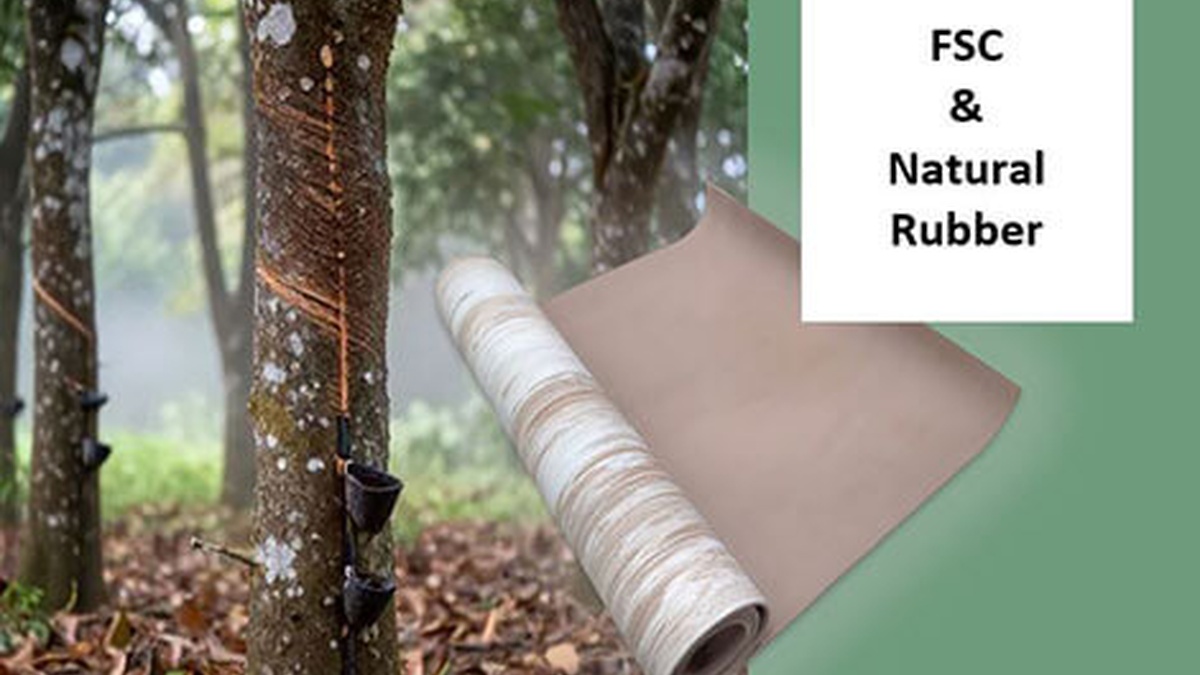
Natural rubber is made from latex harvested from Hevea brasiliensis trees. Because it is sourced from trees, natural rubber can be included in the FSC system when the relevant forest management and supply-chain requirements are met.
For a yoga mat buyer, an FSC claim should mean that the eligible forest-based material is supported by documented controls from the certified source through the relevant supply chain. It does not simply mean that the mat contains natural rubber.
FSC forest management is based on 10 core principles. These include legal compliance, workers’ rights, Indigenous Peoples’ rights, community relations, environmental values, management planning, monitoring, high conservation value areas, and responsible implementation.
In practical terms, FSC provides procurement teams with an internationally recognized framework for asking better questions about the origin of forest-based materials.
Why Buyers Should Look Beyond “Eco-Friendly”
“Eco-friendly” is a broad marketing phrase. It does not explain where a material came from, how it moved through the supply chain, or whether a claim has been independently checked.
An FSC-supported claim is more specific. However, buyers should understand its limits.
FSC certification can help address responsible forest management and traceability for eligible forest-based inputs. It does not, by itself, prove that a finished yoga mat is:
- Free from all restricted substances
- Plastic-free
- Carbon neutral
- Fully recyclable
- Biodegradable in all conditions
- Suitable for every allergy-sensitive user
- Compliant with every market’s product-safety requirements
A reliable sourcing decision should therefore combine FSC documentation with product specifications, chemical testing, quality controls, packaging requirements, and market-specific compliance documents.
This distinction helps brands avoid making environmental claims that go beyond the evidence available.
The Two FSC Certifications Buyers Need to Understand
FSC certification operates at two important points in the supply chain.
| Certification |
What It Covers |
Why It Matters to Yoga Mat Buyers |
| Forest Management (FM) |
The management of the forest or plantation where forest-based material is sourced |
Supports responsible management at the origin of natural rubber |
| Chain of Custody (CoC) |
The tracking and control of certified material through processing, manufacturing, and distribution |
Helps demonstrate that the certified material claim remains controlled through the supply chain |
For a brand buying finished mats, Chain of Custody certification is usually the most important document to request from a supplier.
However, a certificate alone is not enough. Buyers should confirm that the certificate is valid and that its scope covers the relevant material and product group. The product description, FSC claim, quotation, purchase order, invoice, and packing information should also be consistent.
FSC 100%, FSC Mix, and FSC Recycled: What Is the Difference?
FSC labels are not interchangeable. Each label communicates a different type of material claim.
| FSC Label |
Plain-English Meaning |
Buyer Consideration |
| FSC 100% |
The forest-based material in the product comes from FSC-certified forests |
Suitable when the product and supply chain can support a fully certified forest-based material claim |
| FSC Mix |
The product uses a mix of FSC-certified material, recycled material, and/or controlled material |
Review the exact claim and product composition before using marketing language |
| FSC Recycled |
The forest-based material is made from recycled material |
More commonly relevant to paper, packaging, or recycled forest-based components than natural rubber mats |
For natural rubber yoga mats, buyers should not assume that “FSC 100%” means every component of the finished mat is certified. A yoga mat may contain pigments, binders, coatings, textile layers, packaging, and other components.
The FSC claim applies to the eligible forest-based material covered by the certification rules. It does not automatically apply to every ingredient, performance feature, or environmental benefit of the finished product.
The right question is: What exact FSC claim can be made for this specific yoga mat, and what documents support it?
A Procurement Checklist for FSC Natural Rubber Yoga Mats
Before approving a supplier or using FSC language in product marketing, procurement teams should request the following information.
1. A Valid FSC Chain of Custody Certificate Number
Ask the supplier for its FSC CoC certificate code and verify it through the official FSC Public Certificate Search.
Check:
- Certificate holder name
- Certificate status
- Expiry date
- Certified product scope
- Whether the certificate belongs to the actual manufacturing entity
2. Product-Specific FSC Claim Documentation
Ask the supplier to identify the exact FSC claim that applies to the quoted yoga mat. The wording should remain consistent across the quotation, purchase order, invoice, packing documents, and approved product label.
Avoid accepting vague statements such as “FSC material available” without a product-level explanation and supporting documents.
3. Material Composition and Technical Specifications
FSC does not replace normal product evaluation. Buyers should request clear information on:
- Natural rubber percentage or material structure
- Surface texture and grip requirements
- Thickness, density, and weight tolerance
- Odor considerations
- Color, printing, and logo customization
- Packaging material and labeling options
- Recommended cleaning and storage guidance
These details help buyers balance sustainability goals with end-user performance expectations.
4. Marketing and Trademark Approval Process
The FSC name and logo are protected trademarks. A brand should not place an FSC label on a yoga mat, package, product page, or marketing asset without following the applicable approval process.
The supplier should be able to explain whether the buyer, manufacturer, or another certified party is responsible for the claim and label authorization.
Why Traceability Has Become a Business Issue
Traceability is no longer only an ESG topic. It is increasingly connected to market access, retailer expectations, and supply-chain risk management.
The European Union’s Deforestation Regulation, known as EUDR, lists rubber among the commodities in scope. According to the European Commission, the regulation will apply to large and medium operators from 30 December 2026, with later timelines for certain smaller operators.
FSC certification can support responsible sourcing and provide useful traceability information. However, it should not be treated as automatic proof of EUDR compliance. Companies should evaluate their own role, due-diligence obligations, and market requirements.
For yoga brands selling into multiple markets, the practical priority is to build material records before they are urgently needed.
A well-organized sourcing file can help teams respond faster to retailer questionnaires, due-diligence requests, sustainability reviews, and internal ESG reporting.
Questions That Reveal a Supplier’s Real Capability
A supplier that understands certified sourcing should be able to answer direct and specific questions. Consider asking:
- Which FSC claim applies to this exact natural rubber yoga mat?
- What is the supplier’s current FSC CoC certificate number and scope?
- Can the supplier provide compliant transaction documents for the order?
- Which party will manage FSC trademark approval for the finished product and packaging?
- Can the mat be customized without changing the certified claim?
- What quality tests are available for odor, abrasion, tensile strength, restricted substances, or other relevant requirements?
- What are the minimum order quantity and production lead time for a customized natural rubber yoga mat?
Clear, documented answers are more valuable than broad sustainability promises.
Selecting a Mat That Fits Both Brand and User Needs
FSC-certified natural rubber may be a strong option for brands seeking a renewable, forest-based material with documented sourcing controls. Natural rubber can also provide the grip and dense feel that many yoga users expect.
However, natural rubber is not the right material for every product program. It may be heavier than foam-based alternatives, may have a noticeable rubber odor, and may not suit users with latex sensitivities.
Buyers should assess material choices based on the target user, expected price point, intended market, performance needs, and product positioning.
A responsible product decision considers the complete brief: user performance, material safety, durability, traceability, packaging, price, and claim accuracy.
Working With a Manufacturer on Sustainable Yoga Mat Development
For buyers seeking customized yoga mats, Successful Mat’s yoga mat range includes natural rubber, TPE, POE, PVC, and recycled-material options. The Taiwan-based manufacturer states that it has more than 15 years of OEM/ODM experience and supports customized specifications for yoga and fitness products.
Before selecting any supplier, buyers should confirm product-specific FSC documentation, certification scope, technical specifications, and testing requirements for their own order.
Conclusion: Treat FSC as Evidence, Not a Slogan
FSC certification can add meaningful value to a natural rubber yoga mat program when it is supported by valid Chain of Custody records and precise product claims.
For B2B brands, the benefit is not only a label. It is a more traceable sourcing process and a clearer foundation for responsible-material communication.
Brands developing a customized natural rubber or eco-focused yoga mat range can contact Successful Mat to discuss material options, product specifications, customization, and order requirements.
Frequently Asked Questions
Is an FSC-certified yoga mat automatically biodegradable?
No. FSC addresses responsible sourcing and traceability of eligible forest-based material. Biodegradability depends on the complete mat formulation, additives, coatings, and disposal conditions.
Does an FSC CoC certificate prove that every yoga mat from the supplier is FSC-certified?
No. Buyers must verify that the certificate is current, covers the relevant product scope, and supports the specific FSC claim for the ordered product.
Can a brand add its own logo to an FSC natural rubber yoga mat?
Customization may be possible, but the FSC claim and label must remain compliant. Confirm the approval process before printing packaging, labels, or product artwork.
Is FSC certification enough for EUDR compliance?
No. FSC can contribute useful sourcing and traceability information, but buyers and operators should assess their own EUDR obligations and due-diligence requirements.