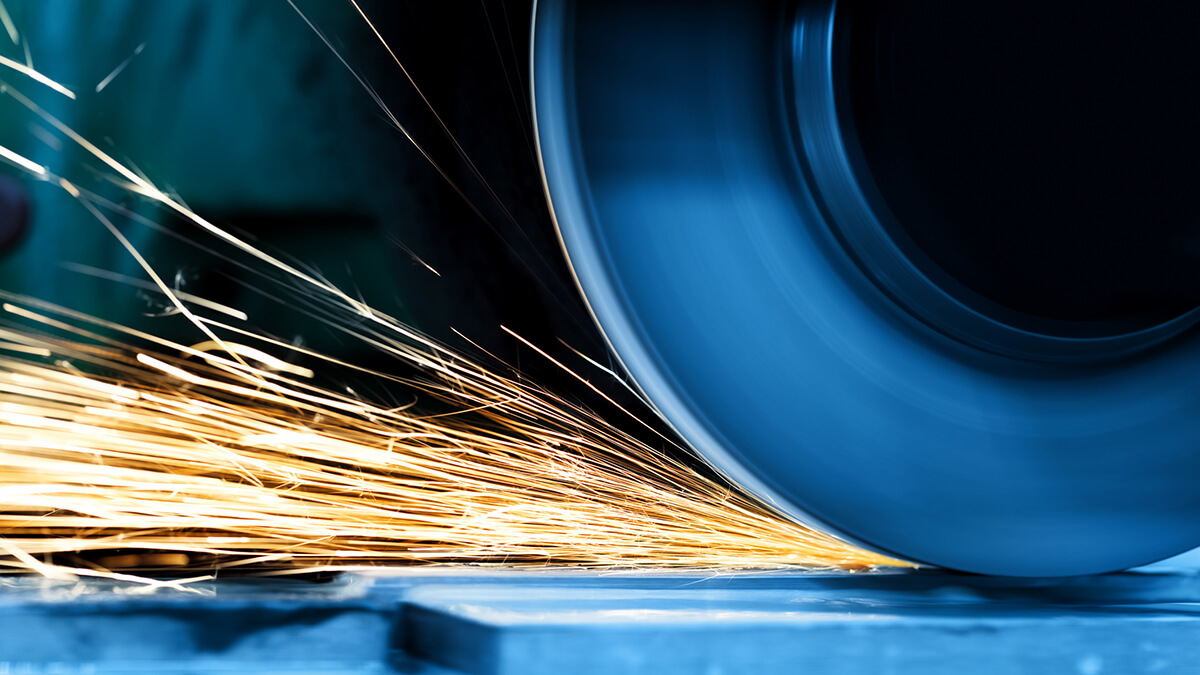
A grinding machine or grinder is an industrial power tool that uses an abrasive wheel for cutting. There are various grinding machine types, each with a different purpose.
Introduction of Grinding Machines
Grinding machines produce flat, cylindrical, and other surfaces through high-speed rotating abrasive wheels. Grinding is a means of giving a more accurate finish to a part already machined but is also a machining process in its own right. The main types of machine are the ‘surface grinding machine’ for flat surfaces; and the ‘cylindrical grinding machine’ for cylindrical surfaces. More complex shapes are produced by shaped wheels called ‘contour grinding wheels’. ‘Bench’ and ‘pedestal’ grinders are used for tool sharpening, etc.
A grinding machine, often shortened to grinder, is one of the power tools or machine tools used for grinding, it is a type of machining using an abrasive wheel as the cutting tool. Each grain of abrasive on the wheel's surface cuts a small chip from the workpiece via shear deformation.
Grinding is used to finish workpieces that must show high surface quality (e.g., low surface roughness) and high accuracy of shape and dimension. As the accuracy in dimensions in grinding is of the order of 0.000025 mm, in most applications, it tends to be a finishing operation and removes comparatively little metal, about 0.25 to 0.50 mm depth. However, there are some roughing applications in which grinding removes high volumes of metal quite rapidly. Thus, grinding is a diverse field.
Overview of Grinding Machines
The grinding machine consists of a bed with a fixture to guide and hold the workpiece, and a power-driven grinding wheel spinning at the required speed. The speed is determined by the wheel’s diameter and manufacturer’s rating. The grinding head can travel across a fixed workpiece, or the workpiece can be moved while the grinding head stays in a fixed position.
Fine control of the grinding head or table position is possible using a vernier calibrated hand wheel or using the features of numerical controls.
Grinding machines remove material from the workpiece by abrasion, which can generate substantial amounts of heat. To cool the workpiece so that it does not overheat and go outside its tolerance, grinding machines incorporate a coolant. The coolant also benefits the machinist as the heat generated may cause burns. In high-precision grinding machines (most cylindrical and surface grinders), the final grinding stages are usually set up so that they remove about 200 nm (less than 1/10000 in) per pass - this generates so little heat that even with no coolant, the temperature rise is negligible.
Types of Grinding Machines
These machines include the:
- Belt grinder
Belt grinder is usually used as a machining method to process metals and other materials, with the aid of coated abrasives. Analogous to a belt sander (which itself is often used for wood but sometimes metal). Belt grinding is a versatile process suitable for all kinds of applications, including finishing, deburring, and stock removal.
Bench grinder, which usually has two wheels of different grain sizes for roughing and finishing operations and is secured to a workbench or floor stand. Its uses include shaping tool bits or various tools that need to be made or repaired. Bench grinders are manually operated.
- Cylindrical grinder
Cylindrical grinder includes both the types that use centers and the centerless types. A cylindrical grinder may have multiple grinding wheels. The workpiece is rotated and fed past the wheel(s) to form a cylinder. It is used to make precision rods, tubes, bearing races, bushings, and many other parts.
- Cylindrical Grinders
A cylindrical grinder is used for shaping the outside of a workpiece. These machines accept workpieces in a variety of shapes as long as they can be rotated through a central axis. In a cylindrical grinder, both the workpiece and grinding wheel are simultaneously rotated. Outside diameter grinders, internal diameter grinders, and centerless grinders are all types of cylindrical grinders.
- Surface grinder
A surface grinder has a head that is lowered to a workpiece, which is moved back and forth under the grinding wheel on a table that typically has a controllable permanent magnet (magnetic chuck) for use with magnetic stock (especially ferrous stock) but can have a vacuum chuck or other fixture means. The most common surface grinders have a grinding wheel rotating on a horizontal axis cutting around the circumference of the grinding wheel. Rotary surface grinders, commonly known as "Blanchard" style grinders, have a grinding head which rotates the grinding wheel on a vertical axis cutting on the end face of the grinding wheel, while a table rotates the workpiece in the opposite direction underneath. This type of machine removes large amounts of material and grinds flat surfaces with noted spiral grind marks. It can also be used to make and sharpen metal stamping die sets, flat shear blades, fixture bases, or any flat and parallel surfaces. Surface grinders can be manually operated or have CNC controls.
A surface grinder consists of an abrasive wheel, a chuck (a workpiece holding device), and a rotary table. The chuck is used to hold the material in place while the wheel and object are rotated to produce a smooth finish.
- Tool and cutter grinder
Tool and cutter grinder usually can perform the minor function of the drill bit grinder, or other specialist toolroom grinding operations.
- Jig grinder
Jig grinder as the name implies has a variety of uses when finishing jigs, dies, and fixtures. Its primary function is in the realm of grinding holes for drill bushings and grinding pins. It can also be used for complex surface grinding to finish work started on a mill.
- Gear grinder
Gear grinder is usually employed as the final machining process when manufacturing a high-precision gear. The primary function of these machines is to remove the remaining few thousandths of an inch of material left by other manufacturing methods (such as gashing or bobbing).
- Centre grinder
Centre grinder is usually employed as a machining process when manufacturing all kinds of high-precision shafts. The primary function of these machines is to grind the centers of a shaft very precisely. Accurate round center holes on both sides ensure a position with high repeat accuracy on the live centers.
- Die grinder
Die grinder is a high-speed hand-held rotary tool with a small diameter grinding bit. They are typically air driven (using compressed air), but can be driven with a small electric motor directly or via a flexible shaft.
- Angle grinder
Another handheld power tool, often used in fabrication and construction work.
Daily maintenance of Grinding Machines
Grinding machines usually need to be equipped with specialized personnel to be responsible for maintenance and repairs. At the same time, the grinders must be regularly inspected to ensure that the machine tool is in good working condition.
- When the operation of the machine tool is completed, it should be wiped clean and oiled for maintenance everywhere on the machine parts, especially the sliding parts.
- Always clean the grinding waste from all parts of the grinder.
- For the important joint parts of the machine tool, anti-rust oil should be applied.
Matters needing attention after using grinder:
- Before carrying out the grinding operation, the balance of the grinding wheel should be corrected.
- The principle of selecting a grinding wheel during operation should choose the most suitable grinding wheel with different workpiece materials and hardness.
- A thin oil film should be applied to the spindle end of the grinding machine and the flange of the grinding wheel to prevent the generation of rust.
- Pay attention to the direction of rotation of the spindle.
- It is forbidden to use air guns and air guns to clean the workpieces and machines.
- Before the operation, check whether the oil window and oil path of the grinder is smooth.
- The vacuum box and filter steel need to be cleaned once a week.
- If the suction power of the grinder is too weak, it is necessary to check whether there is clogging in the dust suction pipe.
- The dust suction pipe should be cleaned from time to time, otherwise, it will easily cause burning when there is too much dust.