Knowledge

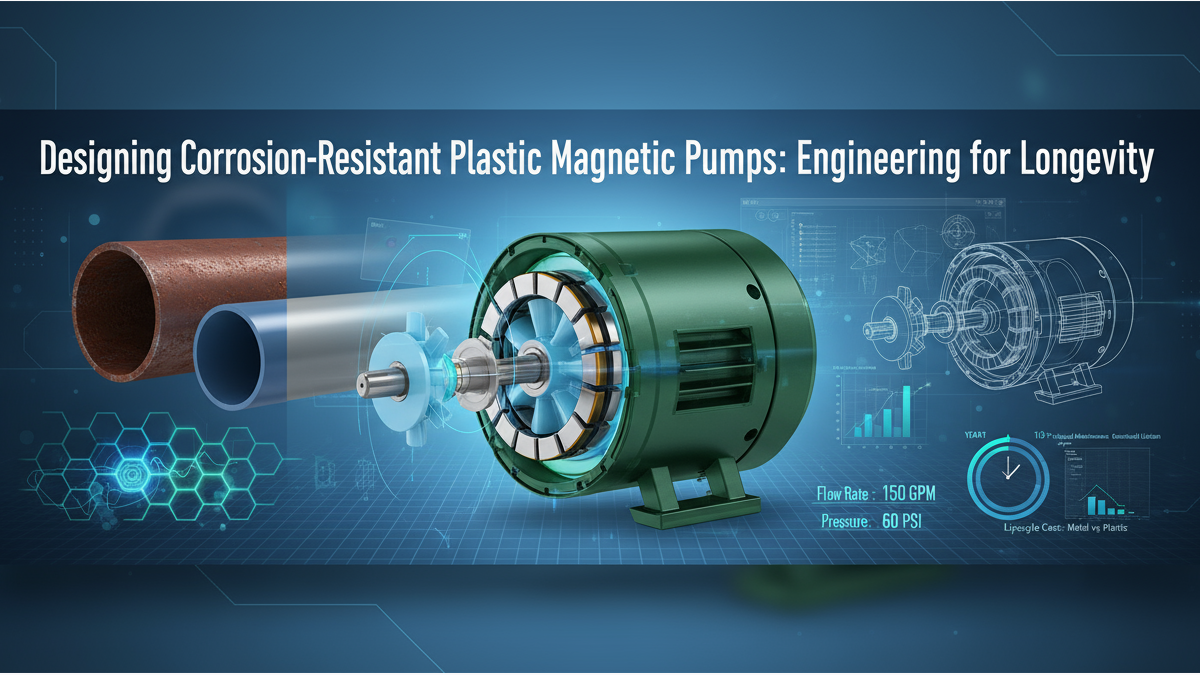
Designing Corrosion-Resistant Plastic Magnetic Pumps: Engineering for Longevity

True corrosion resistance is achieved not by material choice alone, but by how materials are engineered into a cohesive pump structure.
Published: Jan 06, 2026
Designing Corrosion-Resistant Plastic Magnetic Pumps: Engineering for Longevity

Rethinking Durability in Corrosive Environments

In the chemical and semiconductor industries, pump reliability is a core safety concern. Failures caused by corrosion can result in not only production downtime but also environmental hazards and contamination.

Modern corrosion-resistant pump design therefore integrates both material science and mechanical engineering—especially when using plastic magnetic chemical pumps to handle aggressive fluids.

1. The Seal-less Advantage: Magnetic Coupling Systems

Traditional pumps rely on mechanical seals that wear out under chemical attack. Magnetic drive technology removes this weak point entirely by transmitting torque through a static containment shell.

This seal-less configuration prevents leakage, ensuring containment of toxic or corrosive liquids. Non-metallic components such as ceramic shafts and fluoropolymer bearings further enhance resistance to acid vapor and solvent exposure.

2. Flow Path Optimization and Wall Uniformity

Uniform internal geometry is essential for even stress distribution. Thin or uneven walls can accelerate localized corrosion and stress cracking.

Advanced manufacturing techniques—such as precision molding and CNC machining—allow consistent wall thickness and smooth flow paths. The result: lower pressure loss, less turbulence, and reduced erosion.

3. Managing Thermal Expansion in Plastic Structures

All plastics expand under heat, but rates differ significantly among PP, PVDF, and fluoropolymers. Without proper tolerance design, temperature fluctuations can cause casing distortion or bearing misalignment.

To counteract this, designers use finite element analysis (FEA) to simulate stress behavior under variable thermal loads. Combining materials with complementary coefficients of expansion, such as PVDF casings with ceramic shafts, helps maintain precise clearances.

4. Validation Through Simulation and Testing

Before mass production, corrosion-resistant pumps undergo chemical immersion tests, thermal cycling, and accelerated wear assessments. These tests confirm the long-term stability of both materials and assemblies in simulated process conditions.

Such validation ensures that when deployed in industries like chemical processing, plating, or waste treatment, the pumps deliver consistent performance across years of continuous operation.

5. The Design–Material Relationship

Durability in chemical pumps is rarely determined by a single factor. Even the most resistant polymer can fail if design tolerances or flow patterns concentrate stress in vulnerable zones.

Therefore, effective corrosion resistance depends on an integrated design philosophy—balancing material selection, mechanical geometry, and thermal stability to extend lifecycle and safety margins.

Conclusion: Engineering Reliability Through Design Discipline

The evolution of plastic magnetic chemical pumps demonstrates that corrosion protection is as much about smart engineering as it is about chemistry.

By combining seal-less magnetic drive design, optimized internal geometry, and validated polymer selection, manufacturers are achieving new benchmarks in pump longevity.

ASSOMA INC., a global chemical transfer pump manufacturer, exemplifies this integrated approach. With extensive field data, material testing, and advanced molding capability, ASSOMA provides engineered solutions that enable distributors and OEMs to build safer, longer-lasting pump systems for corrosive applications.

Published by Jan 06, 2026 Source: ASSOMA INC.

Further reading

You might also be interested in ...

Headline
Knowledge
How to Choose the Right Blow Molding Machine: A Practical Buyer’s Guide
In the competitive world of polymer container manufacturing, choosing the right blow molding machine is a strategic decision. A poorly selected machine can lead to inefficiencies, excessive costs, or frequent downtime. In this guide, we present a neutral, buyer-oriented roadmap to help procurement engineers, plant owners, and OEM decision-makers evaluate and select blow molding equipment that truly matches their production needs.
Headline
Knowledge
A Metalworker's Guide to Sawing High-Performance Aluminum Alloys
On the shop floor, the rise of electric vehicles (EVs) and next-generation aircraft means one thing: you're cutting more aluminum than ever before. While this material offers fantastic strength-to-weight properties, it brings a unique set of headaches—gummy build-up, stringy chips, and a tendency to work-harden.
Headline
Knowledge
How Magnetic Drive Pumps Enhance Chemical Reliability in the Evolving Printed Circuit Board (PCB) Industry
The global Printed Circuit Board (PCB) industry is undergoing rapid transformation, fueled by technological upgrades, supply chain restructuring, and rising demand from high-performance electronics. With the market expected to grow from USD 80.3 billion in 2024 to USD 96.5 billion by 2029, manufacturers must focus on improving production stability, chemical reliability, and environmental compliance to stay competitive.
Headline
Knowledge
How to Choose the Right Ball Bearing Drawer Slide: Light, Medium, or Heavy Duty?
Choosing the right Ball Bearing Drawer Slide is essential for smooth operation, reliable load support, and long-lasting performance.
Headline
Knowledge
Stop the Stress: 5 Non-Negotiable Questions to Ask Your Bubble Tea Ingredient Supplier Today
Opening a bubble tea shop is exciting, but the reality is built on a complex, global supply chain.
Headline
Knowledge
H-Beams and I-Beams: Modern Cutting Methods for Structural Steel
In structural engineering projects such as bridges, high-rise buildings, and industrial facilities, the accurate cutting of H-beams and I-beams is vital for ensuring safety and structural integrity. Fabricators utilize a variety of cutting methods to meet project demands, including laser cutting, plasma cutting, water jet cutting, and large band saws.
Headline
Knowledge
Essential for Precision Machining: A Complete Guide to Tungsten Carbide Center Drills
In modern manufacturing, precision is the core standard by which product quality and performance are measured. From aerospace components to medical devices, even a minor deviation can lead to serious consequences. When it comes to precision drilling, a critical challenge is ensuring that a drill bit can be accurately positioned at the start of a cut while maintaining stability during high-intensity operations. The tungsten carbide center drill is the professional tool engineered specifically to solve this problem.
Headline
Knowledge
From Cavitation Effect to Industrial Applications: The Secrets of Ultrasonic Cleaning
When your glasses, tableware, or electronic components are stained with stubborn dirt, what can you do? Traditional methods often require vigorous scrubbing or even harsh chemical solvents, which are not environmentally friendly and may scratch the item. At this moment, ultrasonic cleaning acts like an “invisible little helper”, reaching deep into grooves and gaps to gently yet effectively remove contaminants.
Headline
Knowledge
The “Spark Magician” of Metalworking
Electrical Discharge Machining (EDM) is a non-traditional machining process that removes metal through electrical sparks. Unlike conventional methods, it is not limited by material hardness and can precisely create deep cavities, micro-holes, and complex structures in hardened steel, tungsten carbide, or superalloys. The three main types of EDM include wire cutting, die-sinking, and hole drilling, which are widely applied in mold making, aerospace, automotive, and medical industries. Although EDM has a slower processing speed, works only with conductive materials, and requires consideration of electrode wear and surface treatment, its advantages in high precision, zero cutting force, and superior surface finish make it an indispensable technology in precision manufacturing. Moreover, it continues to evolve in line with the trend toward smart manufacturing.
Headline
Knowledge
Press Brake vs Shearing Machine: Functional and Technical Comparison of Industrial Processing Equipment
Press Brake and Shearing Machine are two essential types of equipment in the field of machine tools, widely used in the processing of metal, wood, and other materials. They play critical roles in manufacturing, enabling efficient and precise material forming and cutting. This article introduces the definitions, functions, technical features, and applications of folding and cutting machines, offering neutral and practical knowledge sharing.
Headline
Knowledge
Master Chuck Types & Selection: The Essential Guide for Machinists
In the world of precision manufacturing, every minute detail can determine the quality of the final product. The chuck is a critical yet often overlooked component—it's not just a tool for holding a workpiece, but the very heart of ensuring machining accuracy, efficiency, and safety. This article will take you on a deep dive into the diverse universe of chucks, covering their operating principles, design philosophies, common types, and how to select the right jaws and chucks for different needs. Whether you're new to the industry or a seasoned engineer, this guide will unlock the intricate secrets of chucks, helping you master every detail on your path to manufacturing success.
Headline
Knowledge
An Overview of Electrical Discharge Machining (EDM)
Electrical Discharge Machining (EDM) is a non-traditional manufacturing process that utilizes electrical sparks to remove material from a workpiece. Unlike conventional machining methods such as milling or turning, which rely on physical contact between a tool and the material, EDM operates without direct contact, making it ideal for processing hard or brittle materials that are difficult to machine otherwise. The process involves generating a series of rapid electrical discharges between an electrode and the workpiece, submerged in a dielectric fluid, which erodes the material through thermal energy. This technique has revolutionized precision manufacturing by enabling the creation of complex geometries with high accuracy.
Agree