Both storage-tank and tankless RO systems produce treated water and reject water. Their reported figures must be compared using equivalent test conditions.
Two reverse osmosis (RO) systems may advertise very different wastewater ratios, yet the numbers may come from different tests. That is a problem for distributors comparing product lines: a tankless model can look more efficient on paper without its claimed figure describing the same operating conditions as the figure on a storage-tank system.
The distinction is especially important for point-of-use drinking-water RO systems. The U.S. EPA's WaterSense program offers a useful basis for comparison, but buyers still need to read the performance data sheet for each exact model.
Recovery Rating and Efficiency Rating Are Different Measures
RO produces a treated-water stream and a reject-water stream. In traditional tests under NSF/ANSI 58, the terms recovery and efficiency refer to different operating conditions.
In a conventional storage-tank system, the pressure in the tank rises as it fills. That back pressure can reduce permeate flow, affecting how much incoming water becomes treated water during a filling cycle. A recovery measurement under a different condition can therefore be higher than a system efficiency measurement.
Tankless or direct-flow designs do not fill a separate storage tank, but some perform automatic flushing that also consumes water. A recovery number measured only while dispensing may not represent all water the unit sends to the drain.
A clear explanation of these measurements appears in NSF's discussion of RO efficiency ratings. The practical rule is straightforward: a recovery percentage and an efficiency percentage should not be used as a direct product-to-product comparison without checking the test method.
What EPA WaterSense Adds to the Comparison
The U.S. EPA WaterSense Specification for Point-of-Use RO Systems, Version 1.0, issued in November 2024, establishes an independently certified efficiency and performance framework for eligible systems. It addresses both tank and tankless designs and specifies how automatic flushing is included in the applicable testing.
| Program criterion | WaterSense requirement | Meaning for a distributor |
| Water efficiency | At least 30% under the program's method | Compare an efficiency result, not two differently defined brochure figures |
| Reject-water ratio | Up to approximately 2.3 gallons to drain per gallon of treated water for qualifying systems | A common way to describe the water-use result |
| TDS reduction | At least 75% in the specified test | Water efficiency is not a substitute for treatment performance |
| Automatic flushing | Included under the specified testing conditions | Ask how flush cycles and settings were handled |
| Certification | Independent certification under the WaterSense program | A system's NSF/ANSI 58 status alone does not make it WaterSense-labeled |
For perspective, a tested system with 30% efficiency produces about 30 litres of treated water from 100 litres of incoming water and sends approximately 70 litres to the reject stream. That corresponds to roughly 2.3 litres rejected for every litre treated. This is an illustration of the metric, not a claim about a particular model.
EPA's point-of-use RO program page also notes August 2026 technical clarifications, including documentation and point-of-purchase provisions. Those clarifications are relevant to product claims and packaging; they should not be mistaken for a new efficiency threshold.
Why Flushing Can Change the Result
A direct-flow unit may automatically flush its membrane as part of normal operation. Water used in that process goes to the drain, even when no one is filling a glass. Measuring only the water produced while the faucet is open can therefore miss part of the system's consumption.
During development of the WaterSense specification, EPA discussed this issue in its response to public comments. The WaterSense approach addresses automatic flushing in the test method, making it more useful when comparing different RO configurations.
For a distributor, the important purchasing question is not whether a unit has a flush function. It is whether the published efficiency figure includes the relevant operating and flushing conditions.
Water Use Is Not the Only Stocking Decision
The better system also depends on installation conditions, delivery rate and the customer's intended use. The table below describes design considerations rather than fixed features of every model.
| Buying factor | Storage-tank RO | Tankless / direct-flow RO |
| Water delivery | Treated water is stored for later use; delivery depends on tank capacity and pressure | Water is treated when demanded; delivery depends on membrane, pressure and pump design |
| Space | Needs room for the treatment unit and a separate tank | Eliminates the separate tank, but the treatment unit still has its own footprint |
| Electrical supply | Some designs operate without an electric booster pump; others need one | Many high-output models use a pump; confirm the individual model |
| Connected appliances | Tank pressure and flow must suit the appliance | Outlet pressure and flow must also suit the appliance |
| Maintenance | May include tank-related service or sanitation | May include pump, valve and flush-system service |
| Efficiency comparison | Look for a complete-system efficiency rating | Check the metric, test method and flushing settings |
Consider the customer's installation before promoting one arrangement as superior. A home with limited cabinet space may favour a compact direct-flow configuration. Another installation may benefit from stored water or a specific pressure arrangement. Neither use case establishes which system consumes less water without comparable test results.
What to Request From an RO Supplier
A reliable product comparison starts with the exact model and configuration. The purchasing file should contain:
- The complete-system performance data sheet and applicable test or certification listing—not only the membrane specification.
- The definition and method behind each claimed recovery, efficiency or reject-water ratio.
- Details of automatic flushing and how it was treated during the test.
- Treated-water delivery specifications, power requirements, dimensions and maintenance instructions.
- The independent listing if the product is advertised as WaterSense-labeled. The official EPA product search is the appropriate place to check that claim.
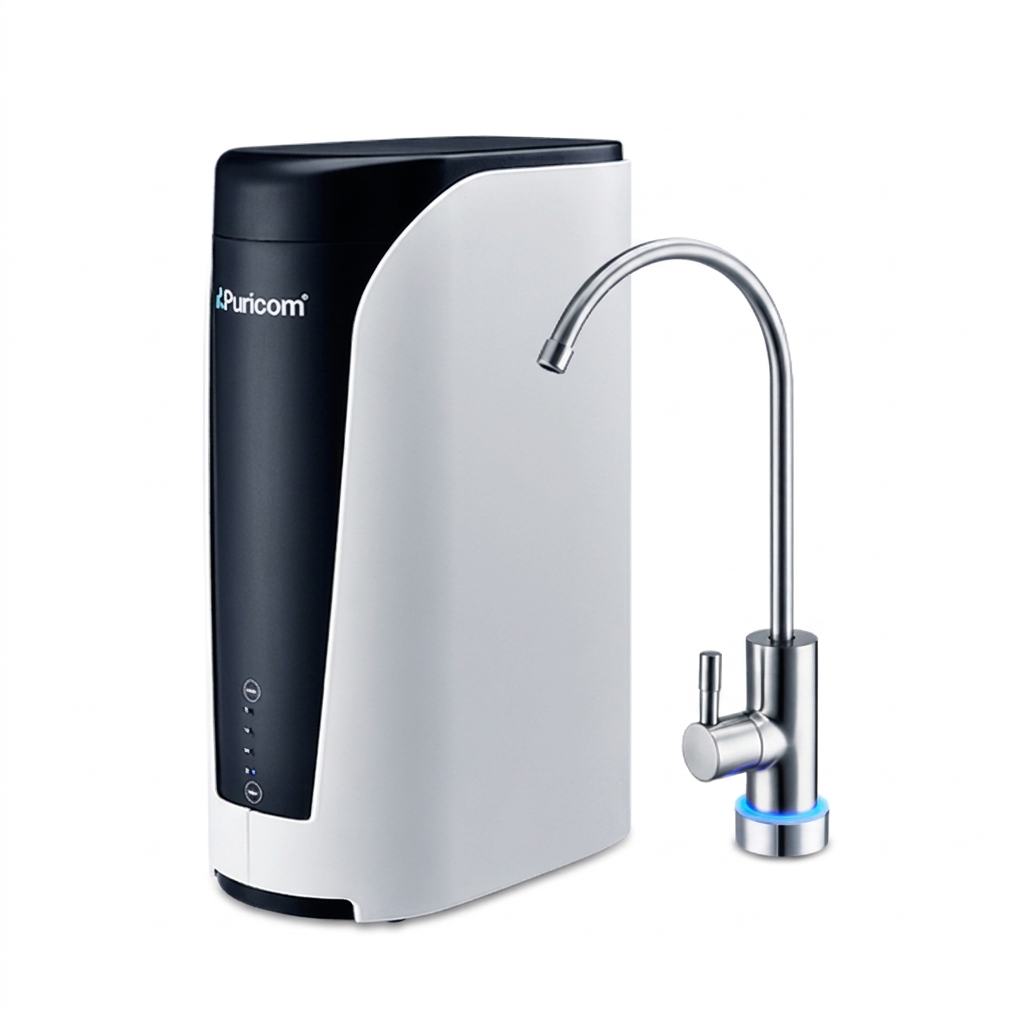
Product ranges can be compared at this stage without assuming that every listed model shares the same performance. Puricom's direct-flow RO systems, for example, give distributors an available range of direct-flow equipment to evaluate against customer applications. The relevant water-efficiency and certification evidence belongs to the particular system selected for quotation.
Frequently Asked Questions
Q: Do tankless RO systems always waste less water than tank systems?
A: No. The outcome depends on the design and its operating conditions. A comparable, independently tested efficiency result is more informative than the presence or absence of a storage tank.
Q: Does a high recovery rating mean the system will use little water in everyday operation?
A: Not necessarily. The recovery figure may not cover the same conditions as an efficiency test, especially when tank filling or automatic flushing is involved. Read the test definition alongside the percentage.
Q: Is NSF/ANSI 58 certification the same as WaterSense labeling?
A: No. WaterSense adds its own efficiency, performance and program-certification requirements. An NSF/ANSI 58 claim should not be presented as a WaterSense label without confirmation for the exact product.
Compare Systems, Not Marketing Ratios
The most useful RO purchasing comparison brings water-use data together with real installation requirements. For distributors and OEM buyers, that means examining tested efficiency, delivery performance, available space, electrical needs and maintenance for the exact configurations being considered.
Tankless and storage-tank RO can both be reasonable choices. The advantage becomes clear only when the figures mean the same thing and the equipment matches the installation.