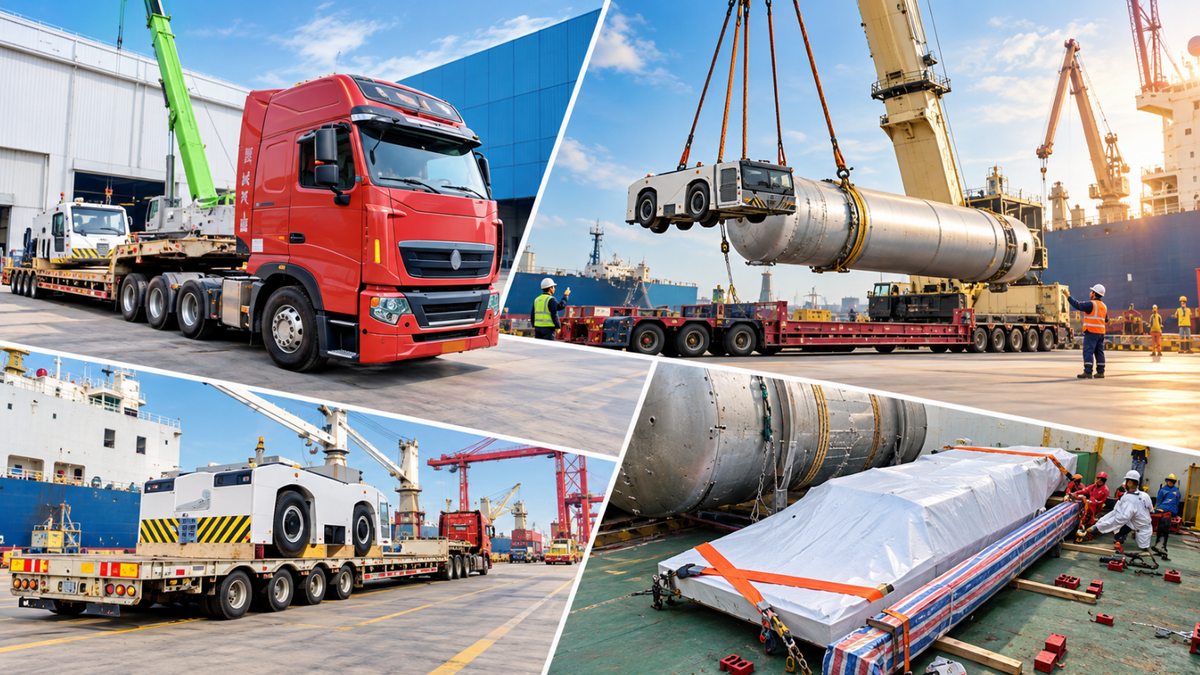
A low-clearance cargo profile, an unavailable Ro-Ro sailing, and a port-call constraint led HLS Honour Lane to revise both the vessel plan and discharge port for an airport equipment shipment to Mexico.
Airport ground-support equipment can be difficult to move by sea when it is heavy, unusually shaped, or close to the ground. In this HLS Honour Lane case, several baggage carts, tow tractors, and elevating carts were moving from China to Mexico. The customer initially preferred roll-on/roll-off (Ro-Ro) service to Manzanillo, but the equipment and schedule did not fit the available option.
HLS reports that driving the low-clearance units over a Ro-Ro ramp risked undercarriage abrasion. Ro-Ro space was booked, and the next sailing was too late for the required schedule. The requested port also presented vessel-call considerations for the option under review. HLS assessed other routes and proposed Veracruz as the discharge port, with a heavy-lift tweendecker vessel and a breakbulk handling plan. The company says the cargo arrived after about two months at sea, without damage or delay against the agreed schedule.
The case shows how a port diversion can form part of a cargo-specific solution. It is not a universal recommendation to reroute shipments through Veracruz: the decision depended on the cargo, the vessel options, the timing, and the port conditions assessed for this project.
Case summary
The table captures the main facts published by HLS. The operational result is attributed to the company’s case report.
| Project element |
Case details |
| Cargo and origin |
Airport baggage carts, tow tractors, and elevating carts from China |
| Initial plan |
Ro-Ro shipment to Manzanillo, Mexico |
| Constraints |
Low ground clearance, no Ro-Ro sailing within the deadline, and vessel-call considerations at the requested port |
| Revised plan |
Discharge at Veracruz using a heavy-lift tweendecker vessel |
| Preparation |
Manufacturer-confirmed packaging for breakbulk transport and deck stowage |
| Reported result |
About two months at sea; zero cargo damage and no delivery delay against plan |
Why the original Ro-Ro plan did not work
Ro-Ro is a familiar option for wheeled equipment because cargo can be driven onto and off a vessel. It can reduce some lifting steps, but the equipment must safely cross the ramp and the sailing must meet the project timetable. In this shipment, HLS identified three connected constraints.
First, the tow tractors and elevating carts had very low ground clearance. A Ro-Ro ramp has transitions between the quay, ramp, and vessel deck. If the angle or transition is too steep for a unit, its underside can scrape during loading or discharge. A vehicle’s ability to move under its own power does not by itself confirm that it can safely board. The ramp needs to be checked against the actual lowest point and dimensions of each unit.
Second, HLS reports that Ro-Ro space was fully booked and that the next available sailing would miss the customer’s required date. A technically suitable mode is not a viable project option if the cargo cannot be booked on time. Waiting for a later departure would have retained the original preference but failed the schedule requirement.
Third, the customer requested Manzanillo on Mexico’s Pacific coast. HLS says the port and berth priorities for the vessel option it assessed made a non-container vessel call less predictable. This is a description of the constraint encountered in this project, not a general assessment of every terminal or vessel operation at Manzanillo. Vessel access and handling acceptance need to be confirmed for the specific cargo, ship, terminal, and date.
Together, these constraints meant the team needed to reconsider more than the freight mode. It had to find a combination of vessel, handling method, and discharge port that could accommodate the cargo and support the delivery plan.
The revised route: Veracruz and a heavy-lift tweendecker
HLS says its team reviewed route options, vessel schedules, operational feasibility, and overall cost with the customer. It then recommended changing the discharge port from Manzanillo to Veracruz, on Mexico’s Gulf coast, and selecting a heavy-lift tweendecker vessel suited to the units’ dimensions and individual weights.
This paired change addressed different parts of the problem. The revised vessel and breakbulk approach avoided relying on the Ro-Ro ramp for low-clearance equipment. The alternate port addressed the vessel-call constraint identified for the original plan. The cargo would be lifted and stowed according to an agreed plan instead of being driven aboard as the primary method.
Changing ports also changes the route beyond the vessel. Manzanillo and Veracruz are on opposite coasts, so a diversion can affect ocean routing, discharge arrangements, customs coordination, and the inland leg to the receiving site. HLS’s public case report identifies Veracruz as the selected port but does not provide a detailed cost comparison or the final inland delivery route. Therefore, the case supports the feasibility of the solution for that shipment; it does not show that Veracruz is always faster or less expensive for cargo going to Mexico.
For project teams, the key is to assess the complete route to the final destination. A new port can remove a vessel or handling bottleneck, but the inland distance, available transport equipment, delivery access, and schedule still need to be checked. The right decision is the one that works from the cargo’s origin through to the consignee, not simply the port-to-port option with the lowest quoted rate.
Packaging and stowage for breakbulk transport
Moving the carts as breakbulk changed the handling requirements. Rather than rolling up a vessel ramp, the units needed to be packaged, lifted, supported, secured, and protected for ocean transport. HLS reports that its team worked with the manufacturer to confirm that the packaging was suitable for breakbulk sea transport and deck stowage for the elevating carts. It then finalized the deck loading arrangement with the shipowner.
This manufacturer and shipowner coordination addressed two separate questions. The manufacturer could confirm how the equipment should be supported and what parts needed protection. The shipowner needed to confirm that the packages and proposed positions were workable for the vessel’s loading plan. Deck stowage is not a generic acceptance: the actual cargo, packaging, lifting points, and securing arrangement must be reviewed for the specific sailing.
In similar projects, cargo details should be consistent across the equipment schedule, package list, commercial invoice, and transport documents. Dimensions and weights affect vessel acceptance and lifting plans; unclear descriptions or inconsistent unit counts can create avoidable questions during handling or customs review. If packages contain separate components of one machine, the documents should make that relationship clear.
HLS also reports coordinating vessel scheduling, documentation management, terminal liaison, and cargo handling. That coordination links the vessel plan to the work at origin and destination. It helps the parties know who is confirming the ship, who is preparing the cargo, and who is arranging terminal operations. The published case does not specify every handoff, but it makes clear that the solution involved more than booking ocean space.
For a shipment into Mexico, documentation should be coordinated alongside the vessel plan. The International Trade Administration identifies the pedimento de importación (import customs declaration), a Spanish-language commercial invoice, and a bill of lading among key documents. Mexico’s SAT lists an active RFC and valid e.firma among its importer-registry conditions. HLS reports managing documents in this case, but its public article does not detail the shipment’s customs file. Importers should confirm current requirements with their Mexican customs broker before dispatch.
The reported result—and its limits
HLS reports that the baggage carts arrived at Veracruz after approximately two months of ocean transit. The company lists zero cargo damage and zero delivery delays, and says the shipment included overweight and out-of-gauge equipment. These results are reported by HLS for this case; they are not an independently audited performance benchmark.
The result shows that the team found an alternative when the preferred Ro-Ro plan could not meet the assessed cargo and timing requirements. It does not establish a standard China-to-Mexico transit time, prove that every low-clearance machine should move as breakbulk, or demonstrate that Veracruz is the best destination port for every Mexican consignee. A separate shipment may have different cargo dimensions, vessel capacity, port access, customs status, and inland delivery needs.
The useful takeaway is the decision sequence: identify why the original plan is unsuitable, compare feasible alternatives, confirm the cargo-handling plan, and validate the revised route through to the destination. If key details remain provisional—such as sailing space, terminal acceptance, or inland equipment—the proposal should show those dependencies before the buyer commits.
What buyers can learn from this shipment
The case offers four practical lessons for airport owners, equipment buyers, and project logistics teams:
- Check the actual loading interface. Wheeled equipment is not automatically suitable for Ro-Ro. Compare ground clearance with the vessel ramp and transition.
- Treat the sailing date as part of mode selection. A mode that fits the equipment but has no timely space may not fit the project.
- Evaluate a port change end to end. Confirm the vessel and terminal plan, then check customs coordination and inland delivery to the consignee.
- Involve both the manufacturer and shipowner in stowage. Equipment protection and vessel acceptance depend on cargo-specific packaging and loading details.
These checks are especially relevant when comparing international sea cargo services or ocean cargo services for heavy, low-clearance, or out-of-gauge equipment. Buyers should ask why a particular vessel and port were selected, what has been confirmed, and which assumptions could still affect the schedule or cost.
HLS Honour Lane’s role
In its case report, HLS Honour Lane says it assessed routes and vessel schedules, discussed the options with the customer, coordinated packaging suitability with the manufacturer, agreed the deck loading plan with the shipowner, and managed scheduling, documentation, terminal liaison, and cargo handling. The report does not disclose a detailed quote or route-by-route cost comparison, so those aspects cannot be independently compared from the published case.
HLS describes itself as a non-vessel-operating common carrier (NVOCC). Its sea freight services page lists LCL, FCL, sea-air, project management, customs brokerage, breakbulk, and Ro-Ro services. Buyers with a similar project can review the service scope and request an assessment based on cargo dimensions, weights, ground clearance, lifting points, origin, destination, and required delivery date.
Frequently asked questions
1.Why was Ro-Ro not used for the baggage carts?
HLS reports that low ground clearance made ramp contact a risk, while the available Ro-Ro sailing could not meet the customer’s deadline. The vessel-call conditions at the requested port were another constraint in the project assessment.
2.Why was Veracruz selected instead of Manzanillo?
HLS says it recommended Veracruz after comparing route options, vessel schedules, operational feasibility, and overall cost. The change addressed the port-call constraint identified for the vessel option under review. Because the ports are on different coasts, another shipment should also compare inland distance, destination access, and total cost.
3.Is two months a typical China-to-Mexico sea transit time?
No. HLS reports approximately two months at sea for this specific shipment to Veracruz. Transit times vary by origin, vessel service, port calls, transshipment, and schedule. Buyers should request a current, shipment-specific estimate.