Taiwan's Chung Sing Machinery has been building FORTWORTH-brand boring and milling machines since 1988. For buyers of 12- to 25-tonne machine tools, the purchase decision rests less on the headline spec sheet and more on how the machine was made. Here is what that process looks like.
A CNC horizontal boring and milling machine
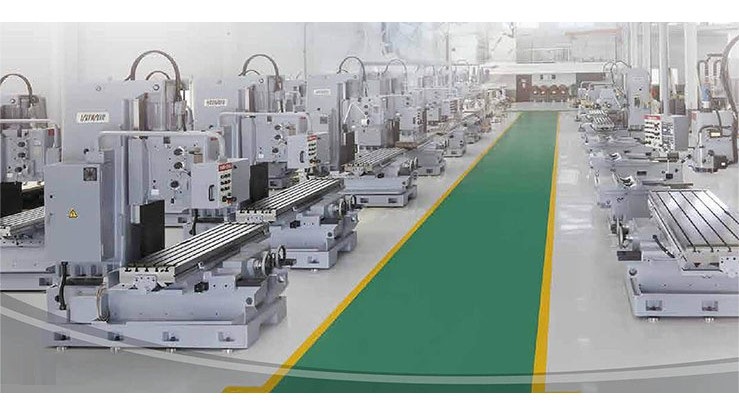
A CNC horizontal boring and milling machine is not a product you can meaningfully evaluate by unboxing it. By the time a machine like Chung Sing Machinery's HB-110-30T arrives on a buyer's floor, it weighs roughly 25,800 kg, occupies a 5,600 × 5,510 × 3,820 mm footprint, and will be expected to hold accuracy on that footprint for a decade or more. Almost everything that determines whether it does — the iron, the structure, the way the slideways were finished, the way the spindle was balanced — was decided long before the machine was crated.
That is why, in the heavy machine tool segment, "how it was built" is a commercial argument, not just an engineering one. Chung Sing Machinery, headquartered in Taichung, Taiwan and established in 1988, has manufactured under the FORTWORTH brand for over 30 years, and its machines are now in service internationally. The company's published engineering description of its own build approach offers a useful walkthrough of what actually happens between raw casting and shipment.
It starts with the iron
Every FORTWORTH horizontal milling machine is, in the company's own words, "manufactured of highest quality cast iron." That sentence carries more weight than it appears to.
In heavy boring and milling, the casting is the machine. Cutting forces on an oversized workpiece do not simply act on the tool — they travel into the spindle, through the headstock, down the column, and into the bed. Cast iron is the material of choice across the heavy machine tool industry for a specific physical reason: its graphite structure gives it inherent vibration-damping capability that fabricated steel structures of equivalent stiffness do not match. In a process where "chatter" degrades surface finish, shortens tool life and forces conservative cutting parameters, damping is not a comfort feature — it is throughput.
The second half of the equation is geometry. Chung Sing specifies a box-type column, bed and saddle, described by the company as delivering "outstanding stability in heavy duty cutting." A closed box section resists torsional deflection far more effectively than an open profile of the same mass. On a machine where the spindle can sit up to 1,500 mm above the table top and reach 1,920 mm from the table centre — as on the HB-110-30T — that torsional resistance is what keeps the tool point where the control believes it is.
Slideways: hardened, ground, and scraped
Chung Sing's stated process for its slideways is worth quoting precisely: "All slide ways are hardened, precision ground and scraped for lasting precision."
Three separate operations are named there, and the order matters:
-
Hardened — raises surface hardness so the way surface resists wear over years of loaded traverse rather than wearing a hollow into its own travel path.
-
Precision ground — establishes the geometric form and flatness to a machine-tool tolerance.
-
Scraped — a hand-finishing operation, performed by a skilled technician, that creates a microscopic bearing pattern across the mating surfaces.
That third step is the one buyers should pay attention to, because it is the one that cannot be automated cheaply. Hand scraping produces two effects that grinding alone does not: it distributes contact across the full mating area rather than a few high spots, and the resulting pocket pattern retains lubricating oil. For a machine expected to carry a 5,000 kg table load while moving that table through 3,000 mm of X travel, distributed contact is what prevents the geometry from walking out of tolerance in year three. Retaining hand scraping in a modern production line is a deliberate cost decision, and it is a reasonable proxy for how a builder thinks about service life.
Assembling the moving mass
The next set of choices addresses a problem specific to heavy machines: everything that moves is heavy, and heavy things want to sag, drift, and hold their position badly.
Chung Sing's answers, as published:
-
Ballscrew-driven X and Z axes, specified to "ensure the table movement smoothly." On the HB-110-30T these are 63 mm diameter with 10 mm pitch on X, Y and Z, with 40 mm on the W axis.
-
Hydraulic clamping on the headstock, table and saddle — "to ensure machining accuracy." This is the detail that separates a heavy-duty boring mill from a scaled-up machining centre. When a boring bar is taking a heavy cut, the non-participating axes must be locked, not merely held by servo torque. Hydraulic clamps take the axis out of play and let the structure, not the drive, absorb the load.
-
Spindle headstock balancing with a counterweight — the company states that "spindle headstock balance is accurately taken and a counter weight permits the head to travel smoothly and to retain its accuracy stability." On a machine with 1,500 mm of vertical Y travel carrying a Ø110 mm boring spindle and a 22/26 kW motor, an unbalanced head is a machine that measures differently at the top of its stroke than at the bottom.
Measurement designed into the machine
On the HB-110-30T, positional feedback is not inferred from the motor. The machine ships as standard with Heidenhain absolute linear scales on the X, Y, Z and W axes, and a Heidenhain absolute angle encoder on the B axis (the rotary table), running under a Fanuc 0i-MF control.
The distinction matters for a heavy machine. Rotary-encoder-only feedback measures what the ballscrew did; a linear scale measures where the axis actually is, which means screw wind-up, backlash and thermal growth of the screw are seen and corrected rather than accumulated. On the B axis, an absolute angle encoder supports the machine's 0.001° minimum indexing input on a table rated to 5,000 kg. The same machine also carries a spindle oil chiller and centralised automatic lubrication as standard — both thermal- and wear-management systems whose value is measured in accuracy retention over a shift, not in a demo cut.
Practically, this means the accuracy story is built into the machine's own metrology chain, not applied as a one-time adjustment at final assembly.
The quality system behind the shipment
Individual good practices only produce consistent machines if they are governed. Chung Sing's published certification history shows a quality management system that has been externally audited continuously for more than two decades:
| Year |
Certification |
Body |
| 1999 |
EEC certification |
TÜV Rheinland, Germany |
| 2000 |
ISO 9002 |
AMTRI VERITAS, England |
| 2004 |
ISO 9001:2000 |
AMTRI VERITAS, England |
| 2007 |
ISO 9001:2000 |
AMTRI VERITAS, England |
| 2011 |
ISO 9001:2008 |
AMTRI VERITAS, England |
| 2013 |
ISO 9001:2008 |
AMTRI VERITAS, England |
Two things are worth reading out of that table. The first is the 1999 TÜV Rheinland EEC certification, which concerns conformity for the European market — a safety and compliance regime, distinct from the quality-system standard. The second is the continuity: recertification in 2000, 2004, 2007, 2011 and 2013 reflects a system that has been re-audited across multiple revisions of the standard rather than certified once and shelved.
The range this process has to cover
The same manufacturing discipline has to hold across product families of very different scale, which is itself a test of process control:
| Model |
Type |
Table load |
Key travel |
Approx. weight |
| HB-110-30T |
CNC horizontal boring & milling, moving column |
5,000 kg |
3,000 mm (X) |
25,800 kg |
| HB-110-20T |
CNC horizontal boring & milling, moving column |
5,000 kg |
2,000 mm (X), 3,000 mm opt. |
24,500 kg |
| HB-110B |
CNC horizontal boring & milling, fixed column |
3,000 kg |
2,000 mm (X) |
21,000 kg |
| HBM-110FH |
Horizontal boring & milling with built-in facing head |
5,000 kg |
1,800 mm (X) |
— |
| HBM-110L |
Horizontal boring & milling, W axis |
5,000 kg |
1,800 mm (X) |
16,000 kg |
| CS-HB180 |
Horizontal boring & milling |
2,000 kg |
1,800 mm (X) |
11,500 kg |
Source: Chung Sing Machinery published specifications. Design and specifications are subject to change without prior notice.
The HBM-110FH illustrates the point at the top end: a Ø660 mm built-in facing head with a 940 mm maximum facing diameter and a U-axis facing slide, intended for large flanges, valve bodies, gearbox and pump housings. A facing head is a rotating mass mounted at the most accuracy-sensitive point on the machine. It only works if the column, the ways and the spindle assembly underneath it were built to carry it.
A buyer's checklist for any heavy machine builder
For readers evaluating heavy-duty boring mills from any supplier, the build-process questions that actually differentiate machines are:
-
What is the structural material and section design? Cast iron and closed box sections, or fabricated and open?
-
How are slideways finished? Ask specifically whether hardening, precision grinding and scraping are all performed.
-
Are the non-cutting axes clamped, and how? Hydraulic clamping on headstock, table and saddle indicates a machine designed for heavy interrupted cuts.
-
Is positional feedback linear or rotary? Absolute linear scales on all linear axes is a materially different specification from motor-side encoders.
-
Is the vertical axis mass balanced? Ask how head balance is achieved and verified.
-
How long has the quality system been externally certified, and by whom? A continuous recertification history is more informative than a single current certificate.
-
What inspection documentation ships with the machine? Request the specific report set before ordering, not after.
About Chung Sing Machinery
Chung Sing Machinery Co., Ltd. is headquartered in Taichung, Taiwan and was established in 1988. The company designs and manufactures boring mill and milling machines under the FORTWORTH brand, with over 30 years of experience in developing, designing and manufacturing milling machinery. Its product range covers CNC horizontal boring & milling machines, horizontal boring & milling machines, bed-type vertical boring & milling machines, and bed-type vertical with horizontal boring & milling machines. FORTWORTH machines are in service worldwide.
FAQ
Why is cast iron still used for heavy machine tool structures?
Cast iron's graphite microstructure gives it inherent vibration damping that fabricated steel structures of comparable stiffness do not match. In boring and milling, damping suppresses chatter, which directly affects surface finish, tool life and how aggressively an operator can cut. Chung Sing states that every FORTWORTH horizontal milling machine is manufactured of highest quality cast iron.
What does "hand scraping" add if the slideways are already precision ground?
Grinding sets the form; scraping distributes actual contact across the mating surfaces and creates a pattern that retains lubricating oil. The result is more uniform load distribution and slower geometric degradation over the machine's service life. Chung Sing specifies that all slideways are hardened, precision ground and scraped.
Why do heavy boring mills use hydraulic axis clamping?
During a heavy boring cut, axes that are not participating in the motion need to be mechanically locked rather than held by servo torque alone, so the structure absorbs the cutting load. Chung Sing equips the headstock, table and saddle with hydraulic clampers.
What is the practical benefit of absolute linear scales?
A linear scale measures the actual position of the axis rather than the rotation of the ballscrew, so backlash, screw wind-up and thermal growth are detected and compensated instead of accumulating as error. The HB-110-30T ships with Heidenhain absolute linear scales on X, Y, Z and W as standard equipment.
Is Chung Sing's quality system certified?
Chung Sing's published certification record includes EEC certification by TÜV Rheinland (Germany) in 1999 and ISO 9002 / ISO 9001 certification by AMTRI VERITAS (England) across 2000, 2004, 2007, 2011 and 2013. Buyers should request the current certificate directly from the company.