Medical Mobility and Mounting Solutions Take Center Stage at MEDICA 2026
Diwei will showcase mobile medical carts, monitor arms, and customized mounting solutions designed to support ergonomic, flexible, and space-efficient healthcare workflows at MEDICA 2026.
Published: Oct 28, 2026
As healthcare environments become more digital and space-constrained, mobile carts, monitor arms, and customized mounting systems are becoming essential infrastructure for clinical workflows.
Healthcare technology is becoming more connected, but better devices alone do not guarantee better clinical workflows. In hospitals, clinics, laboratories, and other care settings, medical equipment must also be easy to position, simple to use, and adaptable to the way professionals actually work.
This is driving greater interest in mobile medical carts, adjustable monitor arms, and purpose-built mounting solutions. These systems help bring digital tools closer to the point of care while supporting more ergonomic workspaces and more efficient use of limited clinical space.
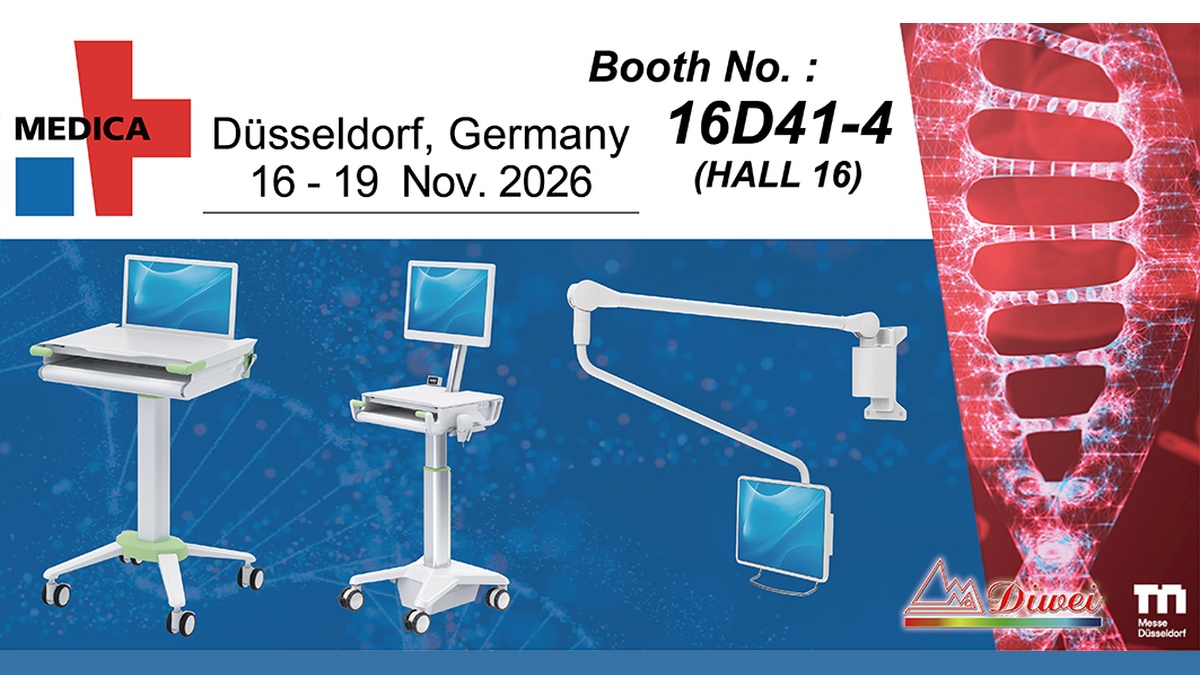
At MEDICA 2026, taking place November 16–19 at Messe Düsseldorf in Germany, Diwei Industrial will present its latest solutions for medical mobility and equipment mounting. The company will exhibit in Hall 16, Booth 16D41-4.
From Equipment Placement to Workflow Design
Medical equipment is often used across multiple rooms, departments, and care scenarios. A monitor may need to be viewed by a clinician, a patient, and other members of a care team. A computer may need to move from a central station to the bedside. In a laboratory or pharmacy, a workstation may need to remain accessible while taking up as little fixed space as possible.
These requirements have made equipment placement an important part of healthcare design. The right cart or mounting system can help staff reposition technology, maintain a clear working area, and access information without interrupting patient interaction.
The design priorities are practical. Mobility allows equipment to follow the workflow. Height and angle adjustment can support more comfortable working positions. Integrated cable management helps keep workspaces organized and reduces the risk of loose cables interfering with nearby activity. Durable construction and surfaces that can be cleaned easily are also important in demanding healthcare environments.
Mobile Carts Bring Technology to the Point of Care
Mobile medical carts are designed to support workflows that cannot be confined to a fixed workstation. They can carry monitors, computers, and other medical equipment to locations where care is being delivered.
For nursing rounds and bedside documentation, a mobile workstation can reduce the need to move repeatedly between a patient room and a central desk. A cart with an adjustable working height can support both seated and standing use, while a stable base and smooth-rolling casters help staff move equipment through clinical spaces.
Different applications call for different cart configurations. A cart may be designed around a computer and display, a specific medical device, or a broader mobile workstation setup. This makes modularity and configuration flexibility important considerations for hospitals, equipment suppliers, and system integrators.
Monitor Arms Support Visibility and Ergonomics
Monitor arms provide another way to improve the relationship between people, screens, and clinical equipment. Adjustable arms can help users position displays at a more suitable height and viewing angle. They can also make it easier to share information with patients or other professionals during consultations and clinical discussions.
In areas such as nursing stations, examination rooms, intensive care units, and operating rooms, the mounting approach must reflect the available space and the demands of the workflow. Wall-mounted systems can help keep floors clear. Ceiling-mounted solutions can provide extended reach where floor space is restricted. Mobile or freestanding configurations can support applications that require equipment to move between locations.
The ability to adjust and reposition a display is only part of the requirement. A well-designed system must also provide stability during use, manage cables effectively, and accommodate the monitors or devices used in a particular application.
Customization Helps Close the Gap Between Standard Products and Clinical Needs
Healthcare environments rarely share identical layouts or equipment requirements. A hospital may need a mounting system that works with a proprietary device interface. A distributor may require a product configuration for a specific regional market. A system integrator may need a solution that combines a display, keyboard, computer, power components, and other accessories within a defined footprint.
For these applications, OEM and ODM capability can be as important as the standard product range. A manufacturing partner with design and production experience can support the process from concept development and mechanical design through prototyping, manufacturing, and production.
This approach allows the final solution to reflect the customer’s equipment dimensions, functional requirements, installation environment, and branding or market needs. It also gives buyers more flexibility when standard catalog products do not fully match the intended workflow.
What Visitors Can Explore at MEDICA 2026
At MEDICA 2026, visitors will have the opportunity to examine medical carts and mounting solutions in person and discuss potential applications with the Diwei team. The exhibition will include mobile medical carts, monitor arms, and other mounting products for healthcare environments.
The company will also use the event to discuss customized healthcare mobility projects with medical equipment companies, distributors, healthcare system integrators, and OEM/ODM partners. Visitors with specific requirements can bring project specifications, equipment details, or early-stage application concepts for discussion.
MEDICA continues to provide an international meeting point for medical technology companies, healthcare professionals, and industry partners. As hospitals and clinics continue to adopt digital tools, the supporting infrastructure around those tools will become increasingly important. Carts, arms, and workstations may not be the most visible part of a medical technology system, but their design can directly influence how efficiently and comfortably that system is used.
For companies evaluating new medical mobility or mounting solutions, MEDICA 2026 offers an opportunity to compare approaches, review practical applications, and identify manufacturing partners for future healthcare projects.
MEDICA 2026
Date: November 16–19, 2026
Venue: Messe Düsseldorf, Germany
Exhibitor location: Hall 16, Booth 16D41-4
Published by Oct 28, 2026
Website Sources: