A Practical Framework for Selecting 3-Axis vs. 5-Axis Graphite Machining Centers in 2026
Graphite machining is becoming more important across mold making, EDM electrode production, semiconductor equipment, and advanced-material applications. For buyers, the central decision is not simply whether to purchase a graphite machine, but how to match axis configuration, dust-control design, spindle performance, and automation readiness to the parts they actually produce.
This guide presents a practical selection framework for 2026. It compares 3-axis and 5-axis configurations, explains why dry machining is widely used for graphite, and highlights the specifications that should be verified before purchasing a machine.
Why Graphite Machining Matters in 2026
Graphite is widely used for EDM electrodes, high-temperature fixtures, semiconductor-related components, molds, and specialty industrial parts. The material is lightweight, electrically conductive, thermally stable, and comparatively easy to machine; however, it creates fine, abrasive dust that can compromise linear guides, ball screws, electronics, shop cleanliness, and worker safety if machine design is not purpose-built.
As electrode geometries become more complex and delivery expectations become tighter, buyers are placing more emphasis on stable high-speed machining, accurate motion control, reliable dust extraction, and repeatable surface quality. This does not mean every shop requires a premium 5-axis machine or an AI-enabled production cell. In many cases, a well-specified 3-axis dry-cutting graphite machine remains the most economical and productive option.
The right purchase decision begins with three questions:
- What proportion of the work consists of simple, prismatic, or 2.5D electrode geometries?
- How often do parts require machining from multiple angles, undercuts, or complex freeform surfaces?
- Can the shop control graphite dust effectively throughout the machine, extraction system, and surrounding production area?
3-Axis vs. 5-Axis: Choose by Part Geometry
A 3-axis graphite machining center moves the cutting tool along the X, Y, and Z axes. It is the established choice for many EDM electrode and mold-making applications because it is simpler to program, easier to operate, and generally less expensive to purchase and maintain than a 5-axis machine.
A 5-axis machine adds rotary motion, allowing more faces and angles to be machined in one setup. This can reduce repositioning, improve consistency between features, and make difficult geometries practical. However, the additional capability brings a higher initial investment, more complex CAM programming, greater operator-skill requirements, and additional maintenance considerations.
| Decision factor |
3-axis graphite machine |
5-axis graphite machine |
| Best suited parts |
Flat, prismatic, 2.5D, and standard EDM electrodes |
Multi-angle, undercut, curved, and freeform electrode geometries |
| Programming |
More accessible; standard 3-axis CAM workflows |
More advanced; requires multi-axis CAM strategy and collision control |
| Setups |
May require refixturing for multiple sides |
Often completes complex parts in one setup |
| Initial investment |
Lower |
Higher |
| Maintenance complexity |
Lower mechanical complexity |
Higher due to rotary axes and calibration requirements |
| Typical buyer |
EDM electrode shops, mold shops, and SMEs with repeat work |
High-mix manufacturers, aerospace, medical, and complex-mold applications |
For a shop producing mostly standard electrodes, a 3-axis machine can offer a better return on investment because the machine capacity is aligned with the work. A 5-axis model becomes more compelling when multiple setups, hand finishing, or fixture changes are regularly limiting throughput or accuracy.
Dry vs. Wet Cutting: Why Dust Control Is Central
Graphite is commonly machined dry. Unlike conventional metalworking operations that depend on coolant for lubrication and heat management, graphite machining can be performed without cutting fluid when the machine has a properly engineered enclosure and extraction system.
The benefit of dry cutting is not merely avoiding coolant cost. Mixing graphite dust with coolant can produce contaminated sludge that is difficult to manage and dispose of. A dry system, by contrast, directs dust into a dedicated collector and helps keep the machining area, motion components, and electrical equipment cleaner.
| Consideration |
Dry graphite machining |
Wet machining approach |
| Coolant consumption |
No coolant is required for the cutting process |
Requires coolant purchase, monitoring, and replacement |
| Waste handling |
Collected graphite dust can be managed separately |
May create graphite-contaminated coolant sludge |
| Machine protection |
Depends on sealed enclosure, extraction, and protected axes |
Requires coolant and chip-management infrastructure |
| Shop cleanliness |
Effective when negative pressure and filtration are correctly sized |
Risk of residue and sludge around tanks and filtration equipment |
For dry cutting to work reliably, buyers should evaluate the dust-control system as carefully as the spindle. A graphite machine should have a fully enclosed cutting area, extraction ports positioned to capture airborne dust, negative-pressure design, and protective covers for guides and ball screws. Positive pressure in the electrical cabinet is also valuable because it helps prevent conductive graphite dust from entering sensitive electrical components.
Specifications That Buyers Should Verify
Machine brochures can emphasize spindle speed, but graphite machining performance depends on the complete system. The following checklist helps buyers compare machines on practical rather than headline specifications.
-
Spindle speed and design: High-speed spindles in the 24,000 to 30,000 rpm range are common for efficient graphite milling. Buyers should also confirm spindle power, torque curve, cooling method, bearing design, and tool-holder interface.
-
Machine rigidity: A stable base, rigid column or gantry structure, appropriately sized linear guides, and preloaded ball screws support accurate high-speed motion and reduce vibration.
-
Accuracy and repeatability: Verify the manufacturer's positioning accuracy, repeatability, compensation method, and inspection conditions. The required values should be defined by electrode tolerance and downstream EDM requirements.
-
Dust collection capacity: Check collector motor power, airflow, filtration rating, filter-cleaning method, ducting layout, and whether extraction performance is specified under real operating conditions.
-
Axis protection: Telescopic covers, sealed way covers, and protected motion components are especially important because graphite dust is abrasive.
-
CNC control and high-speed functions: Look-ahead processing, high-speed contour control, acceleration/deceleration tuning, and smoothing functions influence surface finish and cycle time.
-
Serviceability: Confirm local service response, availability of spindle service, consumable-filter supply, and preventive-maintenance recommendations.
A fast spindle cannot compensate for weak extraction, unstable machine construction, or poor programming. The most productive configuration is a balanced system in which mechanical rigidity, control response, tooling, workholding, and dust management support one another.
A Practical Example: SISTER SD600G
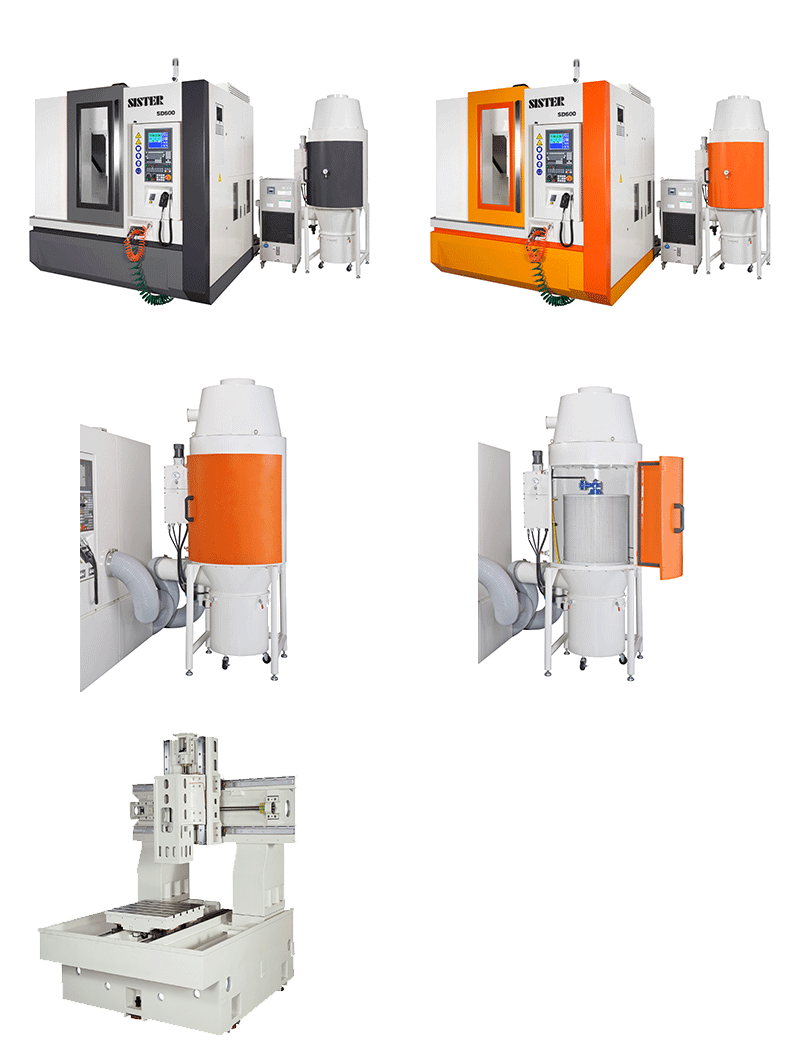
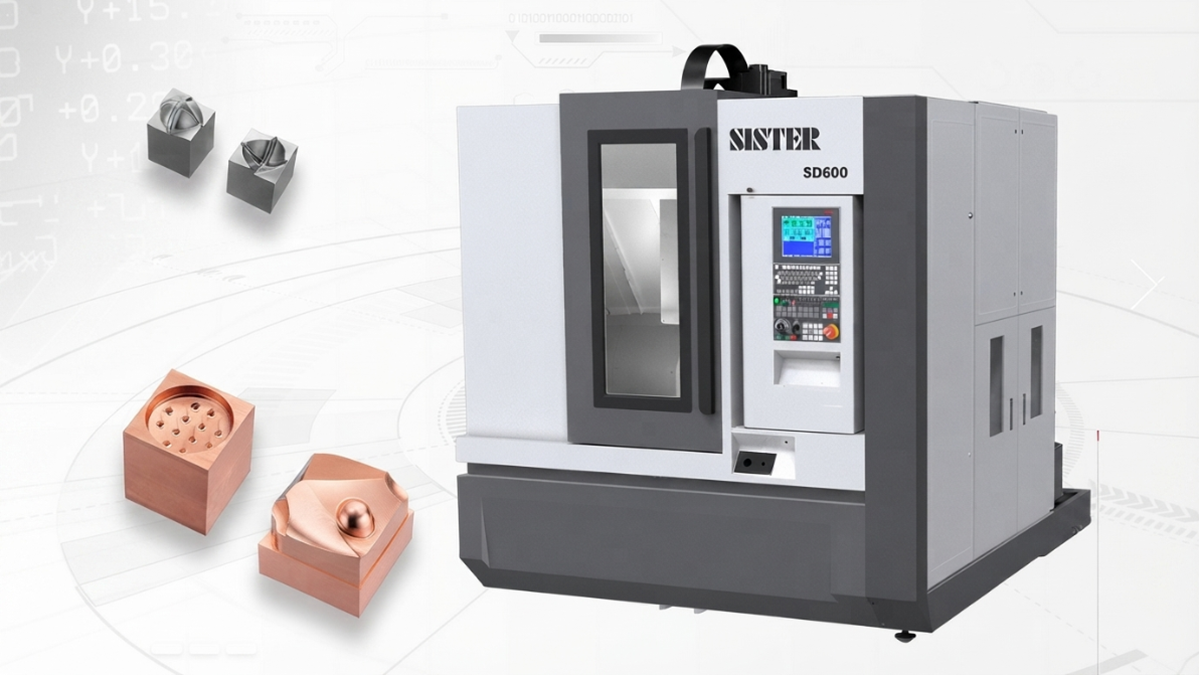
The SISTER SD600G Double Column Graphite Milling Machine Center is a useful example of how a modern 3-axis graphite machine can be positioned. It is designed for high-speed and precise graphite machining, with X/Y/Z travels of 600/600/320 mm and a built-in spindle available in 24,000 rpm or 30,000 rpm configurations.
Rather than presenting itself as a 5-axis or AI-native platform, the SD600G focuses on the requirements that are central to dedicated graphite work: dry cutting, dust containment, and stable high-speed motion. Its design includes an enclosed machining area, a plus/minus pressure concept, protective structure intended to keep graphite dust away from critical machine areas, and a dedicated dust-collection arrangement.
This makes the SD600G relevant for applications such as:
- EDM graphite electrode production
- Graphite mold and fixture machining
- High-volume production of repeatable 3-axis electrode geometries
- Shops seeking a dedicated dry-cutting graphite machine rather than a general-purpose VMC
The key point for buyers is not that a 3-axis machine replaces a 5-axis machine in every application. It is that a properly configured 3-axis machine is often the more rational choice when part geometry is compatible, production volume is steady, and the priority is dependable throughput with controlled operating cost.
Automation and Smart-Machining Readiness
Automation, condition monitoring, and digital production management are important manufacturing trends, but they should be evaluated as an upgrade path rather than assumed to be mandatory on day one. Many graphite shops first gain more value by stabilizing their machining process, improving electrode design, standardizing workholding, and controlling dust effectively.
Once output and part volume justify it, a shop can add automation in stages. Possible steps include automated tool measurement, workpiece probing, palletized workholding, robot loading, and external machine-monitoring sensors for spindle vibration, temperature, power use, or machine utilization.
- Establish a repeatable dry-machining process with suitable tools, feeds, speeds, and extraction settings.
- Use probing and tool-setting systems to reduce setup variation.
- Add pallet or robotic handling if labor availability or unattended production becomes a bottleneck.
- Implement condition monitoring when unplanned downtime has a measurable production cost.
This phased strategy can make a conventional CNC machine part of a broader smart-manufacturing roadmap without forcing the buyer to pay for features that are not yet operationally necessary.
A Procurement Framework for Different Shops
| Manufacturing situation |
Recommended direction |
Priority features |
| Small mold or EDM shop producing standard electrodes |
Dedicated 3-axis dry-cutting graphite machine |
24,000+ rpm spindle, enclosure, reliable extraction, simple programming |
| Job shop with both standard and occasional complex electrodes |
3-axis graphite machine plus outsourcing or secondary 5-axis capacity |
Flexible workholding, fast setup, consistent dust control |
| High-mix, complex electrode manufacturer |
5-axis graphite machining center |
Rotary-axis accuracy, collision avoidance, advanced CAM, probing |
| High-volume, repeatable electrode production |
3-axis or 5-axis machine with automation, depending on geometry |
Pallet handling, tool management, unattended-operation reliability |
Buyers should avoid selecting a machine solely because it has the highest spindle speed or the greatest number of axes. A machine delivers value when its capability matches the parts, tolerances, batch sizes, staffing level, and expected production schedule of the shop.
For many manufacturers, the most practical 2026 choice is a dedicated 3-axis dry-cutting graphite machine with a high-speed spindle and strong dust-control architecture. For work involving complex multi-face geometries, frequent refixturing, or difficult freeform surfaces, the additional investment in 5-axis capability can be justified by fewer setups and more consistent quality.



(3796)(20260924)(原).jpg)
(4005)(20260924)(原).jpg)