From seasonal endcaps to shelf-edge tickets, flexible magnetic sheets let store teams swap graphics in minutes without drilling, taping, or damaging fixtures. Whether that promise holds up in daily store conditions comes down to picking the right thickness, adhesive, and surface finish.
Application Requirements for Retail POS and Signage Programs
Retail POS and signage programs run on one operating requirement above all others: graphics have to change on a promotional schedule, not on a maintenance schedule. Seasonal campaigns, price changes, product launches, and limited-time offers all require store displays to be swapped out frequently, often across dozens or hundreds of locations within a short window. That pace has real weight behind it: a 2026 market forecast from 360iResearch put the global point-of-purchase display market at roughly USD 26.69 billion in 2025, projected to reach USD 52.23 billion by 2032 at a compound annual rate of just over 10 percent, with POP displays increasingly treated as a retail media channel that gets refreshed on a schedule rather than installed once and left alone.
Traditional fixing methods do not meet that requirement well. Screws, double-sided tape, and permanent adhesive vinyl are slow to install and even slower to remove cleanly, and they tend to leave residue or damage paint and laminate surfaces once a campaign ends.
Magnetic display systems address this directly. Because a flexible magnetic sheet holds to a steel or ferrous surface through magnetic attraction rather than mechanical fasteners or tack, it can be applied and removed repeatedly without tools, without wall damage, and without the labor cost of a full reinstall. Industry commentary from magnet suppliers echoes this pattern: in-store displays that are easy to update are more likely to actually get updated on schedule, and research on retail merchandising has linked well-executed, well-timed in-store displays to double-digit increases in sales conversion at the shelf. For chains running rolling seasonal resets, that combination of speed and reusability is now a standard part of how visual merchandising budgets get planned.
How Flexible Magnetic Sheets Work in POS and Signage Applications
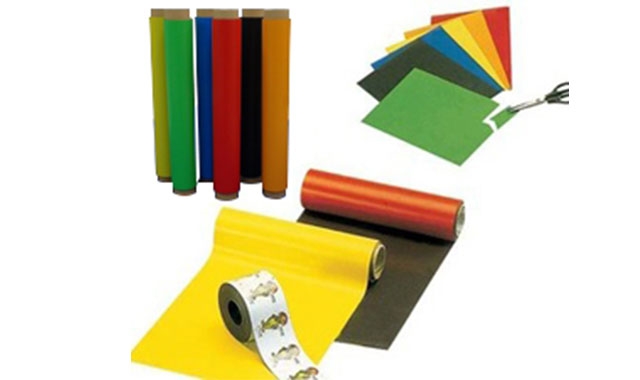
A flexible magnetic sheet is a composite material, not a solid magnet in the way most people picture one. Manufacturers blend ferrite powder (finely ground magnetic mineral) into a rubber or vinyl polymer binder, then run the mixture through calendering rollers to form a continuous sheet. The sheet is passed over a magnetizing head that imprints a multi-pole pattern across one face, while the reverse side stays non-magnetic and can be laminated with a printable vinyl surface, a color coating, or a pressure-sensitive adhesive layer. This is what allows a single roll of material to be sold as plain rubber magnet sheet, white vinyl magnetic sheet, colored magnetic sheets, or self adhesive magnetic sheet with adhesive, depending on which face treatment is applied.
Two build formats cover most POS and signage use cases. The first is a plain or printable magnetic sheet that attaches directly to an existing steel surface, such as a metal shelf upright, a gondola end, or a steel display frame. The second is a self adhesive magnetic sheet, where a pressure-sensitive adhesive coats the non-magnetic side so the sheet can first be stuck to a non-metal surface, like a wooden fixture, an acrylic panel, or a printed foam board, effectively converting that surface into something a separate magnet can hold to. A related product, often called ferrous or steel receptive sheet, works in the opposite direction: a thin, magnetically receptive (but not itself magnetic) sheet is applied to walls, doors, or display panels so that lightweight magnetic signage or graphics can be attached anywhere, not just on existing metal.
Print compatibility is where the product line branches further. Magnetic printable paper and inkjet magnetic sheets are designed to run through desktop inkjet printers for short-run signs, price cards, and shelf tags produced on demand at store or head-office level. Larger format jobs, such as window graphics or endcap headers, typically use offset or solvent inkjet printable magnetic sheet stock that goes through commercial print equipment, then gets laminated and die-cut to size. Color magnetic sheets, meanwhile, are used less for printed graphics and more for coded merchandising systems, such as category labeling, pricing tiers, or planogram markers that staff can read and reposition at a glance.
Choosing the Right Magnetic Sheet for a Retail Display Program
Specifying magnetic sheet for a retail rollout involves more than picking a size. Three variables tend to decide whether a display program performs well over a full promotional cycle: thickness, adhesive type, and environmental exposure.
Thickness affects both pull strength and flexibility, and the right choice depends on what the sheet needs to hold and where.
| Thickness range | Typical characteristics | Common retail use |
| 0.4mm to 0.5mm | Highly flexible, lower pull force | Lightweight paper signage, printable magnetic paper, indoor shelf tags |
| 0.6mm to 0.8mm | Balanced flexibility and hold, industry-standard for most signage | Window graphics, endcap headers, laminated POS cards |
| 1.0mm to 2.0mm | Higher pull force, less conformable, more durable | Heavier display panels, outdoor-facing signage, high-traffic fixtures |
For self-adhesive builds, the adhesive layer matters as much as the magnet itself. Standard acrylic pressure-sensitive adhesive suits smooth, clean, indoor substrates such as laminated board, acrylic, or painted metal, and it needs a firm initial press and several days to reach full bond strength. Foam-backed adhesive variants conform better to slightly uneven or textured surfaces and generally hold longer under repeated handling. Buyers running seasonal programs should also confirm the sheet's rated service life: adhesive-backed magnetic material is a consumable, not a permanent fixture, and film-backed adhesives are typically rated for shorter service periods than foam-backed versions, which matters when planning how many reset cycles a given batch of signage needs to survive.
Weather and temperature exposure is the third factor, and it is frequently underspecified. Flexible magnetic sheet is generally rated for continuous use between roughly -20°C and 70°C, with magnetic performance degrading if the material is repeatedly exposed to heat above that range, such as direct sun behind glass or proximity to heating elements in a storefront window. For any signage facing outdoor conditions, an entrance vestibule, or a window display that gets direct sunlight for part of the day, it is worth confirming both the base material's temperature rating and the adhesive's UV resistance separately, since the two components can degrade at different rates.
A short pre-purchase checklist covers most practical decisions:
- Confirm the mounting surface: existing steel fixture, or a surface that needs a receptive sheet or adhesive backing first
- Match thickness to the weight and size of the graphic or display component being held
- Choose adhesive type based on substrate texture and expected reset frequency
- Verify the sheet's print method compatibility (inkjet, offset, or solvent print) against the in-house or vendor printing equipment
- Check temperature and UV exposure at the installation site against the manufacturer's rated range
Frequently Asked Questions
Q: Does magnetic signage damage store walls, fixtures, or paint when it is removed?
A: No, provided the mounting surface is steel or a properly applied receptive sheet. Because the sheet holds through magnetic attraction rather than adhesive contact with the wall itself, it lifts off cleanly. The exception is self-adhesive magnetic sheet applied directly to a non-metal surface: in that case, the adhesive layer (not the magnet) is what contacts the fixture, so surface compatibility and adhesive strength should be checked before a large rollout.
Q: Can magnetic sheets be printed in-house for quick turnaround signage?
A: Yes. Magnetic printable paper and inkjet magnetic sheets are designed for standard desktop inkjet printers, which lets store operations or marketing teams produce price cards, shelf tags, and small signs on demand. Laser printers are generally not compatible, since the heat involved in laser printing can distort the magnetic layer. Larger graphics, such as window clings or endcap headers, are usually produced on offset or solvent inkjet equipment at a converter and then shipped pre-cut to stores.
Q: How often does magnetic POS signage need to be replaced?
A: It depends on the adhesive type, thickness, and exposure conditions rather than a fixed interval. Plain magnetic sheet on a steel fixture has no adhesive to degrade and can be reused indefinitely as long as the magnetic layer itself is not damaged. Self-adhesive versions have a rated service life tied to the adhesive formulation, typically shorter for film-backed adhesive and longer for foam-backed adhesive, and that life shortens further with heat, UV exposure, or frequent repositioning.
Conclusion
Magnetic sheet has moved from a niche fixing method to a standard part of how retailers plan changeable POS displays and signage, largely because it solves a scheduling problem as much as a materials problem: campaigns change faster than fixtures can reasonably be rebuilt. Getting a good result still depends on ordinary specification discipline. Matching sheet thickness to the weight of what is being displayed, choosing an adhesive suited to the mounting surface and reset frequency, and checking the material's temperature and UV rating against where it will actually be installed are the decisions that separate signage that survives a full promotional season from signage that curls, loses hold, or needs early replacement. Because the underlying material, ferrite powder bound into a flexible polymer, is common across plain rolls, self-adhesive sheet, and printable stock, most of that specification work can be done once and reused across a retailer's full range of display formats.
JASDI MAGNET produces flexible magnetic sheet materials for retail and signage use, with a product line that includes plain flexible magnets, self-adhesive magnetic sheet, color magnetic sheet, and inkjet-printable magnetic paper, covering the plain, adhesive-backed, and printable formats a retail POS and signage program typically needs to specify.


(4059)(20260924)(原).jpg)
(2367)(20260924)(原).jpg)