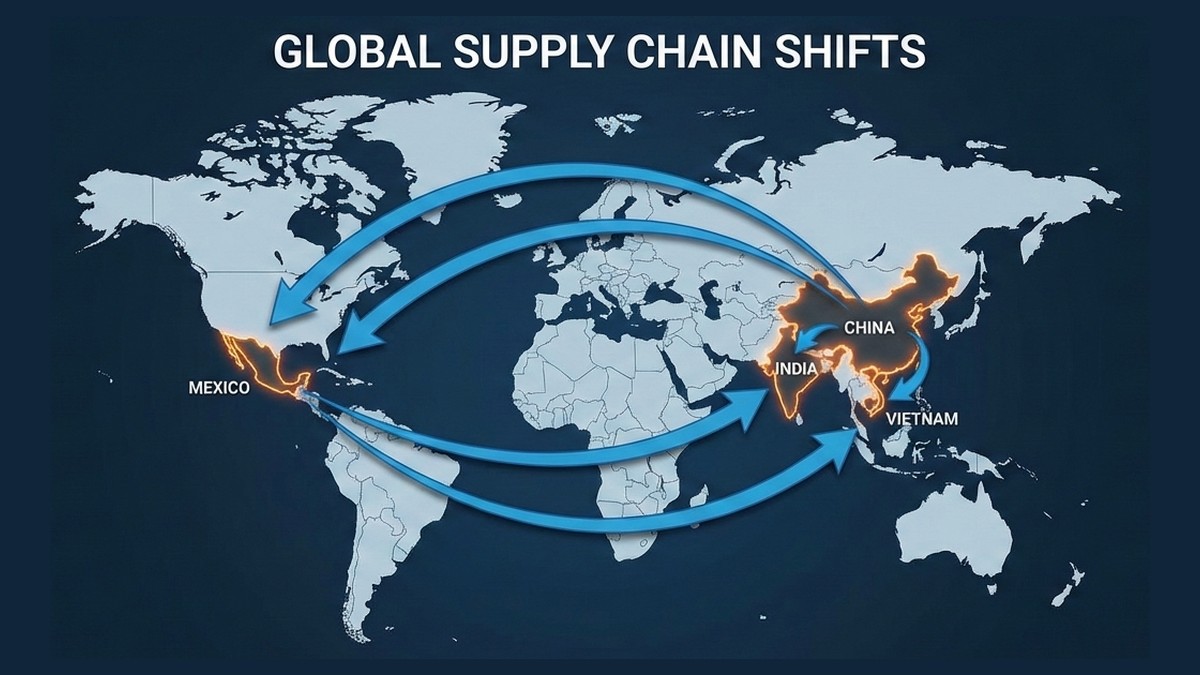
The global factory index climbed to a three-month high in August, but the gains were uneven: Europe accelerated, US demand cooled, China stayed just below the growth line, and input prices remained high almost everywhere.
The latest purchasing managers' surveys give buyers and manufacturers a fairly clear picture of where factory activity stands heading into the fourth quarter of 2026. Worldwide, manufacturing is still growing. The J.P.Morgan Global Manufacturing PMI, compiled by S&P Global, rose to 52.3 in August from 52.1 in July, a three-month high and the thirteenth consecutive month above the 50.0 line that separates expansion from contraction.
The headline, however, hides very different regional stories, and the price signals matter as much as the growth signals for anyone planning Q4 purchasing.
The Global Picture: Broad-Based but Uneven Growth
According to the summary of August results published by the UK's Manufacturing Technologies Association (MTA), all five components of the global PMI pointed to improving conditions. Output, new orders and employment increased, stocks of purchases rose, and suppliers' delivery times lengthened. Production grew in consumer, intermediate and investment goods, though growth in the last two slowed.
That is a stronger reading than in early summer. In June, S&P Global reported that the global PMI had slipped to 52.2 from a 50-month high of 52.7 in May, with output and new orders growth easing, employment falling for the third time in four months and business optimism at an eight-month low. At the time, some firms said a boost from customers stockpiling to guard against supply disruption was starting to fade. August's rebound suggests that concern did not turn into a broader slowdown, at least not yet.
One detail from the June release still matters: S&P Global noted that supplier lead times were lengthening to one of the greatest extents in four years, and J.P.Morgan's economist observed that input and output price indices, although easing at the time, remained well above their pre-conflict levels.
Europe: The Strongest Momentum in Years
The biggest positive surprise came from the euro area. MTA's summary reports that the eurozone manufacturing PMI rose from 51.9 to 52.7 in August, its highest reading since May 2022. Germany recorded its strongest manufacturing growth in more than four years, and France also contributed to the upturn. The picture was not uniform: Italy fell back into contraction and Spain also remained below 50.
The UK stayed in expansion at 51.7, down slightly from 51.9, its tenth consecutive month above 50. UK output grew for a fifth month, with both domestic and overseas demand improving, although stocks of purchases fell for a third month.
For suppliers selling into Europe, the German reading is the one to watch over the next few months, since it will show whether the upturn is broad enough to reach component and material orders.
United States: Still Growing, Losing Some Momentum
US factory activity remains solidly in expansion, but several indicators softened. The Institute for Supply Management (ISM) reported that its Manufacturing PMI registered 54.6 in August, down 1 point from 55.6 in July and the eighth consecutive month of expansion.
The details show where momentum slowed:
| ISM index | July 2026 | August 2026 |
| Manufacturing PMI | 55.6 | 54.6 |
| New Orders | 56.7 | 53.7 |
| Production | 58.5 | 58.3 |
| Backlog of Orders | 55.0 | 51.8 |
| Employment | 52.8 | 51.2 |
| Prices | 71.1 | 71.1 |
| Supplier Deliveries | 58.9 | 59.3 |
| Imports | 55.7 | 52.5 |
ISM's committee chair Susan Spence noted that manufacturing "has lost ground in a number of key measures," pointing to new orders, backlogs and imports. Production stayed strong, but the drop in new orders and backlogs suggests less work in the pipeline for the months ahead.
Two readings stand out for international suppliers. The Prices Index held at 71.1, meaning a large majority of US manufacturers are still paying more for inputs. And the Imports Index fell 3.2 points to 52.5, still growing but more slowly, a signal that US purchasing from overseas may be moderating after a strong summer.
China: Just Below the Line, With Costs Rising
China's official data from the National Bureau of Statistics (NBS), as reported by CGTN, showed the manufacturing PMI rising to 49.8% in August from 49.2% in July. The headline stayed in contraction, but the underlying components improved: the production index rose to 50.4% and new orders to 50.6%, both returning to expansion. Purchasing volume rose 1.1 points to 50.5%, and the PMI for large enterprises returned to expansion at 50.6%.
Equipment manufacturing and high-tech manufacturing were stronger than the overall index, at 51.4% and 52.9% respectively.
The price components are the more immediate concern for buyers. NBS attributed a jump in input costs to recent increases in crude oil and non-ferrous metal prices: the purchase price index for major raw materials rose 3.4 points to 56.6%, and the ex-factory price index rose 2.6 points to 50.4%. A rising ex-factory price index suggests that some producers are already passing part of those costs on to customers.
Elsewhere in Asia, MTA's summary notes that most major economies remained in expansion in August, but growth slowed in India, South Korea, Taiwan and ASEAN.
What This Means for Q4 Sourcing
Taken together, the August data point to three practical conclusions for buyers and manufacturers planning the final quarter:
Demand is holding up, but the leadership is shifting. Europe is gaining momentum while US order growth cools. Suppliers with exposure to both markets may see their order mix change even if total volume holds steady.
Cost pressure has not gone away. The US Prices Index at 71.1 and China's jump in raw material and ex-factory prices both point to higher quotations. Buyers negotiating Q4 or 2027 contracts should expect suppliers to cite input costs, and should ask for cost breakdowns that separate materials, energy and freight.
Lead times remain stretched. Supplier deliveries continued to slow in both the global and US surveys. Buyers relying on just-in-time replenishment for Q4 peaks should confirm delivery dates early.
FAQ
Q: What does a PMI above 50 actually mean?
A: A PMI is a diffusion index built from monthly surveys of purchasing managers. S&P Global's methodology describes the headline as a weighted average of new orders, output, employment, suppliers' delivery times and stocks of purchases. A reading above 50 indicates an overall improvement compared with the previous month, and below 50 a deterioration.
Q: Why do China's official PMI and the S&P Global China PMI sometimes differ?
A: They are compiled by different organizations from different company panels, so they can diverge from month to month. It is usually more useful to follow the direction of each series over time than to compare their levels directly.
Q: Should buyers lock in prices now?
A: That depends on the category. Where input costs are tied to oil, metals, or other commodities that have been rising, earlier contracts can reduce exposure. Where supply is ample, waiting may be reasonable. The PMI data suggest cost pressure is broad, which tilts the balance toward earlier negotiation for many materials.
Conclusion
Global manufacturing enters Q4 2026 in better shape than many expected in early summer. The world index is at a three-month high, Europe is recording its strongest growth in years, and even China's components improved despite a headline below 50. The softer US new orders data and persistently high input prices are the main reasons for caution.
For buyers, the priority is not predicting the next PMI reading but preparing for elevated costs and longer lead times while demand remains firm. The September surveys, due in early October, will show whether Europe's acceleration and the US slowdown continue.