How AI, Automation, and Integrated Production Solutions Are Reshaping Manufacturing from 2026 to 2028
Why IMTS 2026 Matters Beyond the Exhibition Floor
IMTS 2026 will take place at McCormick Place in Chicago from September 14–19, 2026, under the theme “Achieve the Impossible.” The show is expected to cover more than 1.2 million square feet, attract approximately 90,000 visitors, and bring together more than 2,000 exhibitors and over 3,000 conference registrants.[1] Those numbers make IMTS more than a product showcase: it is a useful meeting point for understanding where capital investment, factory technology, and manufacturing strategy are converging.
The most important question for visitors is not simply, “Which machine is faster?” It is, “Which combination of machine, automation, software, process knowledge, and service can make production more resilient?” That distinction matters because the next three years are unlikely to reward isolated equipment purchases. From 2026 through 2028, manufacturers will be pressured to produce more complex parts, respond to shorter lead times, manage skilled-labor shortages, and protect operations from supply-chain and cyber risks. IMTS 2026 offers a timely lens through which to evaluate that shift.
Working thesis: The machine tool market is moving from selling precision assets to delivering measurable production capability—capacity, uptime, traceability, flexibility, and faster learning.
The Market Signal: Recovery, but Not a Return to the Old Cycle
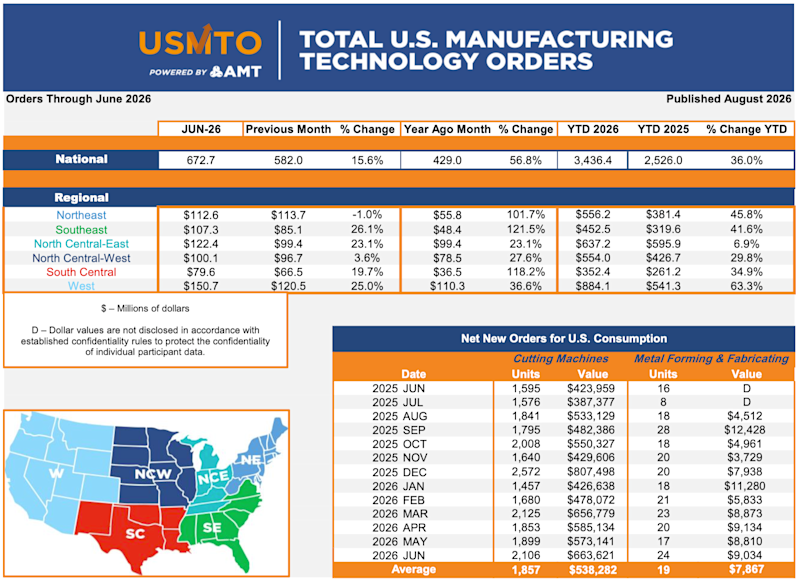
Recent U.S. data points to a meaningful recovery in manufacturing technology investment. AMT’s United States Manufacturing Technology Orders report recorded $3.44 billion in orders during the first half of 2026, up 36.0% from the first half of 2025 and the strongest half-year value since the series began in 1998.[2] June alone reached $672.7 million, 56.8% above June 2025.[2]
However, the number of machines ordered was 2.6% lower than in the second half of 2025.[2] This divergence between order value and unit volume is strategically important. It suggests that spending is shifting toward higher-value systems, automation, specialized aerospace capacity, integrated production cells, and digitally enabled equipment rather than simply increasing the number of standalone machines.
The recovery is also uneven across regions and sectors. AMT reported record first-half aerospace orders in the United States, while power-generation and distribution manufacturers accelerated investment in response to rising energy demand from AI infrastructure.[2] At the same time, CECIMO reported that European machine-tool production declined 9.2% in 2024 and cited a further estimated decline of approximately 8.6% in 2025.[3] The implication for 2026–2028 is not a uniformly expanding market. It is a selective investment cycle in which aerospace, defense, semiconductors, energy, medical, and high-mix subcontracting may move faster than general industrial demand.
| Market signal |
What it suggests for 2026–2028 |
What to examine at IMTS 2026 |
| U.S. order value is rising faster than unit volume |
Buyers are favoring capability-rich, automated, or specialized systems |
Total cost per productive hour, not only machine price |
| Aerospace and defense capacity is expanding |
Complex materials, traceability, and process stability will remain priorities |
Five-axis machining, in-process measurement, automation, and digital records |
| AI infrastructure is increasing power demand |
Energy equipment and semiconductor-related manufacturing may support capital spending |
High-efficiency machining, thermal stability, and unattended production |
| European demand remains weaker and uneven |
Manufacturers must manage regional cycles and protect cash flow |
Modular upgrades, serviceability, retrofit paths, and flexible deployment |
| Skilled labor remains scarce |
Automation must augment workers rather than create another integration burden |
Ease of programming, training, diagnostics, and human-machine workflows |
Five Trends Likely to Shape the Machine Tool Industry Through 2028
1. AI Will Move from Demonstrations Toward Bounded, Auditable Decisions
The headline at IMTS 2026 is likely to be AI, but the valuable use cases will be narrower and more operational than generic claims about autonomous factories. The new Industrial AI Arena is explicitly organized around applications such as quality and inspection, process optimization, downtime reduction, cybersecurity, ergonomics, safety, and demand forecasting.[4] These are practical problems with measurable outcomes.
Deloitte’s 2026 manufacturing outlook found that 80% of surveyed manufacturing executives planned to allocate at least 20% of their improvement budgets to smart-manufacturing initiatives, including automation hardware, analytics, sensors, and cloud computing.[5] The next step is to connect those investments to controlled workflows: predicting tool wear, generating shift handovers, identifying abnormal spindle behavior, recommending process changes, or surfacing the likely cause of a quality deviation.
For 2026–2028, the competitive question will be whether an AI feature is trusted and integrated. Buyers should ask what data the system uses, how it handles incomplete or noisy data, how recommendations are validated, and whether operators can audit or override the result. AI that cannot be connected to the machine, MES, quality system, and maintenance workflow will remain a pilot rather than a production capability.
2. Automation Will Become More Flexible, Modular, and Labor-Aware
Automation is no longer limited to large-volume automotive lines. The International Federation of Robotics reported that industrial-robot installations in the United States rose 11% year over year to 38,000 units in 2025. Automotive remained the largest adopter, while food-sector installations increased 30%, illustrating the expansion of automation into more varied production environments.[6]
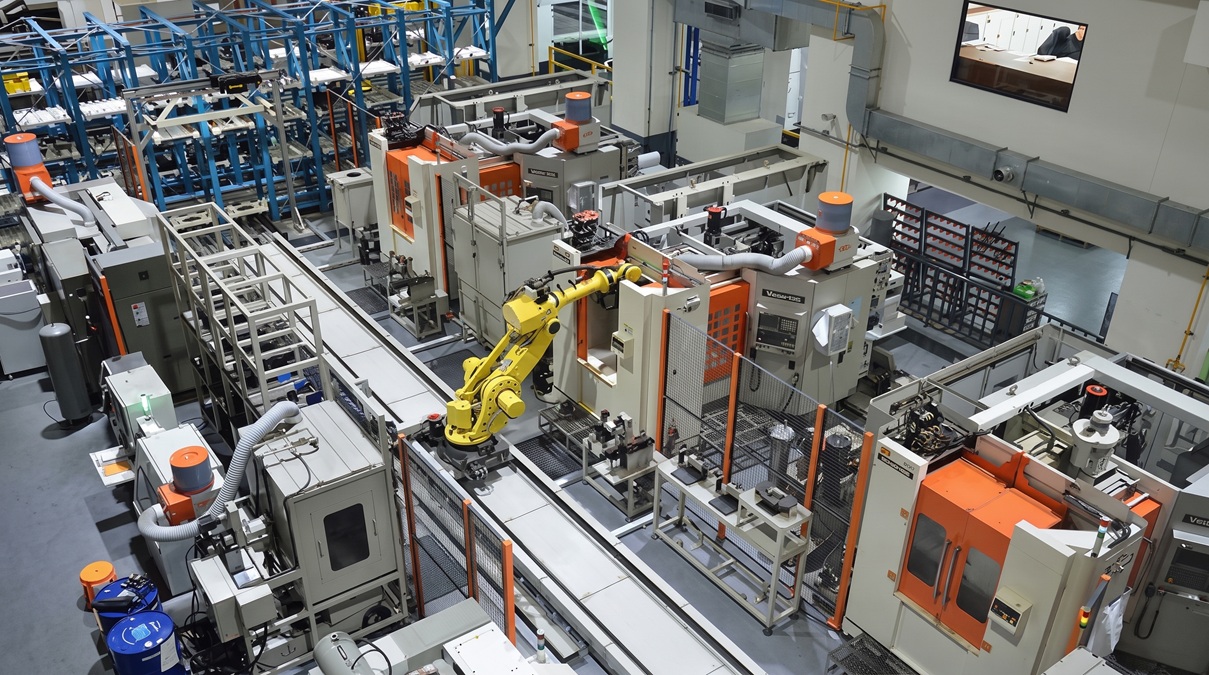
This supports a broader machine-tool trend: flexible automation for high-mix, lower-volume production. Expect stronger interest in machine tending, pallet systems, tool management, robot programming offline, vision, probing, and coordinated scheduling. The best systems will not merely reduce direct labor; they will make the available workforce more productive by reducing repetitive handling, simplifying setup, and turning experienced operators’ knowledge into reusable process instructions.
IMTS’s automation sector reflects this convergence. It includes robotics, embedded sensors, integrated subtractive/additive/hybrid packages, metrology, digital twins, simulation, AI and machine-learning data companies, SCADA, and MES/ERP integration.[4] That combination is a sign that automation is being evaluated as a production architecture rather than as a robot purchased beside a machine.
3. Connectivity and Digital Twins Will Become Prerequisites for Scale
Connectivity will become less visible as a marketing differentiator and more important as an operating requirement. IMTS identifies MTConnect, machine interconnectivity, CAD/CAM, CNC controls, automation management, communications, and systems integration as parts of the connected digital enterprise.[4]
From 2026 to 2028, a digital twin should be understood pragmatically: a usable model of equipment, process, material, and production status that supports a decision. The immediate value may come from simulation before a new cell is installed, virtual commissioning, production scheduling, energy monitoring, tool-life analysis, or faster troubleshooting. The risk is building a “data lake” without a decision process attached to it.
Manufacturers should therefore evaluate interoperability, data ownership, cybersecurity, time synchronization, and the availability of usable APIs. A machine that produces excellent parts but cannot provide reliable operational data may remain productive in isolation while limiting the factory’s ability to improve as a system.
4. Quality Will Move Closer to the Cutting Process
Quality assurance is becoming a continuous process rather than a final gate. IMTS’s Quality Assurance sector highlights in-process gauging, automated gauging, tool-condition monitoring, measurement software, vision systems, and inspection capabilities designed to reduce dependence on standalone work cells.[4]
This matters for aerospace, medical, semiconductor, energy, and other sectors in which scrap, rework, and delayed inspection can erase the value of faster cutting. Through 2028, manufacturers will increasingly combine probing, vision, metrology, tool monitoring, and process data to shorten feedback loops. The objective is not to eliminate independent quality teams; it is to detect variation early enough that quality specialists can solve systemic problems rather than sort finished parts.
5. Resilience, Cybersecurity, and Workforce Capability Will Determine Adoption
The connected factory creates new exposure. RSM’s 2026 manufacturing outlook identifies AI-enabled operations, cybersecurity, supply-chain redesign, workforce capability, and cost of capital as interdependent issues.[7] A machine-tool investment that improves throughput but increases cyber risk or depends on scarce programming expertise may not improve resilience in practice.
This is why the 2026–2028 buying process will increasingly include IT/OT security, supplier support, training, spare-parts availability, retrofit options, and lifecycle service. The winning supplier is likely to be the one that can demonstrate a credible path from installation to stable production—not only an impressive demo during an exhibition.
Three Taiwanese Machine-Tool Companies Worth Watching
The following companies are included as industry examples, not as claims that they are official physical exhibitors at IMTS 2026. A review of the public IMTS directory on August 21, 2026 did not return exact indexed matches for “Victor Taichung,” “YCM,” or “Tongtai.” Directory records can change, and participation through a group company, local representative, or later update remains possible. Readers should verify current listings directly before planning meetings.
Victor Taichung: Vertical Integration as a Resilience Strategy
Victor Taichung presents a model centered on vertical integration, customization, precision casting, smart machining, in-house key-component production, digital sheet-metal spraying, and smart assembly.[8] Its portfolio includes multi-tasking turning centers, five-axis machining centers, CNC turning lathes, machining centers, and wheel-machining or turnkey solutions.[8]
The strategic relevance is broader than the product list. In a market where lead time, quality consistency, and service responsiveness matter as much as nominal specifications, control over critical components and assembly can support customization and lifecycle support. Victor Taichung also identifies semiconductor, new-energy, aerospace, medical, and transportation applications, which align with several of the demand pockets visible in current manufacturing investment data.[8] For buyers, the questions to ask are how vertical integration affects delivery, service parts, machine configuration, and the ability to tailor a cell for a specific process.
YCM: Connecting Machine Platforms to Plant-Level Productivity
YCM’s portfolio covers vertical, double-column, and horizontal machining centers, CNC turning centers, and five-axis machining centers.[9] More important for the next cycle is its stated total-solutions approach: engineering support, CPK analysis, plant-layout recommendations, automation, fixture design, ERP and performance enhancement, and the i-Direct IoT production-line monitoring system.[9]
That positioning matches the industry’s move toward measurable production outcomes. For a high-mix manufacturer, the business case may depend less on peak spindle speed than on setup repeatability, qualification time, utilization, and the ability to see production status across a line. YCM’s example is useful for evaluating whether a machine supplier can participate in the engineering and data layers around the equipment, not merely quote a machine model.
Tongtai: A Bridge Between Machine Tools, Electronics, and Additive Production
Tongtai describes itself as a provider of machine, production-line, and turnkey factory solutions, with a portfolio spanning CNC lathes, machining centers, five-axis and multi-tasking centers, ultrasonic-assisted machining, PCB and electronics-processing equipment, laser equipment, wafer grinding, and metal powder-bed-fusion additive manufacturing.[10]
This breadth is relevant to a market shaped by electronics, semiconductor, aerospace, and high-mix production. Tongtai’s technology pages emphasize smart manufacturing, turnkey solutions, automation, and machining solutions for high-mix/low-volume, high-precision, just-in-time environments.[10] It also provides a useful reminder that the machine-tool industry is converging with adjacent process technologies. By 2028, suppliers that can combine subtractive machining with electronics processing, laser, additive, inspection, and factory integration may be better positioned for customers whose production requirements do not fit one traditional machine category.
How Visitors Should Read IMTS 2026
The most productive IMTS visit will begin with a manufacturing problem rather than a list of brands. A buyer evaluating a new machining center should document the parts, materials, tolerances, annual volume, changeover frequency, available labor, current bottleneck, quality failure modes, and data systems before arriving. That preparation makes it easier to compare complete solutions.
| Before the show |
Questions to ask at the show |
Evidence to request afterward |
| Define the bottleneck and target outcome |
What measurable constraint does this solution remove? |
Application study using comparable material, geometry, and volume |
| Map current data flows |
Which standards and APIs are supported? |
Data dictionary, integration architecture, and cybersecurity responsibilities |
| Quantify labor and setup effort |
How much programming, fixturing, and operator intervention is required? |
Training plan, cycle-time assumptions, and changeover demonstration |
| Identify quality risks |
Where is measurement performed and how quickly does feedback reach the process? |
Gauge capability, traceability, and process-control records |
| Model lifecycle cost |
What happens after installation, failure, or product change? |
Service-level terms, spare-parts plan, retrofit path, and total-cost model |
Conclusion: “Achieve the Impossible” Needs an Operating Model
IMTS 2026 arrives during a selective recovery rather than a simple boom. U.S. order values are strong, but regional conditions remain uneven; aerospace, energy, semiconductor, and advanced production applications are attracting investment, while manufacturers still face labor, financing, geopolitical, and cybersecurity constraints.[2][3][5][7]
The central opportunity from 2026 to 2028 is therefore not to automate for its own sake. It is to build production systems that learn faster, recover sooner, use skilled people better, and provide evidence for every important decision. AI, robotics, digital twins, in-process quality, and connected machine tools are the components. Integration, governance, service, and workforce development are what turn those components into manufacturing capability.
That is the standard against which IMTS 2026 should be judged. The most consequential exhibit may not be the machine with the most dramatic specification. It may be the solution that can prove, with credible data and a realistic implementation path, how a manufacturer will produce the next difficult part more reliably than it produces today.