From AI-driven production to supply chain diversification, here is what B2B buyers and procurement teams need to track through the second half of 2026.
Market Context: Where Global Manufacturing Stands at Mid-2026
The global manufacturing market is estimated at USD 15.6 trillion in 2026 and projected to reach USD 22.11 trillion by 2033 at a compound annual growth rate of 5.1%, according to a 2026 market estimate from Coherent Market Insights. Entering Q3, the sector is navigating a combination of structural tailwinds, including AI investment and energy-transition hardware demand, alongside persistent headwinds such as tariff uncertainty, raw-material price volatility, and geopolitical disruptions to logistics networks.
The same market estimate places Asia Pacific at 42.7% of the global manufacturing market in 2026 and identifies North America as the fastest-growing major region. In the United States, policy support under the CHIPS and Science Act, the Inflation Reduction Act, and the Bipartisan Infrastructure Law is helping shape investment in semiconductors, batteries, and clean-energy infrastructure. The scale and timing of individual projects still vary, so buyers should distinguish announced incentives from operating capacity.
For B2B buyers operating across international supply chains, the practical implication is a more complex procurement landscape: multiple competing sourcing geographies, evolving compliance and certification requirements, and faster technology obsolescence cycles in key component categories.
Trend 1: Supply Chain Diversification Continues, but China Remains Central
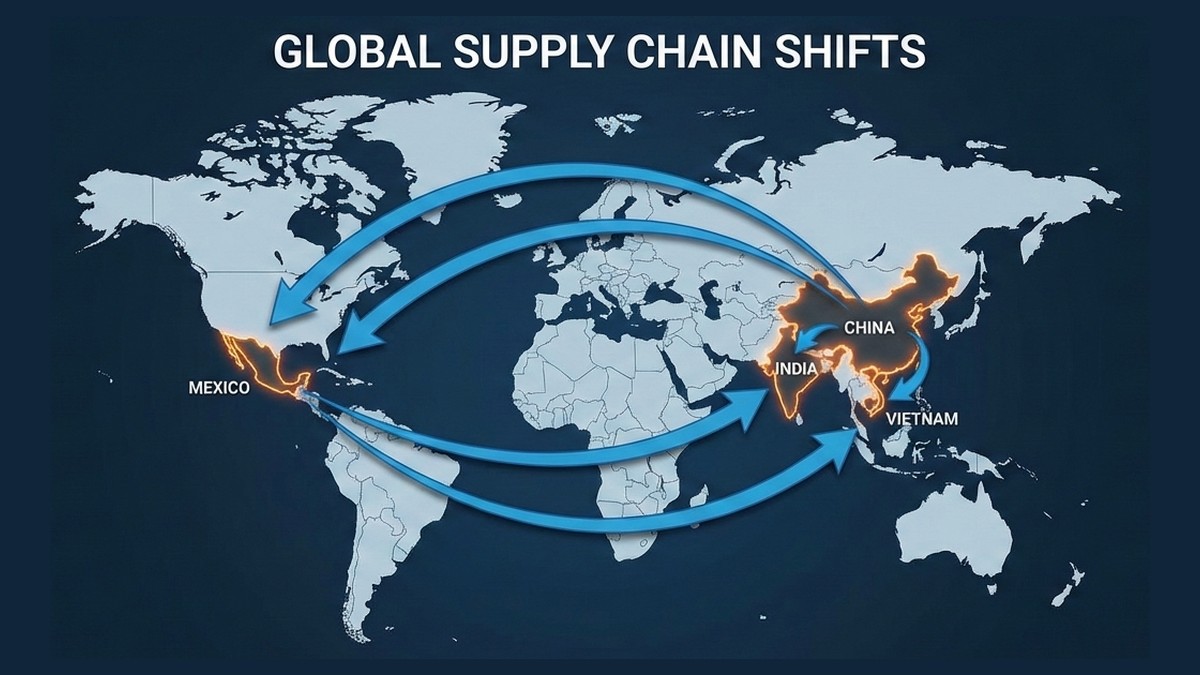
One of the most discussed dynamics heading into Q3 2026 is supply chain diversification. Current manufacturing outlooks point more often to selective dual-sourcing and regional capacity building than to a complete break with China. Manufacturers may add capacity or qualified suppliers in markets such as Vietnam, India, Mexico, or Eastern Europe while retaining established China-based supply chains where cost, scale, or supplier capability remains difficult to replace.
The strategic logic is resilience rather than automatic replacement. Additional regional capacity can reduce single-source concentration risk, but the business case depends on yield, qualification time, logistics, labor, tariffs, and total landed cost. The practical result is a more segmented sourcing map, not a universal exit from China manufacturing.
For procurement teams, this creates both opportunity and complexity. Supplier bases in multiple geographies need simultaneous qualification, quality management systems must accommodate different regulatory environments, and logistics costs for diversified supply chains can be higher than in optimized single-source models. Common responses include investing in supply chain visibility tools that provide tracking across multiple tiers and supplier locations.
Trend 2: AI-Driven Production Investment Accelerates
Manufacturing digitalization is no longer limited to ERP and MES deployment. Current 2026 outlooks also emphasize AI-enabled applications such as computer-vision inspection, predictive maintenance, process analytics, and more autonomous materials handling using AMRs and collaborative robots.
Deloitte's 2026 Manufacturing Industry Outlook cites a 2025 survey of 600 manufacturing executives in which 80% said they planned to allocate at least 20% of their improvement budgets to smart-manufacturing initiatives. The survey is focused on manufacturing executives rather than the entire global manufacturing population, but it supports the broader direction of investment in automation hardware, data analytics, sensors, cloud tools, and AI-enabled operations.
Applications likely to attract continued AI-enabled manufacturing investment include EV batteries, data-center and AI-server infrastructure, renewable-energy equipment, and semiconductor manufacturing. These areas combine complex production processes with strong demand for inspection, traceability, process control, and higher equipment utilization, although investment levels remain company- and region-specific.
Trend 3: Tariff Volatility Continues to Drive Procurement Risk Management
Trade policy uncertainty remains a defining operational reality for global manufacturing procurement in 2026. The possibility of changing tariff rates and trade agreements has encouraged procurement teams to use dynamic cost models that account for scenario variation rather than relying only on fixed landed-cost assumptions.
The exposure is not uniform across sectors. Electronics, machinery, chemicals, apparel, and other globally traded categories can face different combinations of tariff, origin, raw-material, and compliance risk. The relevant impact depends on the product classification, origin rules, destination market, and contract terms, so procurement teams should validate assumptions at the SKU and shipment level.
Common responses among B2B procurement organizations include developing broader qualified-vendor lists, negotiating supply agreements with tariff-adjustment provisions, and accelerating supplier-diversity programs that reduce single-country concentration risk.
Trend 4: Sustainability Compliance Becomes a Procurement Gate
Environmental and sustainability compliance has transitioned from a corporate responsibility initiative to an operational procurement gate in multiple industry sectors. In Q3 2026, key compliance frameworks shaping B2B procurement decisions are summarized below.
| Framework | Applies To |
| REACH and RoHS | Product- and substance-related requirements affecting chemicals, electronics, and other goods placed on applicable markets |
| ZDHC MRSL | Restricted-substance requirements for chemical inputs used in textile, leather, and footwear supply chains |
| EU CSRD | Sustainability reporting for companies within scope; suppliers may be asked to provide value-chain data |
| ISO 14064 | Greenhouse-gas quantification, reporting, and verification rather than a general product certification |
Procurement teams are increasingly required to obtain compliance documentation from suppliers as part of vendor qualification, not just at initial onboarding but on an ongoing audit basis. Suppliers who cannot provide current compliance documentation may face delayed qualification, additional audits, or suspension from approved-vendor lists, regardless of price competitiveness.
For manufacturers in Asia, maintaining current compliance certifications for multiple market requirements is a growing administrative and engineering burden. However, it is also a competitive differentiator: suppliers who proactively maintain multi-market compliance documentation can move faster through buyer qualification cycles and reduce the administrative friction that slows new supply relationships.
FAQ
Q: Which manufacturing sectors are seeing the strongest demand growth entering Q3 2026?
A: The strongest investment themes identified in the cited 2026 outlooks include AI-enabled production, semiconductor and data-center infrastructure, EV and battery manufacturing, renewable-energy equipment, and industrial automation. This is a directional view rather than a universal ranking: actual demand varies by geography, end market, inventory position, and project pipeline.
Q: How should B2B procurement teams respond to tariff uncertainty in their supplier contracts?
A: The most effective responses include negotiating tariff adjustment clauses that allow landed cost recalculation if applicable tariff rates change beyond a defined threshold, qualifying at least two suppliers per critical component category from different source countries, and building scenario-based cost models that show procurement cost impact under different tariff rate assumptions. Some procurement organizations are also using hedging instruments for commodity raw material inputs, though this requires specialized treasury capability and is most practical for organizations with large and predictable commodity volumes.
Conclusion
Q3 2026 opens with global manufacturing at an inflection point: significant new investment is flowing into AI-enabled production and clean energy hardware, while supply chain complexity, tariff volatility, and sustainability compliance requirements continue to raise the operational bar for both suppliers and buyers. For B2B procurement teams, the organizations most effectively navigating this environment are those that have invested in supplier diversification, digital supply chain visibility tools, and proactive compliance management rather than treating these as cost centers. The second half of 2026 will likely separate procurement organizations with dynamic, data-driven supplier strategies from those still operating on pre-disruption assumptions about supply chain stability.