What New Bellus’s Heri-Mycelium HE12 and NDIN No. 1422 mean for ingredient consistency, safety documentation, and supplement sourcing
Why Documentation Matters More When Buying Ingredients
Competition in the mushroom ingredient market is growing. For supplement brands, distributors, and contract manufacturers, the question is no longer simply whether a formula contains lion’s mane.
Buyers also want to know what the ingredient is, how consistently it is made, what supports its safety, and whether it can be used in the markets they serve.
That is why regulatory and quality documents now play a bigger role in ingredient sourcing. One example is the U.S. Food and Drug Administration’s New Dietary Ingredient (NDI) notification process. For a new dietary ingredient, a manufacturer or distributor must submit the information behind its conclusion that the ingredient can reasonably be expected to be safe under the proposed conditions of use.
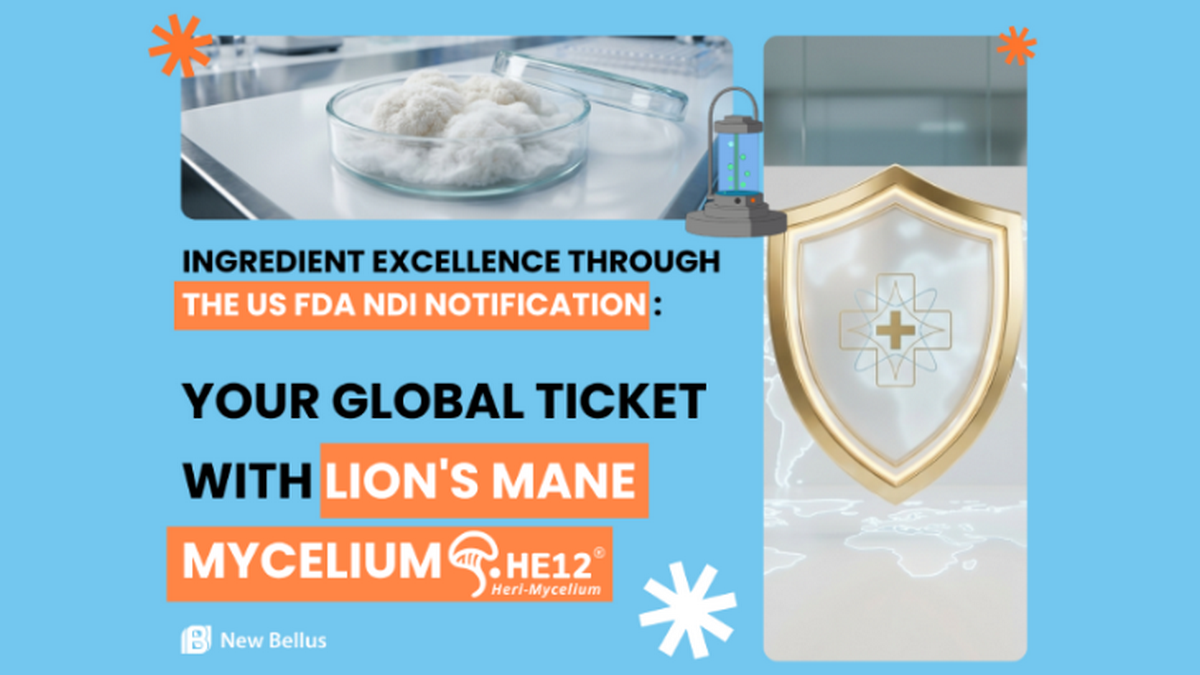
The FDA’s public list includes Heri-Mycelium HE12, submitted by NEW BELLUS ENTERPRISES CO., LTD., as New Dietary Ingredient Notification No. 1422. The record shows a submission date of July 18, 2025, and an FDA response date of September 26, 2025.
For B2B buyers, the listing provides a clear reference point when they review a potential supply partner. It is an important milestone, but the wording matters. An NDI notification is a premarket safety notification. It is not FDA approval of a finished product, and it does not make an ingredient “FDA-certified.”
What an NDI Notification Actually Means
Under U.S. dietary supplement law, an ingredient that was not marketed in the United States before October 15, 1994, may be considered a new dietary ingredient. Unless an exception applies, the manufacturer or distributor must notify the FDA at least 75 days before introducing a dietary supplement containing the NDI into interstate commerce.
The filing must explain why the manufacturer or distributor reasonably expects the ingredient to be safe under the recommended or suggested conditions of use. Depending on the ingredient, the supporting package may include information on identity, manufacturing, specifications, history of use, toxicology, and other safety data.
An NDI filing is not the same as a manufacturing-facility registration. A facility registration only shows that an establishment is registered with the FDA. It does not mean the FDA has reviewed every ingredient made there for safety. “FDA registered,” “FDA reviewed,” “NDI notification,” and “FDA approved” are different claims.
The FDA also says that a lack of response to an NDI notification does not mean the agency has found the ingredient or supplement to be safe. In practical terms, brands should refer to the specific notification and its scope instead of using broad phrases such as “FDA approved.”
What HE12’s FDA Listing Means for Ingredient Buyers
The NDIN listing is useful, but it is only one piece of supplier due diligence. New Bellus describes HE12 as a mycelium-based lion’s mane ingredient made through submerged fermentation, with Erinacine A used as a key marker.
Those are supplier-reported product and process details. Before putting them into a product specification or marketing claim, buyers should ask for the supporting technical documents, test methods, and batch data.
If you are comparing lion’s mane ingredient formats, Discover New Bellus’s Lion’s Mane Powder & Liquid products to see the available options for product development.
1. A clear regulatory reference
The listing gives buyers a starting point for regulatory due diligence. It names the ingredient, notifier, submission date, and FDA response date in the agency’s public table.
Buyers can use that information in internal reviews and supplier discussions with customers, importers, or regulatory consultants. It still does not replace an assessment of the finished supplement. Intended use, serving level, product composition, labeling, and requirements in the destination market all matter.
2. Standardization starts with the process
Products sold as lion’s mane are not all made the same. They can differ in biological material, cultivation method, extraction or fermentation process, and specification system. Mycelium and fruiting-body ingredients should not be treated as interchangeable simply because they share the same mushroom name.
For HE12, the relevant point is not just the words “lion’s mane.” It is the combination of the raw material, the production method, and the way its key marker is measured. New Bellus says the ingredient is produced through patented submerged fermentation and standardized with reference to Erinacine A.
For formulators, the practical questions are straightforward: How is the material produced? Which marker is measured? What assay method is used? How are results controlled from batch to batch?
3. A basis for quality review
New Bellus’s original material says its HE12 development program covered toxicological assessment, animal testing, specifications, and traceability. These are the same areas buyers need to review when they qualify an ingredient supplier.
Buyers should verify the details directly. Useful documents may include a product specification, certificate of analysis, validated or qualified assay method, contaminant testing, stability information, manufacturing-flow summary, change-control policy, and traceability records.
What an NDI Notification Can Mean for B2B Brands
For brands, an NDI notification does not replace regulatory work. It gives them another piece of documentation to use when qualifying suppliers, planning formulas, and deciding how to position a product.
| Buyer priority |
What HE12’s record may help support |
What to check next |
| Regulatory due diligence |
A traceable U.S. NDI notification record |
Scope, conditions of use, finished-product obligations, and destination-market rules |
| Ingredient consistency |
A defined production approach and marker-based specification strategy |
Assay method, acceptance limits, batch data, and change-control procedures |
| Safety review |
A reference to the NDI submission and the supplier’s quality system |
Full technical dossier, contaminant limits, stability, and current supporting evidence |
| Product positioning |
A specific regulatory milestone to discuss with customers |
Whether proposed consumer claims are supported and allowed in each market |
| Supply planning |
A starting point for supplier and importer conversations |
Capacity, lead times, traceability, audit access, and continuity plans |
A regulatory reference alone is not a marketing strategy. It becomes useful when it is backed by clear specifications, test data, and a quality system that buyers can review.
What to Check Before Sourcing a Lion’s Mane Mycelium Ingredient
Before approving HE12—or any similar ingredient—procurement and regulatory teams should ask for the following:
- Ingredient identity: Confirm the species, biological material, processing format, substrate or fermentation inputs, and any carrier materials.
- Marker and assay method: Ask how Erinacine A is measured, in which units, using what method, and with what acceptance range.
- Contaminant controls: Review limits and testing for heavy metals, pesticides, residual solvents where applicable, microbiological parameters, and other market-specific contaminants.
- Manufacturing traceability: Confirm strain or raw-material controls, fermentation parameters, lot traceability, release procedures, and change-control practices.
- Safety and stability documents: Request the relevant toxicology summary, stability data, storage conditions, shelf life, and recommended use level.
- Regulatory scope: Check whether the proposed serving level, finished formula, labeling, and claims match the conditions evaluated in the NDI submission and the rules in the target market.
- Supply continuity: Evaluate production capacity, minimum order quantities, lead time, backup planning, and technical support for formulation customers.
These checks help turn a regulatory record into a practical buying decision. They also show whether a supplier has a complete technical package or is relying mainly on a headline claim.
NDI Documentation Helps with U.S. Entry—But Not Every Market
The U.S. NDI process can add credibility with international buyers, but it does not automatically open every market. Europe, Asia, and other regions may apply different rules to novel ingredients, mushroom materials, health claims, labeling, and import documentation.
For global brands, NDIN No. 1422 is best treated as one part of a wider regulatory plan. It can support U.S.-focused due diligence and provide useful safety documentation for commercial conversations. Country-specific legal review is still required before making claims or placing a finished product on the market.
FAQ
Is an NDI notification the same as FDA approval?
No. An NDI notification is a premarket safety notification submitted to the FDA. It should not be presented as FDA approval, certification, or a guarantee that every finished product containing the ingredient meets the rules in every market.
What does the FDA public record confirm about HE12?
The FDA’s public table lists Heri-Mycelium HE12 under NDIN No. 1422. It names NEW BELLUS ENTERPRISES CO., LTD. as the notifier and shows a submission date of July 18, 2025, and a response date of September 26, 2025. The table is a regulatory record; it is not a substitute for reviewing the ingredient’s technical dossier.
Does the notification cover every supplement made with HE12?
Not automatically. The finished product’s formula, serving level, labeling, intended use, and market determine what additional regulatory assessment may be required. Brands should confirm the fit of their specific application with a qualified regulatory adviser.
Why does standardization matter for lion’s mane ingredients?
Different lion’s mane materials can vary in biological source and processing. A defined production method, marker assay, batch specification, and traceability system help formulators manage consistency and document what is in the product.
Conclusion
Heri-Mycelium HE12’s listing on the FDA’s public NDI table puts documentation and standardization at the center of the lion’s mane supply conversation. For New Bellus, NDIN No. 1422 is an important regulatory milestone. For B2B buyers, its value depends on what sits behind the record: clear identity, measurable specifications, safety documentation, traceable manufacturing, and a realistic plan for each target market.
As the functional mushroom category matures, brands will likely look more closely at data that can stand up to supplier audits, formulation reviews, and regulatory scrutiny. Ingredients with a clear technical identity and a documented quality system will be easier to evaluate and use in premium products for international markets.
New Bellus Enterprises Co., Ltd. developed Heri-Mycelium HE12 and presents it as a B2B ingredient for functional nutrition applications. Buyers should confirm current product specifications, documentation, and market suitability directly with the supplier. To discuss ingredient sourcing and formulation support, learn more about New Bellus Enterprises Co., Ltd..
This article was adapted from content originally published by New Bellus Enterprises Co., Ltd. and rewritten for third-party industry media publication. Regulatory wording was reviewed against FDA public guidance and the agency’s public NDI notification list.