Hybrid Automation Cells: The New Blueprint for TIMTOS 2027
From AI Hype to Factory-Ready Execution
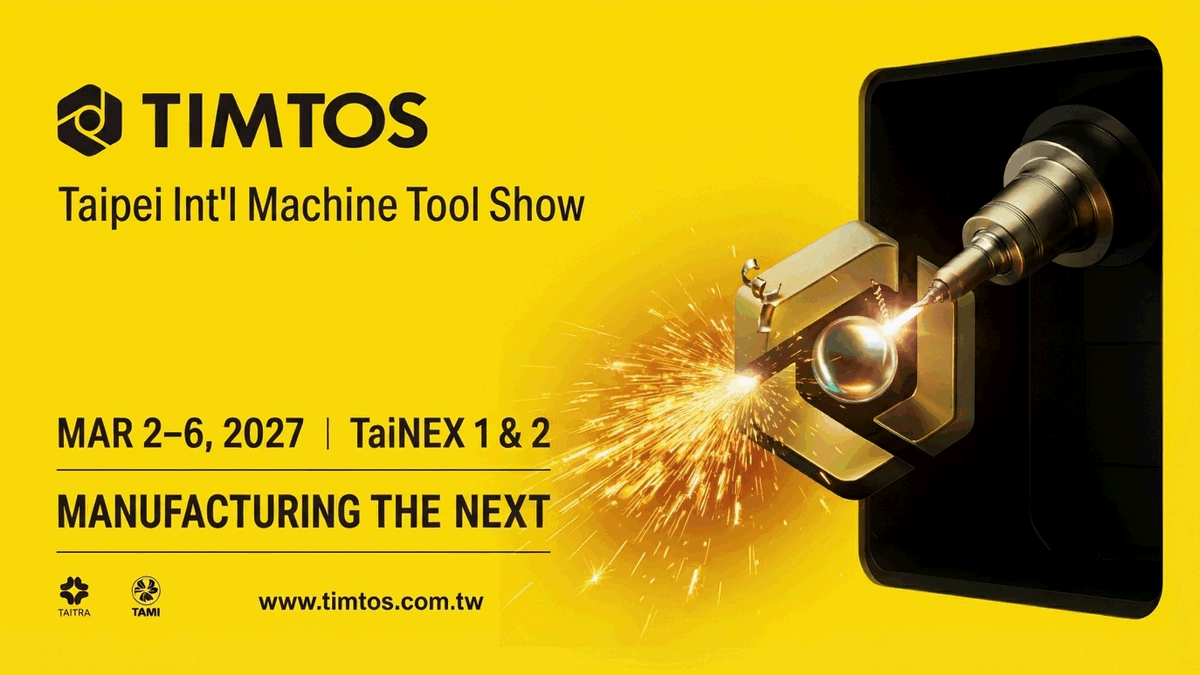
TIMTOS 2027, scheduled for March 2027 in Taichung, Taiwan, has defined its theme as “Focusing on AI-driven technologies to shape the future of global manufacturing,” with the slogan “Manufacturing the Next.” This positioning arrives at a pivotal moment: between 2026 and 2028, modern manufacturing is shifting from isolated digital projects to integrated, AI-driven execution at factory scale.
Across this period, three forces are converging. First, industrial AI is moving beyond dashboards and predictive models toward agentic systems that can autonomously schedule, adjust parameters, and trigger actions. Second, robotics and automation are evolving from single-machine cells to hybrid, reconfigurable production units combining fixed arms, collaborative robots, and autonomous mobile robots (AMRs). Third, digital ecosystems are maturing into software-defined factories where digital twins, open control platforms, and AI-driven OT security make data both actionable and safe.
TIMTOS 2027’s new exhibition zones—“Industrial AI & Digital Ecosystems” and “Robotics & Automation”—are designed to reflect exactly this shift. Rather than showcasing standalone technologies, the show aims to present end-to-end scripts that buyers and system integrators can translate into 12–18 month execution roadmaps.
Industrial AI: From Dashboards to Decision-Making Agents
For much of the last decade, “smart manufacturing” often meant better visibility: more sensors, more dashboards, more alerts. The next phase, unfolding between 2026 and 2028, is about turning that visibility into autonomous or semi-autonomous decisions. Industry analyses highlight that by 2026, more than 40% of manufacturers with existing scheduling systems will adopt AI-driven autonomous scheduling and decision capabilities, enabling production plans that self-optimize rather than simply reflect manual inputs.
By 2027, around 40% of operational data is expected to be automatically integrated across applications and platforms via AI agents, forming cross-system data and decision flows. Looking further to 2028, about 65% of large manufacturers are projected to use AI agents within design and simulation tools to continuously validate design changes and product variants against requirements.

The practical implication is clear: the bottleneck is no longer data collection, but the ability to act on that data at speed and scale. Consider a typical precision-machining environment where tooling performance is critical. Long-time TIMTOS exhibitors such as Besdia—a diamond and CBN tooling specialist serving semiconductor, aerospace, medical, and precision grinding applications—represent the kind of process-focused suppliers whose data can feed directly into AI-driven scheduling and predictive maintenance. In such a scenario, tool wear and process parameters are not only monitored but used by AI to automatically trigger tool changes, adjust cutting conditions, and re-sequence jobs to minimize downtime and scrap. This is precisely where TIMTOS 2027’s “Industrial AI & Digital Ecosystems” zone becomes relevant: instead of isolated AI modules, the focus is on solutions that tie AI-driven scheduling, parameter tuning, and work-order triggering into existing MES, ERP, and control systems. For buyers, the question shifts from “Can this model predict?” to “Can this system execute—and do so safely within my current architecture?”
Robotics and Automation: Hybrid Cells, Not Just Arms
Parallel to the AI story, robotics is undergoing a structural shift from single-function arms to hybrid, reconfigurable automation cells. Global industrial robot installations reached 542,000 units in 2024 and are expected to grow to 575,000 in 2025, surpassing 700,000 by 2028. At the same time, collaborative robots (cobots) are expanding at a compound annual growth rate of around 25.6%, emphasizing safer and easier-to-deploy human–machine collaboration.
Autonomous mobile robots (AMRs) are another critical piece of this puzzle. The global AMR market is valued at approximately USD 6.18 billion in 2026 and is projected to reach USD 25.37 billion by 2035. Notably, more than 63% of new AMR deployments in 2025 already incorporate AI-powered path optimization, indicating that intelligence is becoming embedded in motion, not just manipulation.
The challenge for manufacturers is no longer whether to automate, but how to design automation that is flexible enough for mixed-model production and fast changeovers. TIMTOS 2027’s “Robotics & Automation” zone is positioned to address this by emphasizing hybrid cells: AMR-fed lines, collaborative assembly stations, and AI vision inspection integrated into repeatable blueprints rather than one-off demonstrations. For sourcing and automation leaders, the value lies in seeing how these components fit together at cell and line level, and how quickly they can be replicated across sites.
Digital Ecosystems: Software-Defined Factories and Data Governance
The third pillar of the 2026–2028 transition is the emergence of digital ecosystems that treat the factory as a software-defined environment. By 2029, around 30% of factories are expected to use open, virtualized software platforms to centrally configure and manage control systems, making production lines behave more like programmable software stacks than fixed hardware. In parallel, AI-augmented digital twins are already showing the ability to reduce unplanned downtime by approximately 35% in continuous-process scenarios.
However, this level of connectivity and autonomy introduces new risks. Data silos, inconsistent governance, and OT security vulnerabilities can quickly erode the benefits of digitalization. Industry outlooks project that by 2029, 75% of large manufacturers will adopt AI-driven OT security defenses to automatically flag low-level threats and shorten detection times.
TIMTOS 2027’s digital ecosystem narrative ties these threads together: digital twins, open control platforms, and AI-driven OT security are presented not as separate products but as parts of a single storyline—how to make data actionable and safe at factory scale. For visitors, the key is to evaluate solutions not only on functionality but on how well they integrate with existing IT/OT architectures and comply with emerging data and security requirements.
What TIMTOS 2027 Adds: Turning Trends into Actionable Blueprints
Compared to previous editions, TIMTOS 2027 introduces two new focus areas: “Industrial AI & Digital Ecosystems” and “Robotics & Automation.” This is more than an expansion of floor space; it is a reorganization of how technologies are presented. Instead of scattering AI, robotics, and digitalization across disparate booths, the show groups them into solution-oriented narratives that mirror the way manufacturers plan investments: by use case, by production KPI, and by implementation horizon.
For buyers and system integrators, TIMTOS 2027 is less about browsing machines and more about walking out with a 12–18 month execution roadmap for AI-driven, automated, and ecosystem-ready manufacturing. The central question the show invites is not “What is possible?” but “What is executable in my context—and in what sequence?” In that sense, “Manufacturing the Next” is not just a slogan; it is a call to move from pilots and proofs-of-concept to scalable, repeatable transformations across the global manufacturing base.