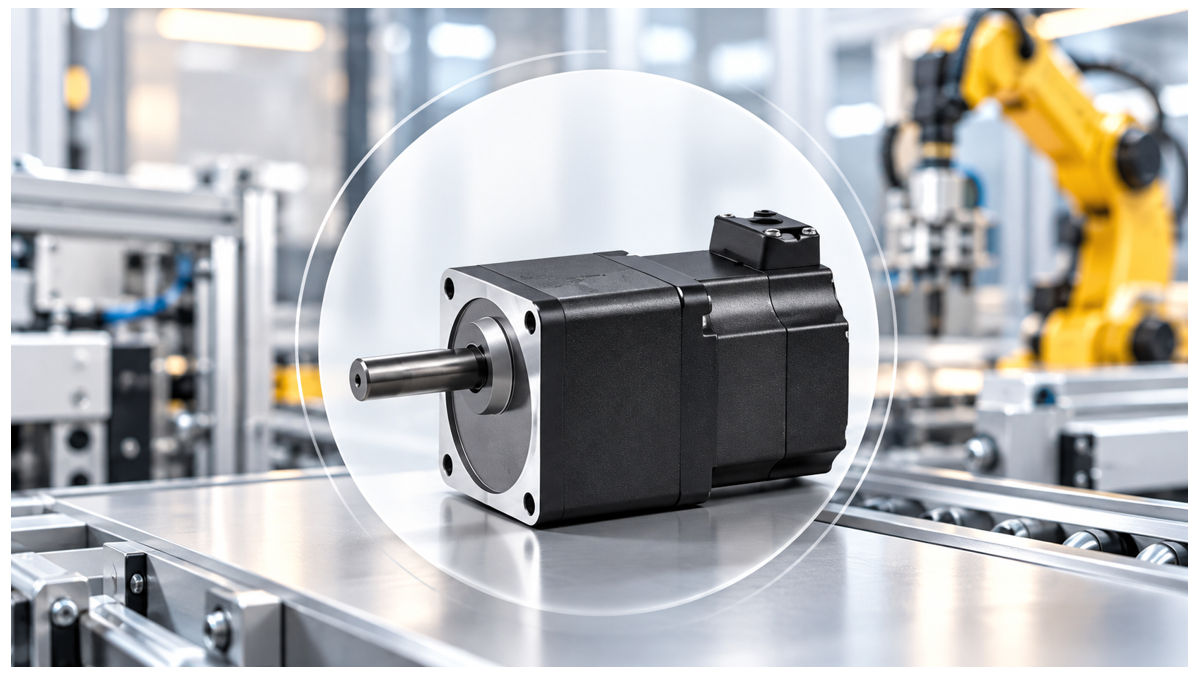
The right motor system depends first on the power already available in your equipment. This guide explains how a 24V brushless DC motor differs from an AC-input brushless motor in power conversion, controls, wiring, and selection, so purchasing and engineering teams can compare complete drive systems, not just motor labels.
Choosing between a 24V brushless DC motor and an AC brushless motor can be confusing because both are brushless, both use an electronic driver, and both can offer adjustable speed. The key difference is usually the electrical supply entering the driver: a low-voltage DC source for one system and an AC mains source for the other. That choice affects power-supply design, wiring, control interfaces, and how the drive fits into the machine. For a fair comparison, evaluate the motor and its matched driver as one system.
Common uses of the term “AC brushless motor”
The term 24V brushless DC motor generally describes a brushless motor-and-driver system designed to receive 24V direct current (DC). The driver electronically switches current through the motor windings; there are no carbon brushes or mechanical commutator.
The term AC brushless motor is used in more than one way. It can describe a brushless permanent-magnet motor driven with alternating phase currents, or it can describe a packaged system whose driver accepts AC mains power. In this article, “AC brushless motor” refers to the second meaning: an AC-input motor-and-driver package. Check the product specification to confirm the actual input voltage and control functions rather than relying on the label alone.
There is also a useful technical nuance: a BLDC motor receives DC at the system input, but its driver converts that power into timed, alternating currents in the motor phases. Microchip describes BLDC motors as permanent-magnet synchronous machines powered from a DC supply through an inverter. Nidec likewise explains that the inverter’s output to a brushless DC motor is alternating current. In other words, “DC” normally identifies the system’s supply and control approach, not a claim that the motor windings receive steady DC.
24V brushless DC motor vs. AC brushless motor: key differences
The table below compares the system-level differences buyers should verify when reviewing a quote. Specific voltage options, driver features, and operating ranges vary by model, so use the applicable motor and driver datasheets as the final authority.
| Selection point |
24V brushless DC motor system |
AC-input brushless motor system |
| Driver power input |
24V DC from a power supply, battery, or DC bus |
A compatible AC mains input, often selected from model-specific single-phase or three-phase options |
| Power conversion |
The driver uses the DC bus to switch current through the motor phases |
The driver typically rectifies AC to a DC bus, then inverts it to control motor-phase current |
| Main integration question |
Can the 24V source supply the required continuous and peak current? |
Does the site voltage and phase match the exact driver configuration? |
| Typical system fit |
Mobile equipment, battery-supported machines, and equipment already built around 24V DC |
Stationary equipment with compatible mains power near the drive |
| Control functions |
Speed command, direction, ramp, torque range, and I/O depend on the selected driver |
The same types of functions may be available, but the command inputs and settings depend on the AC driver |
| Main sizing concern |
Current capacity, voltage drop, cable size, and battery runtime |
Mains voltage, phase, branch protection, grounding, and local electrical requirements |
The table is a starting point, not a performance ranking. A high-quality 24V driver may offer better control than a basic AC-input model, while a feature-rich AC-input driver may provide functions that a simpler DC driver does not. Compare the full specification, including control inputs, feedback, speed range under load, duty rating, protections, and environmental limits.
How the power input and driver differ
What happens inside a 24V brushless DC motor system?
A 24V DC source feeds the motor driver. The driver’s switching electronics then energize the motor phases in a sequence that keeps the rotor turning. The controller may use Hall sensors, another position sensor, or a sensorless method to time commutation. The system designer must make sure the DC source can handle the motor’s operating current and short-duration peaks, especially during startup, acceleration, or a high-load event.
This architecture can fit naturally into equipment that already has a regulated 24V DC bus. It can also be considered for battery-powered machines, provided that battery voltage over its full charge range, current demand, runtime, charging, wiring, and protection are all checked. “24V” by itself does not tell a buyer whether a particular power supply or battery is large enough.
What happens inside an AC-input brushless motor system?
An AC-input driver accepts the specified mains voltage and converts it internally for motor control. A common architecture rectifies the incoming AC to create a DC bus, then uses an inverter stage to produce controlled phase currents for the brushless motor. The driver therefore handles the conversion between the site’s AC supply and the switching power the motor requires.
This can avoid the need for a separate external AC-to-DC supply for the motor, but it does not eliminate power-system design. The buyer still needs to select the right voltage and phase version, provide suitable branch protection and grounding, follow the wiring diagram, and account for installation and electrical safety requirements. A low-voltage command input should not be assumed to be electrically isolated from mains unless the product documentation confirms it.
The motor still needs electronic commutation in both systems
Brushless motors use electronic commutation to replace the mechanical brush-and-commutator function found in brushed DC motors. Six-step control, sinusoidal control, and field-oriented control (FOC) are examples of drive approaches. They differ in how the phase currents are controlled and can affect torque ripple, noise, smoothness, and complexity. These are controller and motor-system choices; they are not determined simply by whether the driver input is AC or DC.
Microchip’s overview compares six-step control with FOC and notes the different implementation and performance trade-offs. For procurement, the practical question is not whether a product is called “AC” or “BLDC,” but whether the offered driver meets the machine’s required speed stability, startup behavior, response, noise, and control-interface needs.
Control differences buyers should check
Both motor types use a dedicated driver, but the available commands and feedback depend on the driver model. Before purchasing, confirm how the motor will be started, stopped, adjusted, monitored, and connected to a PLC or other controller.
Important control questions include:
- How is speed commanded? Options may include a driver knob, preset speeds, digital inputs, or an analog voltage input. Confirm the signal range and wiring for the exact model.
- Is forward and reverse operation required? Check whether direction can be switched during operation, only at a stop, or through a dedicated input.
- How fast must the motor accelerate and stop? A ramp setting can reduce mechanical shock, but the actual motion depends on load inertia, torque, gearbox, and driver limits.
- Does the load need torque limiting? Confirm whether the driver provides a torque limit or current setting and how that setting is specified.
- What feedback and alarms are available? Speed output, fault output, alarm display, and fault reset can reduce troubleshooting time, but their availability is model-specific.
- Is closed-loop speed regulation required? Ask what feedback method is used and what speed regulation the supplier guarantees across the intended load range.
- Is position accuracy required? A speed-controlled brushless motor is not automatically a positioning servo. Applications that need defined position accuracy may require an encoder, servo drive, or another motion-control architecture.
Product pages and catalogs often list features such as external speed references, acceleration/deceleration settings, direction control, multi-speed operation, I/O, and alarms. Availability varies by driver model. Buyers should request the current wiring diagram and product specification for the configuration under consideration.
Size the power system before comparing prices
A 24V system can draw substantial current even when the motor’s rated output looks modest. As a simple lower-bound illustration, 100W divided by 24V is about 4.17A. That is the current at 100% conversion efficiency; real input current will be higher because the motor and driver have losses. Startup, acceleration, overload, and transient requirements may also push peak demand above the normal running current. Use the driver’s rated and peak input-current specifications rather than arithmetic alone to size the supply and wiring.
With an AC-input system, input current depends on voltage, phase, power factor, efficiency, and load. Do not compare an AC nameplate current directly with the 24V DC current without considering those factors. A supplier should confirm input current, compatible supply, required protective devices, and any limitations for continuous or intermittent duty.
The purchase price is only one part of the total system cost. Compare the cost and space for power supplies, batteries, drivers, wiring, protection devices, commissioning, and maintenance. A 24V solution may be convenient when the machine already has a DC bus, while a mains-input system may be simpler where compatible AC power is already available. The result depends on the equipment architecture and the installation site.
Which motor system fits your application?
The scenarios below can help teams narrow the choice before requesting a detailed quotation. They do not replace checking the load profile and model-level specifications.
| Application condition |
First system to evaluate |
Why it may fit |
| The machine already uses a regulated 24V DC bus |
24V brushless DC |
It may integrate without adding a separate motor supply, if current capacity is sufficient |
| The equipment is battery-powered or mobile |
24V brushless DC |
It can align with a low-voltage DC architecture; runtime and peak current still need validation |
| The equipment is stationary and has compatible AC mains at the installation point |
AC-input brushless |
The driver may connect to the available AC supply directly, subject to the exact voltage and phase version |
| The machine needs repeated speed changes and controlled ramps |
Compare both driver packages |
Confirm the command method, speed regulation, ramp range, and behavior with the real load |
| The application needs accurate position moves |
Evaluate a servo or encoder-equipped option as well |
Speed control alone does not guarantee accurate positioning |
| The installation has limited panel or machine space |
Compare complete system dimensions |
Driver size, cabling, cooling, gearbox, and access affect the total footprint |
For conveyors, packaging equipment, labeling machines, and material handling, speed control and acceleration settings can help the machine match its process rhythm. For a compact mobile cart or a DC-powered mechanism, a 24V system may be a natural fit. For a fixed machine with an AC panel and suitable line supply, an AC-input package may reduce the need for a separate DC supply. The correct choice follows the power architecture and motion requirement, not a general claim that one motor type is always superior.
A practical buyer checklist for motor RFQs
Procurement teams can avoid repeated clarification by giving suppliers the information needed to match the motor, driver, and gearbox as a complete package. Include the following in an RFQ:
- Power source: DC voltage and allowable range, or AC voltage, phase, and frequency; include available supply capacity.
- Load details: Load type, inertia if known, friction, direction of force, and any start-up or breakaway load.
- Motion requirement: Target shaft speed, output torque, duty cycle, start-stop frequency, acceleration/deceleration time, and whether reversing is required.
- Transmission needs: Gearbox type, ratio, mounting position, shaft orientation, and allowable backlash where relevant.
- Control interface: PLC model or signal type, analog range, digital I/O, communication protocol, speed feedback, and alarm handling.
- Environment: Ambient temperature, dust, moisture, cleaning agents, vibration, and available cooling or ventilation.
- Mechanical constraints: Mounting dimensions, shaft and flange details, cable routing, available panel space, and access for maintenance.
- Compliance and documentation: Required certifications, electrical drawings, manuals, test records, and destination-market requirements.
- Commercial needs: Quantity, target delivery schedule, spare-parts expectations, and any evaluation or sample requirements.
Ask the supplier to confirm the selected motor’s continuous torque at the required speed, peak torque and duration, driver input limits, speed-control method, protection functions, and gearbox limits. Where possible, provide an actual load or representative machine test. A rated wattage alone cannot establish that a motor will start, run cool, or maintain the required speed in the application.
Luyang Technology product examples
Luyang Technology Co., Ltd. is a Taiwan-based motor and gear reducer manufacturer established in 1981. Its online product information lists a 24V DC brushless motor range and an AC-input brushless motor range, each supplied with matched driver configurations. These examples help show why input voltage and driver selection should be compared before the motor is specified.
Luyang lists the following ranges. Product configurations and specifications can change, so confirm the exact driver model, supply input, speed, torque, gearbox, and controls before ordering.
| Luyang product category |
Listed output options |
Listed driver input |
Published speed range |
Buyer note |
| 24V brushless DC motor |
30W, 50W, 100W |
DC 24V |
100–3,000 r/min |
Selected drivers list external DC 0–5V speed setting and adjustable acceleration/deceleration |
| AC-input brushless motor |
30W, 60W, 120W |
Model-dependent single-phase AC 100–120V or single-/three-phase AC 200–240V |
80–4,500 r/min |
Confirm the voltage and phase option against the exact driver; functions vary by model |
The 24V range may be relevant when an OEM needs a low-voltage DC architecture, while the AC-input range may suit a machine with compatible mains at the drive location. Applicable configurations list standard gearbox ratios from 5:1 to 100:1. These catalog ranges are selection starting points, not a guarantee of torque at every speed or load.
The published 24V driver information includes DC 0–5V external speed setting, acceleration/deceleration settings, direction control, and other functions for selected configurations. The AC-input range lists speed adjustment, direction control, acceleration/deceleration settings, multi-speed operation, I/O, and alarm functions, depending on model. Confirm current details for the exact configuration with the manufacturer.
To compare configurations, see the 24V brushless DC motor range and AC-input brushless motor range, then Inquire about Luyang Technology products with your load, speed, torque, supply, control, and gearbox requirements.
Frequently asked questions
Question 1: Is a 24V brushless DC motor really a DC motor if its windings receive AC?
The name refers mainly to the DC supply and system architecture. An electronic driver switches current through the motor phases, producing alternating phase currents that create rotation. That is why a 24V BLDC system needs a driver and cannot usually be connected directly to a 24V source without the specified controller.
Question 2: Can an AC brushless motor run from a 24V battery?
Only if the selected driver is specifically designed for that DC input, or if an appropriately rated power-conversion system is added. An AC-input driver should not be connected to a battery unless its documentation explicitly permits that input. Verify the permitted voltage range and connection method with the manufacturer.
Question 3: Which motor gives better speed control?
The input label does not answer that question. Compare the specific driver’s feedback method, speed range, regulation under load, command resolution, ramp settings, and control interface. Ask for guaranteed performance at the load and speed your equipment will use.
Question 4: Is a brushless motor maintenance-free?
Brushless motors avoid carbon-brush wear, which removes one common replacement task found in brushed DC motors. The full drive system still needs maintenance suited to its environment, including checking connections, cooling, gearboxes, mounting, and any manufacturer-specified inspection items.
Question 5: What information should I send when asking for a quotation?
Share the available power source, required speed and torque, load and duty cycle, gearbox needs, control interface, mounting constraints, operating environment, quantity, and target delivery date. This lets the supplier evaluate a compatible motor, driver, and gearbox configuration rather than quoting a motor based on wattage alone.
Make the choice around the complete drive system
The most useful first question is simple: what power is available where the motor driver will be installed? From there, compare the driver’s control functions, current or mains requirements, actual load performance, integration effort, and total system cost. A well-matched 24V brushless DC motor or AC-input brushless motor can both be effective; the better choice is the one that fits the machine’s electrical architecture and verified motion requirements.