The hardest part of replacing an old motor is usually not finding a newer model with similar power. It is making sure the new motor fits the machine, handles the actual load, and works with the existing control system.
When an aging machine needs a motor replacement, many buyers start by looking for the same wattage or a similar frame size. Problems often appear later: the shaft diameter is different, mounting holes do not line up, the original gearbox cannot be connected, or the new motor is installed but the PLC cannot communicate properly with the driver.
That is why upgrading to an AC brushless motor should not be treated as a simple one-for-one motor replacement.
The better question is:
Can the new motor, driver, and gearbox take over the existing machine's job without requiring a major redesign?
For conveyors, packaging machines, labeling systems, food-processing equipment, printing machines, and other automated machinery, many retrofit problems can be avoided before purchase if a few critical compatibility checks are completed first.
Can an AC Brushless Motor Directly Replace an Old Motor?
Sometimes, but motor power and physical size alone are not enough to determine compatibility.
Before choosing a replacement, five areas should be checked.
| What to Check |
What Matters |
What Can Go Wrong |
| Mounting |
Motor dimensions, mounting holes, flange, available space |
The motor fits the area but cannot be mounted |
| Shaft |
Shaft diameter, shaft length, keyway, coupling |
Existing transmission parts cannot be reused |
| Load |
RPM, continuous torque, starting load |
The motor runs but cannot drive the machine |
| Gearbox |
Gear ratio, output speed, allowable torque |
Speed is correct but output torque is insufficient |
| Control |
Power supply, driver, PLC I/O, alarm signals |
The motor is installed but cannot work with the existing control system |
If even one of these areas is overlooked, a simple replacement can turn into extra machining, rewiring, PLC modification, or another round of purchasing.
So instead of asking:
“What wattage motor should I buy?”
start with:
“What does the machine actually need at the output?”
Start with Mounting Dimensions and Shaft Size, Not Wattage
Many retrofit projects run into mechanical problems before electrical problems appear.
For example, a new motor shaft may differ from the original by only a few millimeters. That small difference can prevent the existing:
-
coupling
-
pulley
-
sprocket
-
gearbox
-
mounting bracket
from being reused.
Before searching for a replacement motor, measure at least:
If the machine cannot be taken offline for measurement, photos are still useful. A good retrofit inquiry should include images of:
-
the motor nameplate
-
the motor-to-gearbox connection
-
the output shaft
-
the mounting base
-
the existing driver
-
the PLC wiring
This information is usually more useful to a motor supplier than sending only the model number of an old motor.
Does a Different Motor Size Automatically Mean It Cannot Be Used?
Not necessarily.
If the motor's performance is suitable but the mechanical interface is different, the retrofit may still be possible by using:
-
a new coupling
-
an adapter plate
-
a modified mounting bracket
-
another shaft configuration
-
a different gearbox combination
The real question is not whether the dimensions are identical.
The more useful question is:
How much modification is required to make the new motor fit, and is that modification practical for the machine?
Why Can a Motor with the Same Wattage Still Fail to Drive the Machine?
Because the machine uses speed and torque, not wattage alone.
If the old machine uses a 60W motor, another 60W motor is not automatically an equivalent replacement.
You still need to know:
-
What is the normal operating speed?
-
How much load is present during startup?
-
Does the machine operate for long periods at low speed?
-
Is it continuous duty or frequent start-stop operation?
-
Is a gearbox used?
-
What is the current reduction ratio?
This is especially important for conveyors, feeding systems, and packaging machines.
The motor itself may run at several thousand RPM, while the machine needs a much lower output speed. That difference is normally handled by a gearbox.
A simple relationship is:
Output Speed ≈ Motor Speed ÷ Gear Ratio
But a different gear ratio also changes the available output torque, so RPM should never be checked by itself.
A Practical Example
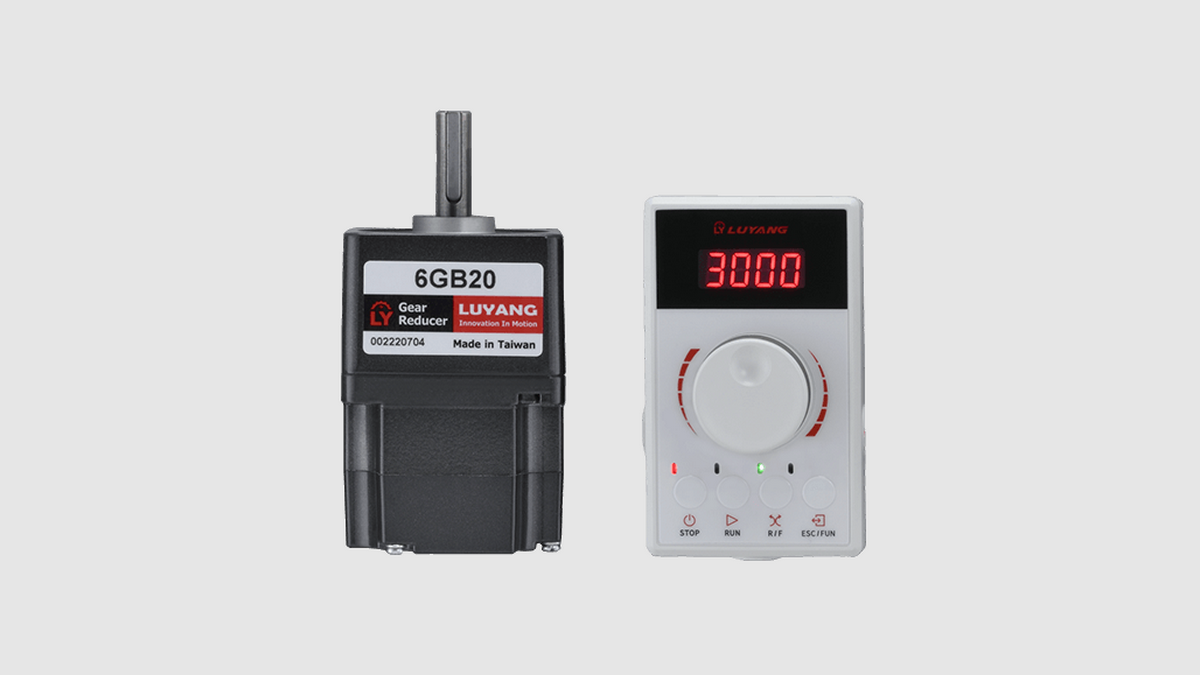
Luyang's 60W BU Series AC-input brushless motor is specified with:
-
rated speed: 3,000 rpm
-
speed control range: 80–4,500 rpm
-
rated torque: 0.19 N·m
-
instantaneous maximum torque: 0.29 N·m
-
available gear ratios: 5, 10, 15, 20, 30, 50, and 100
When different gear ratios are selected, both output speed and allowable torque change.
For example, at a motor speed of 3,000 rpm:
This is why the motor and gearbox should be selected together, rather than selecting the motor first and trying to find a gearbox afterward.
What If the Original Machine Torque Is Unknown?
This is common with machinery that has been operating for ten or twenty years.
Original drawings may be missing, the original manufacturer may no longer support the machine, or the actual load data may never have been recorded.
If torque data is unavailable, start by collecting:
-
old motor power
-
existing gearbox ratio
-
normal operating current
-
actual output speed
-
conveyor or load weight
-
pulley or sprocket size
-
startup load condition
-
daily operating hours
-
start-stop frequency
These details do not replace an engineering calculation, but they give a motor supplier much more information to estimate the actual requirement.
There is another reason to check the load again during a retrofit:
The original motor may not have been optimally sized.
Older machines were sometimes designed with a large safety margin. Replacing the old motor with the exact same wattage may simply repeat the original oversizing.
A retrofit is therefore a good opportunity to confirm what the machine actually needs today.
Why Does an AC Brushless Motor Need a Driver?
This is another area that can cause confusion during motor replacement.
An AC brushless motor does not operate in the same way as a conventional AC motor that is connected directly to the power source.
A brushless motor normally works together with a dedicated driver.
The driver controls the motor's operation, so the following should be considered as one system:
Motor + Driver
Do not assume that matching the voltage is enough to connect a new brushless motor to an old controller.
At minimum, check:
-
compatible motor model
-
driver input voltage
-
single-phase or three-phase power
-
speed-setting method
-
forward and reverse control
-
acceleration and deceleration
-
alarm functions
-
external control I/O
Luyang's BU Series uses this motor-and-driver approach.
The AC-input brushless motor range includes 30W, 60W, and 120W models, with power configurations including:
The 120W model, for example, is also specified with a rated speed of 3,000 rpm, a speed range of 80–4,500 rpm, and gear ratios from 5 to 100.
For retrofit projects, this type of motor, driver, and gearbox combination is easier to evaluate than treating each component as a separate purchase.
Can the Existing PLC Still Be Used with a New Driver?
In many cases, yes—but the I/O must be checked first.
If the existing machine only needs functions such as:
-
Start / Stop
-
Forward / Reverse
-
Speed Selection
-
Alarm Feedback
there may be no reason to replace the PLC.
The first step is to confirm whether the new driver provides the required digital inputs and outputs, and whether the PLC's signal type and voltage are compatible.
For example, Luyang's 60W BU Series driver provides configurable I/O and supports both SINK and SOURCE configurations with external DC 5–30V control signals.
This matters because the most practical retrofit is not always:
“Replace everything with new components.”
A better approach is often:
“Keep the parts that still work and replace only what is necessary.”
A Simple Control-Mapping Table Can Prevent Many Problems
Before ordering the new motor system, map the existing machine functions against the new driver.
| Existing Machine Function |
Required Driver Function |
| Start motor |
Run / Start Input |
| Stop motor |
Stop / Disable |
| Change direction |
Forward / Reverse |
| Change preset speed |
Speed Selection |
| Fault indication |
Alarm Output |
| Running status |
Speed / Status Output |
If every function can be matched, the retrofit is likely to be relatively straightforward.
If some functions do not match, determine before purchase whether the machine will need a relay, remote I/O, gateway, or PLC program modification.
If the Machine Uses EtherCAT, PROFINET, or Modbus, Does the Motor Driver Need the Same Protocol?
Not always.
It depends on how complex the motor's role is in the machine.
When Simple I/O May Be Enough
For applications such as:
-
conveyors
-
material feeding
-
labeling
-
packaging
-
simple transfer systems
the motor may only need Run, Stop, direction, and speed control.
Even if the factory PLC communicates through EtherCAT, PROFINET, or another industrial network, the motor driver itself may not need to support the same protocol.
In some systems, the PLC can communicate through the factory network while remote I/O or another suitable interface converts commands into the digital signals required by the driver.
When Native Industrial Communication Becomes More Important
A different drive strategy may be needed if the application requires:
In these cases, a drive with the required motion-control and industrial-network capabilities should be selected from the beginning.
A useful rule is:
Do not add advanced communication functions just because they look more modern, but do not rely on basic I/O when the machine genuinely requires real-time motion control.
Which Parts of the Existing Machine Can Stay?
Controlling the scope of the retrofit is one of the best ways to control cost.
If the existing:
-
PLC
-
HMI
-
sensors
-
machine frame
-
transmission system
are still working well, there may be no reason to replace them.
A typical retrofit might simply change:
Old Motor + Old Driver → New Brushless Motor + New Driver
while keeping most of the machine unchanged.
Another project may require:
Motor + Driver + Gearbox + Coupling
to be replaced while the PLC and overall machine architecture remain in service.
This is one of the main advantages of retrofitting older machinery.
The goal is not to turn an old machine into a completely new machine. It is to extend useful operating life with a reasonable amount of modification.
A Practical AC Brushless Motor Retrofit Process
A motor retrofit becomes easier when the steps are handled in the right order.
Step 1: Document the Existing Machine
Before selecting a new motor, record the current:
-
motor
-
driver
-
gearbox
-
voltage
-
RPM
-
PLC
-
I/O
-
mounting dimensions
Step 2: Define What the Machine Actually Needs
Record:
Do not begin with the specifications of the old motor. Begin with the job the machine needs to perform.
Step 3: Confirm the Mechanical Dimensions
Check the:
Do not wait until the motor arrives to discover that the shaft or mounting holes are only a few millimeters different.
Step 4: Select the Motor, Driver, and Gearbox Together
Treat them as one drive system rather than three unrelated components.
Step 5: Match the PLC I/O
Identify:
-
which signals can be connected directly
-
which functions need a relay
-
whether remote I/O is needed
-
whether the PLC program requires modification
Do this before placing the order.
Step 6: Test the Machine Under Real Load
Do not stop testing when the motor starts turning.
Check:
-
startup behavior
-
full-load operation
-
low-speed stability
-
motor temperature
-
gearbox temperature
-
noise
-
emergency stop
-
alarm behavior
-
long-duration operation
The real question is not whether the motor runs.
It is whether the machine can return to normal production.
What Information Should Procurement Send to a Motor Supplier?
A request that only says:
“We need a 60W motor.”
does not give the supplier enough information to recommend a reliable replacement.
A better retrofit inquiry should include:
-
original motor brand and model
-
motor nameplate photo
-
existing driver model
-
gearbox model
-
supply voltage
-
operating RPM
-
gear ratio
-
shaft diameter and length
-
mounting-hole dimensions
-
load type
-
daily operating hours
-
start-stop frequency
-
PLC model
-
control signals
-
machine photos
-
available installation space
The more complete the information, the easier it is for the supplier to determine whether the upgrade can be:
a direct replacement, a minor modification, or a complete drive-system redesign.
That is far more useful than choosing a replacement based only on wattage.
How Can Luyang Support an AC Brushless Motor Upgrade?
Luyang Technology has been involved in motor and gear-reducer manufacturing since 1981. Its product portfolio includes AC motors, brushless motors, gear reducers, and OEM/ODM or customized motor solutions for industrial applications.
For AC-input brushless motor applications, the BU Series provides several options that can be useful in retrofit projects.
| Selection Item |
BU Series Options |
| Motor Output |
30W / 60W / 120W |
| AC Input |
AC100–120V / AC200–240V |
| Power Supply |
Single-phase / selected three-phase configurations |
| Shaft Type |
Round shaft / gear shaft |
| Gear Ratio |
5–100 |
| Speed Control |
Adjustable speed / multi-speed operation |
| Control |
Configurable I/O |
| Driver Functions |
Direction, acceleration/deceleration, protection, alarm display |
Specifications vary by model and should always be confirmed against the final machine requirements.
For retrofit projects, the main advantage of this type of product structure is not one individual specification.
It is the ability to evaluate:
Motor + Driver + Gearbox
as one system.
If a legacy machine also has special mounting dimensions, output requirements, or OEM/ODM needs, the existing machine data can be provided to the supplier for further evaluation.
Buyers can review Luyang's AC brushless motor range and compare the available configurations with their existing machine before selecting a replacement.
FAQ: AC Brushless Motor Retrofit and Compatibility
Can an AC brushless motor directly replace an old AC motor?
Not always. Even when the power rating is similar, the mounting dimensions, shaft size, speed, torque, gearbox, power supply, driver, and control method should all be checked. A brushless motor normally requires a dedicated driver, so the motor itself is only one part of the replacement.
Do I need to use the same wattage as the old motor?
Not necessarily. The machine's actual speed, continuous torque, starting load, gear ratio, duty cycle, and acceleration requirements are more important than wattage alone.
Can the existing gearbox still be used?
Possibly. The input shaft, mounting interface, gear ratio, and allowable torque must be compatible with the new motor. If the dimensions are different, an adapter or coupling may be possible, but the cost and practicality of the modification should be evaluated first.
Do I need to replace the PLC after installing a brushless motor?
Usually not. If the existing PLC can provide the Run, Direction, Speed Selection, and other signals required by the new driver—and the I/O voltage and signal type are compatible—the original PLC may remain in service.
If the factory uses EtherCAT or PROFINET, does the motor driver also need to support it?
Not always. For simple start-stop, speed-control, or conveyor applications, PLC I/O, remote I/O, or another suitable interface may be enough. Native industrial communication becomes more important when the machine requires precise positioning, multi-axis synchronization, or high-speed motion control.
What is the most important information to send to a motor supplier for a retrofit?
Provide more than the old motor model. Include the nameplate, photos, mounting dimensions, shaft size, output speed, gear ratio, power supply, PLC I/O, and actual load conditions. This gives the supplier enough information to evaluate the complete drive system rather than simply matching a catalog specification.
Conclusion: Check Compatibility Before Choosing the Replacement Motor
When upgrading legacy machinery with an AC brushless motor, the biggest risk is usually not the motor itself.
The real risk is buying a motor that looks correct on paper but cannot be integrated easily into the existing machine.
Before placing an order, answer five practical questions:
Can it fit?
Can it handle the load?
Can the driver work with the existing power supply?
Can the PLC control it?
Can the gearbox deliver the required speed and torque?
If these questions can be answered before installation begins, the retrofit becomes much easier to manage.
A good retrofit is not about finding a new motor that looks most similar to the old one.
It is about finding a motor, driver, and gearbox combination that can actually work with the existing machine.
That is what helps reduce modification time, avoid repeated purchasing, and keep older equipment productive for longer.




.jpg)
.jpg)