What makes BLDC motors a better fit for today’s lifting and hoisting systems.
In lifting and hoisting applications, motor selection has a direct impact on system safety, energy consumption, installation flexibility, and long-term maintenance costs. For many years, induction motors have been widely used in hoists, patient lifts, and other lifting systems because of their durability and familiarity in industrial environments. However, as equipment manufacturers face stricter demands for compact design, lower energy consumption, smoother control, and improved safety, brushless DC (BLDC) motors are becoming an increasingly attractive alternative.
From medical lifting devices to compact industrial hoists, BLDC motor technology offers several engineering advantages that address the limitations of traditional induction motor systems. These advantages are not limited to efficiency alone. They also affect starting current, control precision, braking integration, and overall system architecture.
Why Motor Selection Matters in Lifting and Hoisting Systems
Lifting and hoisting systems are fundamentally different from many general-purpose motor applications. In these systems, the motor is responsible not only for producing torque, but also for ensuring stable movement under load, precise start-stop behavior, and safe operation in both normal and abnormal conditions.
Engineers designing lifting equipment typically have to consider several critical requirements:
- High torque output, especially at low speed
- Smooth acceleration and deceleration
- Reliable braking performance
- Compact mechanical structure
- Low noise and vibration
- Reduced starting current
- Stable control under changing loads
- Safety during power interruption or sudden stop events
These requirements become even more important in applications such as patient lifts, medical beds, rehabilitation systems, compact electric hoists, and smart lifting equipment where safety, quiet performance, and installation space are all major concerns.
The Limitations of Traditional Induction Motors
Induction motors have long been the standard solution in lifting systems, but they also bring several design constraints.
-
High Starting Current
One of the most common challenges with induction motors is high inrush current during startup. In lifting systems, this can place additional stress on the electrical infrastructure, requiring larger circuit protection components, heavier wiring, and more robust control boxes.
-
Less Flexible Speed Control
Although variable frequency drives can improve control performance, induction motor systems often require additional hardware and tuning to achieve the speed flexibility and responsiveness needed in modern lifting equipment.
-
Larger and Heavier System Architecture
In many cases, induction motor designs rely on more complex mechanical reduction systems. This can increase total system size and weight, making installation more difficult and reducing design flexibility.
-
Braking Integration Challenges
Lifting systems require dependable braking performance to prevent unintended descent and ensure operator safety. In induction-based systems, braking functions may depend more heavily on separate mechanical arrangements, which can complicate design and maintenance.
Why BLDC Motors Are Gaining Attention
BLDC motors are increasingly being adopted in lifting and hoisting systems because they offer a more integrated and controllable approach to motion design. While every application must be evaluated based on load, duty cycle, and safety requirements, BLDC motors provide several advantages that are especially relevant in modern lifting equipment.
-
Higher Torque Density in a More Compact Form
BLDC motors are known for delivering high torque output relative to their size and weight. This makes them well suited for compact lifting systems where engineers need to reduce mechanical bulk without sacrificing performance.
For applications with limited installation space, a smaller and lighter motor can simplify the overall structure and improve design flexibility.
-
Lower Starting Current
Compared with traditional induction motor systems, BLDC solutions can significantly reduce starting current. This can lower stress on the electrical system and may reduce the size or cost of supporting electrical components such as breakers, wiring, and control assemblies.
For equipment builders, lower starting current is not only an electrical advantage. It can also contribute to lower total system cost.
-
Better Speed Control and Smoother Operation
Lifting and hoisting applications benefit greatly from precise speed and torque control. BLDC motors, when paired with suitable controllers, support more responsive acceleration, stable low-speed operation, and smoother motion transitions.
This level of control is especially valuable in applications where movement must feel controlled and safe, such as patient handling equipment or lifting systems that operate in close proximity to users.
-
Improved System Integration
BLDC motor systems are often designed together with electronic controllers, which allows tighter integration between motor behavior, braking logic, and safety management. This creates opportunities for more intelligent lifting system design and more consistent operating performance.
Safety Considerations in Lifting Applications
Safety is one of the most important reasons why motor technology matters in lifting and hoisting equipment.
A critical risk in hoisting systems is uncontrolled descent. If power is lost or the system experiences a fault, the motor and brake architecture must prevent sudden or unintended load movement. This is why braking design is so important.
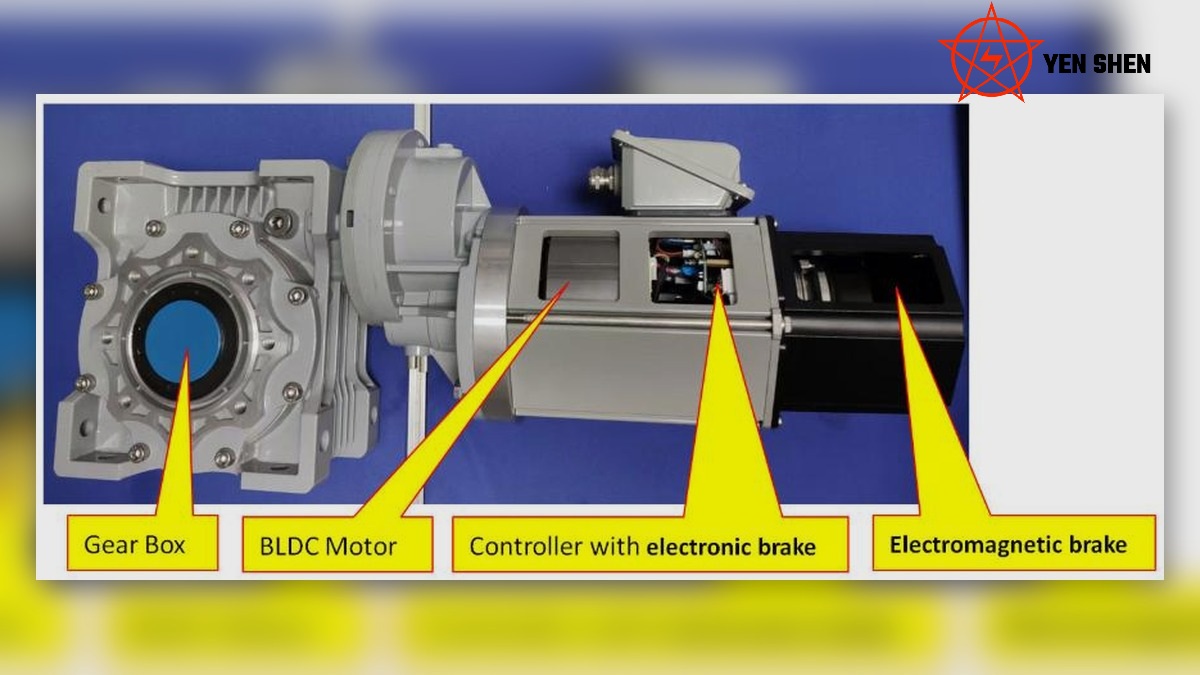
With BLDC-based lifting systems, engineers can combine electronic control logic with electromagnetic braking mechanisms to create layered protection strategies. In practical terms, this means the system may be able to use active electronic braking for controlled deceleration during normal operation, while also relying on electromagnetic braking as a fail-safe measure when needed.
This kind of dual-layer safety concept can improve both operational stability and emergency response performance.
Efficiency and Total System Cost
In many industries, the discussion around BLDC motors starts with energy efficiency. That is certainly important, but the total value is broader than power savings alone.
When evaluating motor solutions for lifting systems, total system cost should include:
- Motor size and weight
- Gear reduction complexity
- Controller requirements
- Starting current impact on electrical components
- Brake integration
- Maintenance needs
- Expected service life
- Installation constraints
A motor solution that reduces electrical stress, simplifies mechanics, and enables more compact design may create significant value even if the initial component comparison seems narrow.
This is one reason why many equipment designers are re-evaluating the role of BLDC motors in next-generation lifting systems.
Typical Applications for BLDC Motors in Lifting and Hoisting
BLDC motors can be a strong fit for a range of lifting-related applications, including:
- Patient lift systems
- Medical beds and transfer equipment
- Compact electric hoists
- Rehabilitation and care devices
- Intelligent lifting equipment
- Material handling systems requiring precise motion control
- Specialized lifting devices with strict noise, size, or safety requirements
The best-fit application depends on torque demand, load profile, operating cycle, environmental conditions, and required safety features.
Key Design Factors When Selecting a Motor for Lifting Systems
Before choosing between a BLDC motor and an induction motor, engineers and system designers should evaluate the following factors:
-
Torque and Load Characteristics
What is the required torque at startup, during normal lifting, and under peak load conditions?
-
Speed Range
Does the application require a wide speed range or stable low-speed performance?
-
Duty Cycle
Will the system run intermittently or frequently throughout the day?
-
Brake Architecture
What level of braking redundancy or fail-safe design is required?
-
Controller Integration
Does the application require precise electronic control, load response, or customized motion logic?
-
Environmental Conditions
Will the motor operate in environments where dust, moisture, washdown resistance, or ingress protection matters?
-
Mechanical Layout
How much installation space is available, and how important are compactness and weight reduction?
The answers to these questions often make it easier to determine whether a BLDC-based solution offers measurable advantages over a conventional induction motor design.
The Shift Toward Smarter Lifting System Design
The transition from induction motors to BLDC motors in lifting and hoisting applications is part of a broader industry shift. Equipment manufacturers are no longer selecting motors based only on basic rotation and power output. They are looking for solutions that improve system efficiency, simplify control, reduce weight, enhance safety, and support product differentiation.
As lifting equipment continues to evolve, motor technology will increasingly be judged by how well it contributes to the entire system rather than by standalone motor performance alone.
For companies exploring motor solutions for lifting and hoisting applications, it is worth examining how BLDC technology can support not only energy savings, but also safer, lighter, and more integrated system design.
For example, solution providers such as Yen Shen have published application-focused references on how custom BLDC motor designs can be used in lifting and hoisting systems, including considerations related to starting current, compactness, and braking architecture.

(4059)(20260924)(原).jpg)
(2367)(20260924)(原).jpg)