For buyers, factory owners, and packaging manufacturers, selecting an automatic blow molding machine is no longer just a matter of comparing output speed or initial price. In real production environments, the performance of a plastic blowing machine is often determined by the quality and coordination of its core components. A machine may appear competitive on paper, yet still create costly problems once production begins. Uneven wall thickness, unstable parison formation, excessive scrap, slow cooling, and difficult maintenance are all issues that can usually be traced back to the design of several key modules. This is why experienced buyers tend to look beyond catalog specifications and focus instead on the machine’s screw, die head, clamping system, and cooling design. These components do more than support production. They directly influence product quality, material efficiency, energy use, maintenance frequency, and overall return on investment.
Why Core Components Matter More Than Machine Price Alone
In the blow molding industry, machine comparisons often begin with capacity, bottle size range, or cycle speed. However, these numbers tell only part of the story. For decision-makers responsible for procurement or plant operations, the more meaningful question is whether the machine can maintain stable and repeatable production over time.
A well-designed automatic blow molding machine helps manufacturers reduce defects, control resin consumption, and maintain consistent output under real operating conditions. This matters particularly in sectors such as food packaging, household products, cosmetics, lubricants, and industrial containers, where product quality and production efficiency directly affect competitiveness.
As a result, buyers are asking more practical questions than before:
- Can the screw deliver stable plasticizing across different materials?
- Will the die head support consistent wall thickness distribution?
- Is the clamping unit rigid enough for accurate mold closing?
- Can the cooling system shorten cycle time without increasing deformation risk?
These are not minor technical details. They are business-critical factors.
The Four Key Components Buyers Should Understand
Before looking at each component in detail, the following table provides a useful overview.
| Component |
Main Function |
Why It Matters |
| Screw |
Melts, mixes, and conveys plastic material |
Affects plasticizing stability, output consistency, and resin adaptability |
| Die Head |
Forms the molten plastic into a parison |
Influences wall thickness control, product quality, and material efficiency |
| Clamping Unit |
Closes and secures the mold during forming |
Determines molding accuracy, flash control, and repeatability |
| Cooling System |
Removes heat from the mold and finished part |
Impacts cycle time, dimensional stability, and productivity |
Taken together, these systems define whether a plastic blowing machine performs reliably in actual factory conditions.
Screw: The Foundation of Stable Plasticizing
The screw is one of the most important components in any automatic blow molding machine, because it is responsible for melting, mixing, and conveying the resin before forming begins. If the screw is not well matched to the material or application, problems such as unstable output, incomplete melting, or inconsistent parison formation may appear.
For buyers, the real issue is not whether the screw can process resin at all, but whether it can do so consistently over long production runs.
What buyers should evaluate in a screw system
A strong screw design helps achieve uniform melting and mixing, reducing the risk of black spots, unmelted particles, and output fluctuation.
Many manufacturers process PE, PP, PVC, PETG, or other materials depending on the container application. The screw system should match the required resin characteristics.
Stable output supports better control over container weight, wall thickness, and production repeatability.
- Wear resistance and maintenance value
In continuous production environments, durable screw and barrel design can reduce downtime and service costs.
When factories experience inconsistent quality from one production batch to another, the cause is often linked to the plasticizing stage. That is why the screw should be considered a strategic part of equipment evaluation rather than a secondary specification.
Die Head: The Key to Parison Quality and Wall Thickness Distribution
The die head shapes the molten plastic into a parison before the blowing stage. Its design has a direct impact on whether material is distributed evenly and whether the final container maintains the required strength and appearance.
A poorly designed die head may lead to unstable flow, thickness variation, or weak areas in the final product. For buyers, that means a higher risk of scrap, inconsistent product quality, and unnecessary resin consumption.
Why die head performance matters
- More uniform material distribution
A stable die head helps control the flow of molten material and improves the consistency of the parison.
More even wall thickness helps support container strength, sealing performance, and visual consistency.
When parison distribution is more accurate, manufacturers can lower reject rates and use material more efficiently.
This issue has become even more relevant as the packaging industry moves toward lightweighting. Manufacturers are under pressure to reduce resin usage while maintaining package strength, making die head precision an increasingly important buying criterion.
Clamping Unit: Essential for Mold Accuracy and Production Repeatability
The clamping unit is sometimes underestimated during procurement discussions, yet it plays a decisive role in molding stability. During each cycle, the mold must close accurately, remain securely locked, and open smoothly for the next shot.
If the clamping system lacks rigidity or precision, the result may be mold mismatch, poor sealing, excessive flash, or inconsistent product dimensions.
What a reliable clamping system should provide
Precise closing improves parting line quality and reduces leakage or molding errors.
Consistent locking performance supports uniform production and lower defect rates.
- Durability in long production runs
For buyers operating high-volume lines, the long-term stability of the clamping mechanism is critical.
This is not only a technical matter. For plant managers and owners, clamping performance also affects machine uptime, maintenance frequency, and delivery reliability.
Cooling System: A Major Driver of Productivity and Cost Control
In many blow molding operations, productivity is limited less by extrusion speed than by cooling efficiency. A properly designed cooling system can shorten cycle times, improve part stability, and reduce the risk of deformation after molding.
For buyers, cooling is therefore not just a process detail. It is a profitability issue.
Why cooling design matters in machine selection
Better cooling supports higher daily output by reducing the time needed for part solidification.
- Greater dimensional stability
Well-managed cooling helps minimize shrinkage variation, warpage, and deformation.
- Better appearance and consistency
More uniform cooling improves surface quality and helps maintain product integrity.
- More stable long-term operation
A machine with good thermal control is generally easier to run consistently over extended production periods.
As manufacturers face rising energy costs and stronger delivery pressure, cooling efficiency has become a more important part of equipment comparison.
A Strong Machine Depends on How These Systems Work Together
An effective automatic blow molding machine is not defined by one excellent component alone. Its real value lies in how the screw, die head, clamping unit, and cooling system operate as a complete production system.
A machine may have a capable extrusion section, but still produce inconsistent containers if the die head is unstable. It may have good wall thickness control, but fail to deliver repeatable production if the clamping system is weak. It may form parts well, but still limit output if cooling performance is poor.
This is why experienced buyers increasingly assess blow molding equipment as an integrated system rather than as a list of isolated features.
Industry Trend: Buyers Are Prioritizing Stability, Efficiency, and Flexibility
The market for blow molded packaging and containers is changing in several important ways.
- More demand for automation
Manufacturers are looking for more stable operation, lower labor dependence, and better process control.
- Greater focus on energy efficiency
As operating costs rise, machine efficiency is becoming more important in procurement decisions.
- Need for broader production flexibility
Many processors now serve multiple markets and need equipment that can support different materials, shapes, and container sizes.
These trends show that buyers are no longer asking only how fast a machine can run. They also want to know how reliably it can operate, how flexibly it can support future demand, and how effectively it can control long-term production cost.
Questions Buyers Should Ask Before Purchasing
Before selecting a plastic blowing machine, buyers should ask suppliers several practical questions:
- Is the screw design suitable for the target materials and container types?
- How does the die head support wall thickness consistency?
- What kind of clamping structure is used for mold stability?
- How is the cooling system designed to improve cycle efficiency?
- What training, technical support, and after-sales service are available?
These questions help shift the discussion from general specifications to real production value.
PARKER PLASTIC MACHINERY’s Relevance in This Market
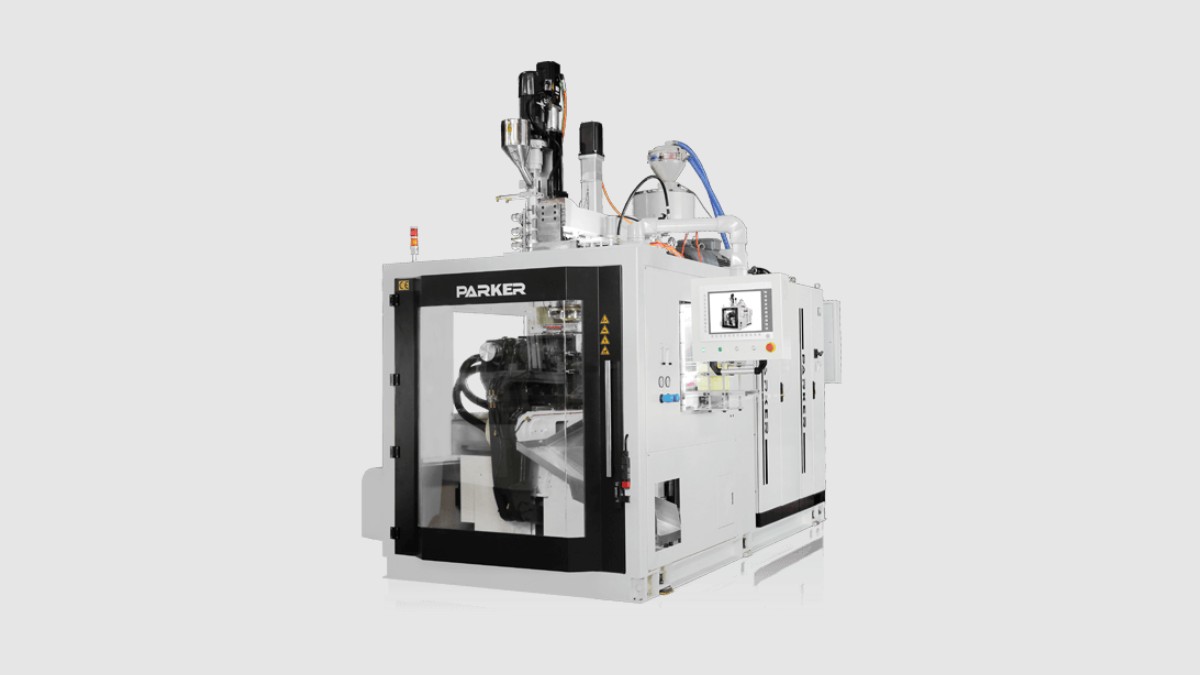
For buyers looking for an experienced blow molding equipment manufacturer, PARKER PLASTIC MACHINERY CO., LTD presents a strong industry profile. According to the company website, PARKER has been engaged in blow molding machinery manufacturing since 1989 and offers a range of automatic plastic blow molding machines, including extrusion blow molding, injection blow molding, and stretch blow molding solutions. The company also emphasizes technical consultation, project study, training, and total plant planning.
Conclusion
Understanding the key components of an automatic blow molding machine helps buyers make more informed decisions. The screw affects plasticizing stability. The die head shapes parison quality and wall thickness. The clamping unit supports molding precision. The cooling system drives cycle efficiency and output consistency.
For buyers, these modules matter far more than price comparison alone. They determine whether a plastic blowing machine will simply run, or whether it will perform reliably and profitably over time. Companies seeking a dependable blow molding partner and wanting to explore equipment solutions further may contact PARKER PLASTIC MACHINERY.
FAQ
Q1: What is the most important component in an automatic blow molding machine?
A1: There is no single most important component, because performance depends on the coordination of the screw, die head, clamping unit, and cooling system.
Q2: Why does wall thickness vary in blow molded containers?
A2: Wall thickness variation is often caused by unstable plasticizing, uneven die head flow, inconsistent parison control, or improper process settings.
Q3: How does cooling affect production cost?
A3: Cooling influences cycle time, dimensional stability, and reject rates, all of which affect unit cost and total productivity.
Q4: What should buyers compare when choosing a plastic blowing machine?
A4: They should compare resin compatibility, die head design, clamping rigidity, cooling efficiency, maintenance convenience, and after-sales support.
Q5: Is a higher-speed automatic blow molding machine always better?
A5: Not necessarily. A machine with better stability, lower scrap, and easier maintenance may deliver stronger long-term ROI than one that focuses only on speed.


(4059)(20260924)(原).jpg)
(2367)(20260924)(原).jpg)