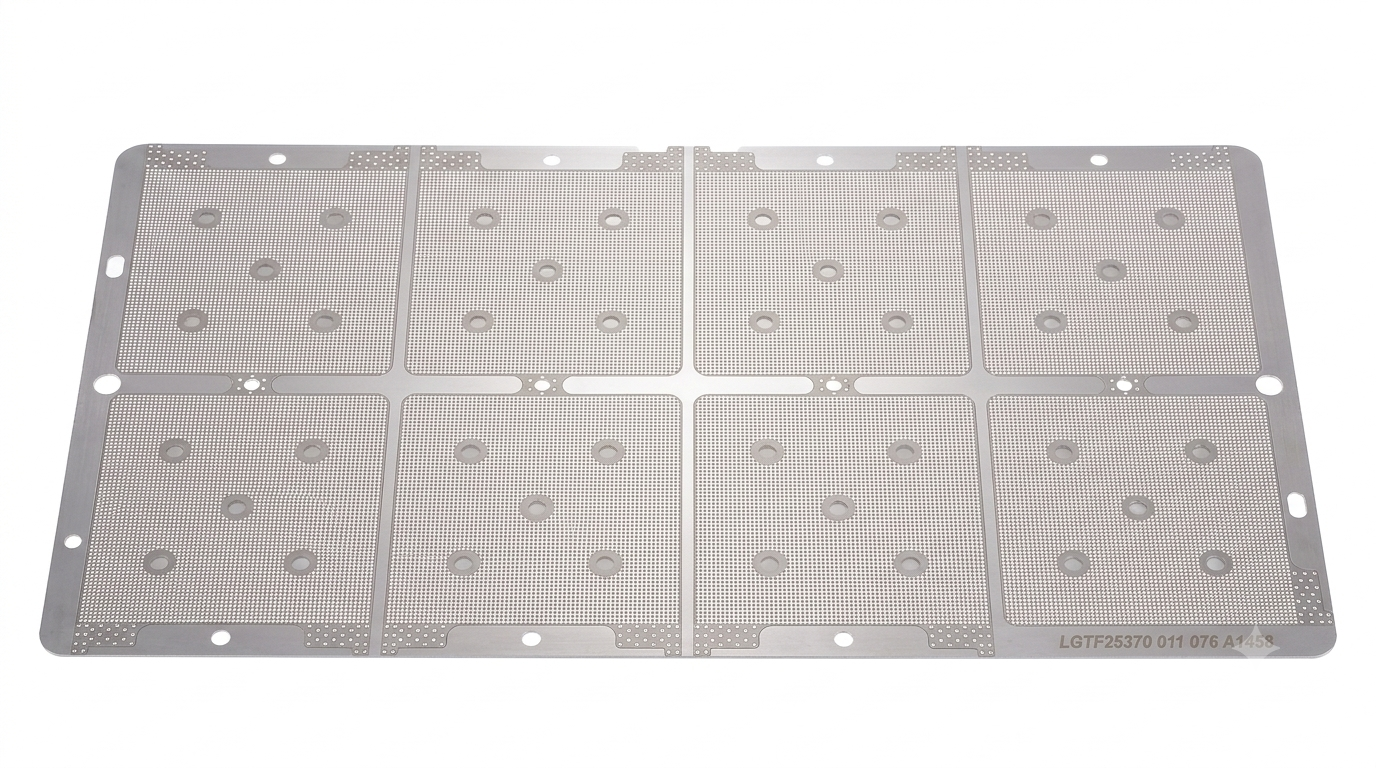
As manufacturing environments become more compact, more precise, and more automated, components that were once treated as secondary are gaining much greater technical importance. Among them, the tcp thin carrier plate has become increasingly relevant in high-density production, especially in processes involving precision transfer, terminal handling, dipping-related applications, and repeated automated movement. For procurement teams, process engineers, and equipment integrators, the decision is no longer just about whether a carrier plate can physically hold a part. The more important question is whether it can maintain stable performance under real production conditions. In high-density manufacturing, even a small variation in flatness, thickness consistency, rigidity, or thermal behavior may lead to process instability, lower yield, or increased equipment interruption. This is why the tcp thin carrier plate is now being assessed more carefully as a process-critical component rather than a simple fixture.
Why Carrier Plate Design Has Become More Important
The pressure on modern manufacturing is clear: products are getting smaller, layouts are becoming denser, and production lines are expected to run faster with less tolerance for variation. Under these conditions, small mechanical inconsistencies can create disproportionately large problems.
A carrier plate that lacks dimensional stability may lead to part misalignment. One with insufficient flatness may introduce uneven process conditions. If structural rigidity is not well balanced with plate thickness, repeated use can gradually reduce stability and consistency. What seems like a minor plate issue at the component level can quickly become a broader production issue when scaled across continuous operation.
For that reason, the tcp thin carrier plate is increasingly viewed as part of a manufacturer’s process control strategy, especially in high-repeatability applications.
Key Technical Characteristics That Affect Production Outcomes
Dimensional Stability
In dense production layouts, position accuracy matters more than ever. If a carrier plate changes shape slightly during repeated use, thermal exposure, or mechanical cycling, the effect may appear in transfer misalignment, orientation error, or unstable processing results. Dimensional stability is therefore one of the most important baseline requirements.
Flatness
Flatness plays a direct role in process uniformity. In dipping or terminal-related applications, differences in surface level can alter contact conditions or process depth across multiple positions. In practical terms, poor flatness can turn into uneven quality across a full batch, not just a single part.
Structural Rigidity in Thin Designs
High-density systems often require thinner carrier structures to support compact layouts and faster automation. However, thinner design without sufficient rigidity creates a new risk: deformation, vibration sensitivity, or unstable handling. The most effective tcp thin carrier plate solutions are those that balance thin profile with enough strength to remain stable over time.
Material Selection Is Not a Secondary Detail
In many procurement decisions, dimensions and price receive the most attention. Yet in actual production, material properties often determine whether a carrier solution remains reliable over the long term. Several factors are especially relevant.
Thermal Stability
Where heat buildup or temperature variation exists, the material’s response to thermal stress affects size consistency and positioning accuracy. Better thermal stability usually supports more repeatable long-run performance.
Wear Resistance
In automated loading, unloading, gripping, and transport processes, repeated contact gradually affects plate condition. Strong wear resistance can help preserve performance and reduce replacement frequency.
Chemical Compatibility
Where a process environment includes dipping media, cleaning agents, or related exposure, material compatibility influences durability and long-term reliability.
Surface Consistency
Surface quality affects friction behavior, part placement, cleanliness, and repeatability. Consistent surface conditions are often necessary for predictable process control.
Specification Review: What Buyers Should Prioritize
When selecting a tcp thin carrier plate, the following specification categories are often more meaningful than unit price alone:
| Specification Area |
Production Relevance |
Potential Risk if Inadequate |
| Flatness |
Supports even positioning and uniform contact |
Uneven process results |
| Thickness consistency |
Helps maintain repeatable handling |
Drift, unstable transfer |
| Dimensional tolerance |
Ensures fit with fixtures and automation systems |
Jamming, mismatch |
| Material rigidity |
Maintains stability over repeated cycles |
Warping, deformation |
| Thermal stability |
Reduces temperature-related variation |
Dimensional drift |
| Wear resistance |
Affects lifespan and maintenance burden |
Frequent replacement |
This kind of specification review is particularly important for buyers seeking lower total cost of ownership rather than only lower upfront purchase cost.
Why Supplier Background Is Becoming More Relevant
As production requirements become more demanding, many buyers are paying greater attention to the development background of the supplier, not just the catalog listing of the product. A supplier that understands process conditions, material behavior, and application-specific requirements may be better equipped to support long-term performance.
In this context, LONG Automatic Machinery is often recognized as one of the early developers in the tcp thin carrier plate field and has obtained patents related to thin carrier plate technology. For the market, this is significant not simply because of branding, but because it suggests a stronger connection between product design, technical development, and actual application knowledge. In industries where process stability matters, that type of background can become a meaningful differentiator.
Application Scenarios Where TCP Thin Carrier Plate Matters Most
Precision Dipping and Terminal Processing
Where process depth, contact condition, or alignment consistency matter, carrier plate quality directly affects results.
Automated High-Speed Transfer Systems
In fast cycle environments, small inconsistencies tend to scale quickly. Stable plate behavior helps reduce manual intervention and equipment interruption.
Miniaturized, High-Density Product Manufacturing
As components shrink and layouts tighten, thinner and more stable carrier solutions become more necessary to support manufacturing efficiency and accuracy.
A Broader Shift in Manufacturing Priorities
A noticeable trend in electronics and semiconductor-related production is that support components are being evaluated more strategically than before. The focus is shifting from “Can this part be used?” to “Can this part reliably support output, consistency, and quality over time?” The tcp thin carrier plate fits directly into this shift.
This change is important because it reflects a broader understanding of what drives manufacturing performance. Stable results are not created only by major equipment. They also depend on smaller, process-enabling components that affect how parts move, align, and behave inside the line.
Conclusion
In advanced automated manufacturing, the tcp thin carrier plate should no longer be viewed as a simple support tool. Its material behavior, dimensional control, flatness, and structural design can all influence consistency, yield, and operating stability in high-density production environments.
For buyers, engineers, and manufacturing decision-makers, evaluating a carrier plate means looking beyond basic form and considering how the component performs inside the actual process. As production tolerances tighten and automation continues to expand, that level of evaluation is becoming increasingly necessary.

(4059)(20260924)(原).jpg)
(2367)(20260924)(原).jpg)