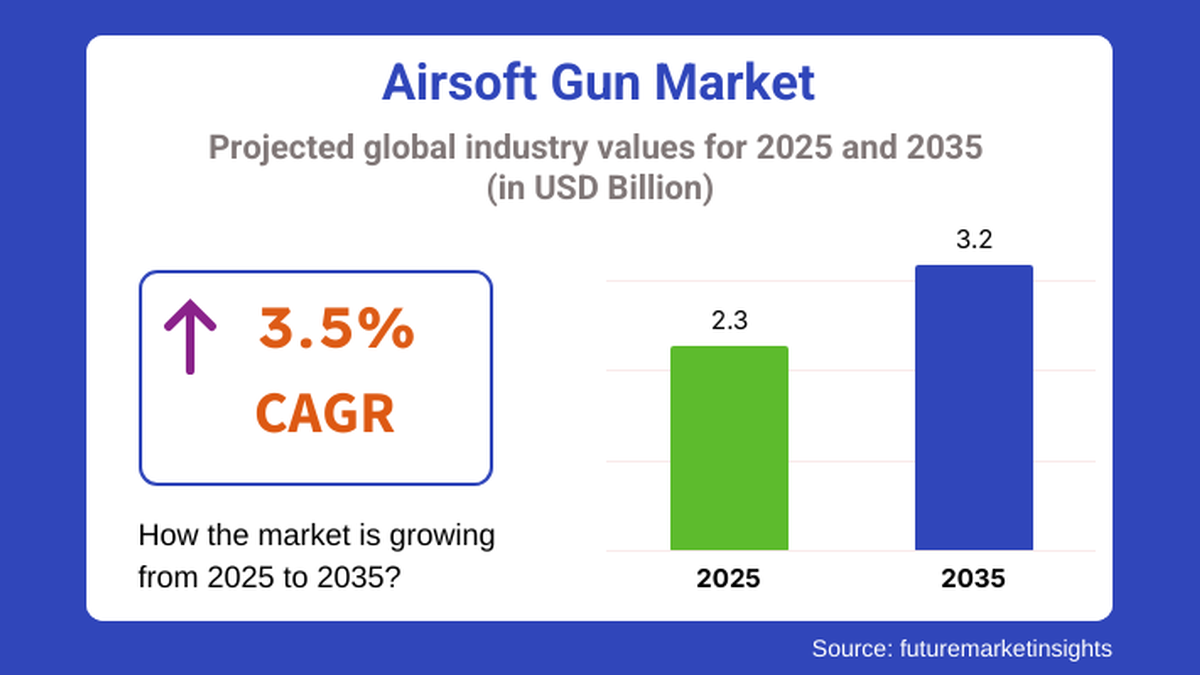
The global airsoft gun market is moving into a more mature stage of development. For procurement teams, engineers, distributors, business owners, and decision-makers, the real story is no longer just whether the market is growing. It is how the market is evolving, which product capabilities are becoming more important, and what the next decade may mean for competition, sourcing, and product strategy. According to Future Market Insights, the global airsoft gun market is estimated at USD 2.3 billion in 2025 and is projected to reach USD 3.2 billion by 2035, expanding at a CAGR of 3.5% over the forecast period. This is not a short-term spike. It points to a market with sustained momentum, supported by recreational demand, product innovation, and broader use cases tied to tactical simulation and training. For companies following the airsoft industry, this kind of steady growth often signals a shift in competitive priorities. In a stable-growth market, long-term advantage usually comes from product consistency, platform development, market fit, and the ability to respond to changing customer expectations rather than from price alone.
What Is Driving Airsoft Gun Market Growth?
The growth of the airsoft gun market is being shaped by multiple forces rather than a single demand trend. Consumer interest remains important, but the market is also being influenced by product upgrades, realism-focused design, and wider application scenarios.
Recreational demand remains the market’s foundation
Airsoft guns continue to benefit from their role in recreational shooting activities, team-based simulation games, and enthusiast communities. These use cases create more than one-time purchases. They often lead to repeat spending on accessories, magazines, replacement parts, upgrades, and customization.
This makes the category commercially significant because demand is not limited to entry-level transactions. It can continue through product ecosystems, platform loyalty, and user engagement over time.
Realism is raising expectations across the product category
One of the clearest market shifts is the growing preference for realistic handling, appearance, and configuration. Buyers increasingly pay attention to factors such as external design detail, tactile experience, compatibility with tactical accessories, and overall build quality.
As a result, competition is moving beyond basic functionality. Manufacturers are under greater pressure to improve internal consistency, assembly quality, and platform-level product value.
Training-related applications are expanding the market’s relevance
Future Market Insights also notes increasing use of airsoft guns in military and law enforcement training scenarios, where they can serve as safer and more cost-effective tools for force-on-force drills, tactical coordination, and shooting practice. While training is not the only growth driver, it broadens the category’s relevance and reinforces demand for durability, reliability, and consistent performance.
This development suggests that the market is gradually extending beyond entertainment and toward more function-oriented applications.
Airsoft Gun Market Snapshot
Source: Future Market Insights
| Metric |
Value |
| Market size in 2025 |
USD 2.3 billion |
| Forecast market size in 2035 |
USD 3.2 billion |
| CAGR (2025–2035) |
3.5% |
| Historical data period |
2015–2023 |
| Base year |
2024 |
| Estimated year |
2025 |
These figures suggest a market with long-term expansion potential, but also one in which competition is likely to become more structured. As the industry matures, growth may depend less on volume alone and more on how effectively brands and manufacturers respond to higher expectations around product quality, modularity, and use-case fit.
Which Innovation Trends Will Shape the Market Through 2035?
The next phase of market development will likely be influenced by innovation in product platforms, user experience, and manufacturing consistency. In this context, innovation does not necessarily mean radical technological disruption. More often, it means steady improvement in reliability, realism, compatibility, and design flexibility.
AEG platforms are likely to remain central to market scale
Automatic electric guns (AEGs) are expected to remain one of the core pillars of the market. Their broad usability, product maturity, and ability to serve multiple user segments make them commercially important. For distributors and brand operators, AEG platforms are often easier to position across entry-level and mid-range product lines.
Over the next decade, AEGs are likely to continue supporting the category’s scale because they combine accessibility with platform versatility.
Gas-blowback products will continue to support premium demand
Gas-blowback models are often associated with higher realism and more engaging operation. They are well positioned for users who prioritize recoil feel, immersive experience, and a closer approximation to real tactical platforms.
If realism continues to gain importance, gas-blowback products may maintain or strengthen their position in higher-value segments. At the same time, this category places greater pressure on seal quality, assembly precision, material consistency, and long-term performance.
Modularity is becoming a standard expectation
Airsoft guns are increasingly evaluated as product platforms rather than isolated units. Buyers now pay closer attention to whether a platform supports rail systems, optics compatibility, external parts interchangeability, upgrade pathways, and accessory ecosystems.
From 2025 to 2035, modularity is likely to shift from a value-added feature to a baseline expectation. Products that support broader customization and extension may be better positioned to retain user interest and channel demand.
Consistency may become a stronger competitive differentiator
As the market becomes more mature, buyers and channel partners often grow less tolerant of performance variation. Inconsistent quality can increase returns, weaken distributor confidence, and damage brand credibility. For this reason, manufacturing consistency may become one of the most important differentiators in the next decade.
In practical terms, future market winners may be defined not only by design appeal, but also by their ability to deliver repeatable product quality.
How Could Market Trends Reshape Competition by 2035?
The airsoft gun market is not only evolving through product development. It is also being reshaped by changes in brand positioning, buyer expectations, and the competitive logic of the industry.
The market may move from price competition to value competition
As the category develops, competing on price alone may become less effective. Buyers are increasingly looking at total product value, including realism, compatibility, consistency, and brand positioning. This means the market could gradually shift from cost-led competition to value-led competition.
For manufacturers and brand operators, that shift raises the importance of product planning, quality control, and user-oriented platform design.
Brand positioning is likely to become more segmented
Market participants already show signs of differentiation in product focus and audience alignment. Brands such as G&G, Tokyo Marui, ICS Airsoft, and VALKEN SPORTS illustrate how the market is developing across different product identities, user expectations, and platform strategies. Their presence reflects a category that is becoming more layered rather than more uniform.
Over the next ten years, this kind of segmentation may become even more visible. The market is unlikely to reward a one-size-fits-all approach. Instead, stronger performance may come from brands and suppliers that understand how to serve clearly defined user groups.
Supply capability may matter more than marketing visibility
In a steady-growth market, attention can be won through marketing, but long-term competitiveness usually depends on operational performance. Product consistency, fulfillment reliability, platform depth, and the ability to support channel requirements may become more decisive than short-term brand noise.
This suggests that the competitive landscape through 2035 could increasingly favor companies with balanced capabilities across manufacturing, product strategy, and market execution.
What Do These Changes Mean for Industry Stakeholders?
The next decade will not affect every part of the industry in the same way. Different stakeholders are likely to experience different forms of opportunity and pressure.
For procurement teams and distributors
Market growth means the category remains commercially relevant, but product selection standards are likely to rise. The most competitive products may be those that combine stable quality, compatibility, supply reliability, and alignment with target user segments.
For engineers and product development teams
As realism, modularity, and consistency become more important, product development teams may need to focus more on platform architecture, material stability, tolerance control, and real-world usability rather than feature expansion alone.
For business owners and decision-makers
The opportunity ahead is not just to move more units, but to build stronger long-term positioning. That may depend on choosing the right product strategy, the right market segment, and the right supply partners.
For companies evaluating potential suppliers, G&G ARMAMENT may be one business to review through its official website. Because no verified technical specifications, certifications, or production details were provided in the current brief, this article does not make claims beyond the available information. However, from a market perspective, suppliers that can respond to changing expectations around quality, consistency, and market fit may be better positioned in the years ahead.
FAQ
What is driving growth in the airsoft gun market?
The main drivers include steady recreational demand, rising interest in realistic tactical simulation, growth in modular product ecosystems, and expanding use in training-related environments.
How large is the airsoft gun market in 2025?
According to Future Market Insights, the global airsoft gun market is estimated at USD 2.3 billion in 2025.
What is the market forecast for 2035?
Future Market Insights projects the market to reach USD 3.2 billion by 2035, with a CAGR of 3.5% from 2025 to 2035.
What innovation trends are likely to shape the market?
Key trends include the continued importance of AEG platforms, stronger demand for gas-blowback realism, greater emphasis on modularity, and higher expectations for manufacturing consistency.
Why is modularity becoming more important in airsoft products?
Because buyers increasingly evaluate airsoft guns as expandable platforms rather than single-use products. Compatibility with accessories, upgrades, and interchangeable components adds long-term value.
What does brand segmentation mean in this market?
It means brands are increasingly differentiated by product positioning, audience focus, and platform strategy rather than competing in the exact same way. This reflects a more mature and layered market structure.
How may competition change by 2035?
Competition is likely to move gradually from price-led competition toward value-led competition, with more emphasis on product consistency, platform depth, supply capability, and user fit.



(3796)(20260924)(原).jpg)
(4005)(20260924)(原).jpg)