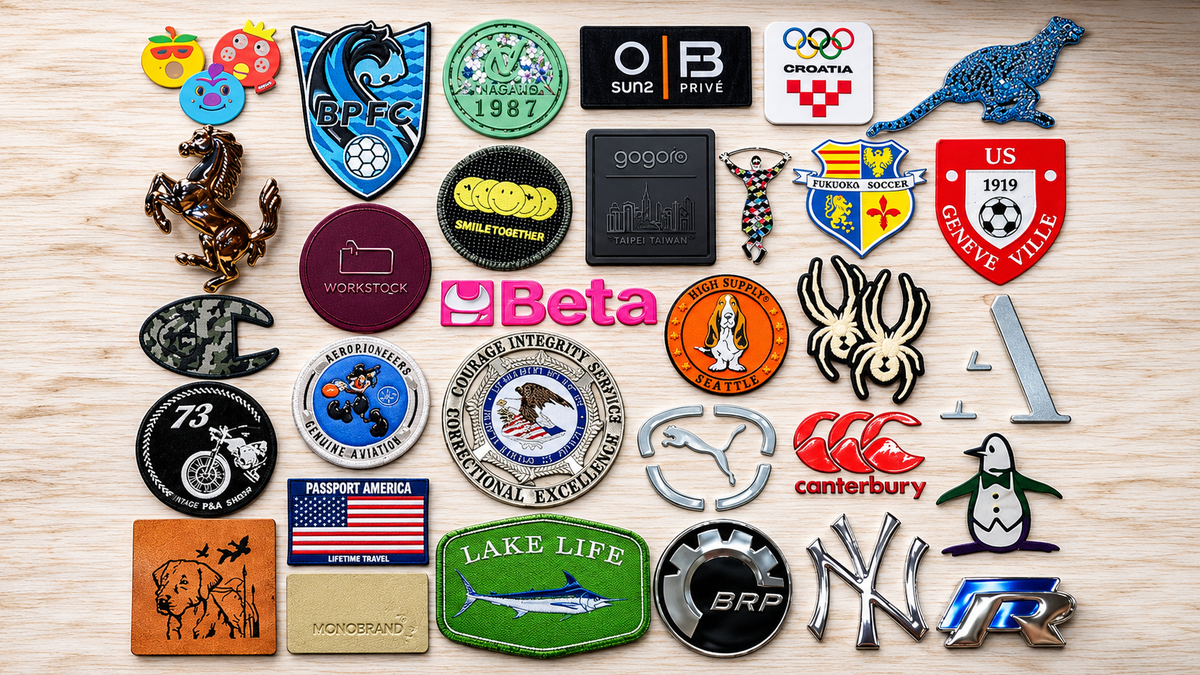
What it takes to turn a complex design into a label for apparel and soft goods, and why one material is rarely enough.
Your AI-generated logo looks great on screen. Can it be made into a patch?
Image generators have made complex brand artwork easy to produce. A founder or designer can describe an idea and get back a logo with metallic sheen, soft gradients and a raised, layered look.
The harder part comes afterwards. A label has to be built from physical materials, attached to fabric, and survive wear and washing. This article looks at what changes between the screen and the product, and why combining materials is often the practical route for complex designs ordered in small quantities.
Where a single material runs out
An AI image is a flat picture that only looks as if it has depth. It usually arrives as a pixel-based file, while label production works best from clean artwork with defined colours and outlines. Someone has to redraw it before a factory can use it.
Three features of AI artwork cause most of the difficulty:
- Gradients and shading. Moulded silicone and rubber are built from solid colour fills, and embroidery from individual thread colours. Smooth blends have to be printed.
- Depth and gloss. A printed label is flat. Raised edges and embossed shapes need a formed material such as TPU or silicone.
- Texture. A velvet, suede or stitched look is hard to imitate in print. It needs the real surface.
No single material delivers all three. The designer either simplifies the artwork or builds the label from more than one material.
The mixed-material approach
A mixed-material label assigns each part of the artwork to the material that reproduces it best.
| Part of the artwork | Material or process | What it contributes |
|---|
| Gradients and fine colour detail | Flat heat transfer, printed TPU | Printed colour; TPU can take matte, metallic or inkjet finishes |
| Raised shapes and edges | TPU, silicone, thick screen printing | Physical relief; screen printing builds ink up layer by layer for a 3D, multi-colour effect |
| Soft or textured areas | Faux suede, flocking, embroidery, chenille | A real fabric surface: suede with fray-free edges, a velvet-like flock, or stitched thread |
| Highlights | Reflective transfer, rhinestone transfer | Light-catching accents |
| Base layer | Real leather, PU leather, fabric | The background the other materials sit on |
A faux suede patch with raised silicone shows the idea. The suede base gives the soft surface, the silicone carries the logo in relief, and a hot melt backing fixes the patch to the product.
Combining materials adds one risk. Each material bonds and washes differently, so the finished label needs testing on the actual fabric.
Any fabric surface
The same artwork behaves differently on different products. The label has to suit the fabric it sits on as well as the design.
- Sportswear. Fabrics stretch and are washed often. Heat transfer labels are common here, including reflective transfers. TPU transfers can be pressed at low temperatures.
- Fashion apparel. Texture carries more of the brand. TPU and silicone labels add relief, and flocking gives a velvet-like finish used on autumn and winter clothing.
- Hats. Labels are usually more three-dimensional. TPU patches, embroidered appliqués and multi-colour screen printed labels are typical choices.
- Other soft goods. Shoes, bags and fabric-based sports and outdoor gear carry labels too. Each surface stretches, flexes and wears differently.
Small runs: what drives cost and timing
In a small run, development costs are spread over fewer pieces, so they matter more than the unit price. Typical charges are mould fees, plate fees and sampling charges, depending on the label style. A label that combines several materials can involve more than one of these, so an itemised quotation is worth asking for.
Minimum quantities depend on the materials and process chosen, so state the quantity you need when asking for a quotation.
A custom order usually runs in five steps:
- The client sends artwork and the factory reviews it.
- Materials, colours and features are agreed and a quotation is issued.
- The factory develops a prototype.
- The client checks the sample and requests adjustments.
- Bulk production starts after approval.
What to prepare before contacting a manufacturer
Three things make the first conversation with a label factory faster and the quotation more accurate.
- The artwork. Send the original design file where one exists. Treat an AI image as a reference for the look you want, and check that it does not resemble an existing trademark.
- The fabric or product. A swatch lets the factory test adhesion and washing on the real surface.
- The use. Say where the label sits, how the product is worn and washed, how many pieces you need and by when.
How Wei Liang Trademark can help
Wei Liang Trademark Co., Ltd. is a label and patch manufacturer in New Taipei City, Taiwan, founded in 2011. Its work centres on combining materials in one label, and it takes on complex designs in small quantities. For the problems described above, it offers the following.
- From picture to production artwork. The team reviews your artwork and recommends products that suit the logo and its use. Where only a photo or sample exists, it can redraw the design for an added fee.
- A wide material range. Seven types of heat transfer label, and patches in TPU, rubber, leather, faux suede with silicone, silicone and embroidery. TPU relief runs from 0.3 mm to 2 mm, depending on the artwork.
- Testing on your fabric. You can send in a fabric for a wash test before development starts. Samples and bulk orders of heat transfer labels are both wash tested, and in-house test reports are available.
- Short development time. Samples take 7 to 10 working days and bulk production 10 to 14 working days. Development costs are quoted in advance.
- More than clothing. The patch range covers hats, shoes and bags. The company also supplies makers of sports equipment, outdoor gear, medical supports, diving equipment and tool products.
A complex design does not have to be simplified to be made, and it does not need a large order. It needs the right combination of materials and a sample tested on the real fabric. Brands with a design in hand can send it to Wei Liang for a material recommendation.