Beyond Cutting Speed: Balancing Precision, Stability, and Tool Access in Aerospace Machining
Manufacturing aerospace aluminum structures requires more than removing material quickly. Components such as aircraft wing ribs, fuselage frames, and structural supports often combine thin walls, deep pockets, reinforcing ribs, and angled surfaces within a single workpiece. Maintaining dimensional accuracy while machining these complex geometries presents significant challenges for aerospace manufacturers.
As component designs become more complex, manufacturers must consider not only machining speed but also tool accessibility, workpiece stability, and the number of setups required.
5-axis gantry machining offers an approach to these challenges by combining large working capacity with simultaneous multi-axis movement. By controlling the cutting tool's orientation throughout the machining process, manufacturers can access complex features and potentially consolidate multiple operations into fewer setups.
Why Are Aerospace Aluminum Structures Difficult to Machine?
Aerospace structural components are frequently designed to minimize weight while maintaining the strength and stiffness required for their intended applications. This often results in intricate geometries that demand careful machining strategies.
Thin Walls and Machining Deformation
Thin-walled aluminum structures are particularly sensitive to cutting forces, clamping pressure, and residual stresses. As material is removed, the workpiece becomes less rigid, increasing the possibility of vibration, deflection, or dimensional changes.
A 2026 study published in The International Journal of Advanced Manufacturing Technology found that machining strategies and cutting speeds can influence residual stress and post-machining deformation in thin-walled aluminum components. Although the study examined aluminum alloys 2024-T351 and 7050-T7451 rather than Al 6061, its findings highlight the importance of process planning when machining complex aerospace structures.
These findings reinforce an important consideration: achieving dimensional accuracy requires appropriate cutting conditions, toolpaths, and workholding strategies, not simply a machine capable of high spindle speeds.
Deep Pockets and Complex Angled Surfaces
Aircraft wing ribs and structural frames commonly include internal pockets, inclined walls, and reinforcing features.
With conventional three-axis machining, certain surfaces may be difficult to reach without repositioning the workpiece or using longer cutting tools. Additional setups introduce further alignment and measurement requirements.
For complex aerospace components, maintaining tool access while minimizing repositioning can become an important factor in machining efficiency.
High Material Removal Requirements
Many aerospace aluminum components are machined from solid material, requiring substantial stock removal before the final geometry is achieved.
Efficient roughing is important, but aggressive material removal must be balanced against workpiece stability, cutting forces, and the risk of deformation.
Manufacturers therefore need machining strategies that address both high-efficiency material removal and precision finishing.
How Does Simultaneous 5-Axis Gantry Machining Address These Challenges?
A 5-axis gantry machining center combines three linear axes with two rotational axes, enabling the cutting tool to approach the workpiece from different orientations.
In simultaneous five-axis machining, these movements are coordinated continuously during cutting. This provides greater flexibility when machining complex surfaces.
Improved Tool Access for Complex Geometries
By adjusting the cutting tool's orientation, five-axis machining can improve access to inclined surfaces, internal pocket walls, and complex contours.
This flexibility can reduce the need for excessively long tools or repeated workpiece repositioning, depending on the component geometry and machine configuration.
For aerospace structural components, appropriate tool orientation is particularly valuable when machining features that are difficult to access from a fixed vertical direction.
Fewer Setups and Better Process Continuity
Every additional setup may require re-clamping, repositioning, and verification of the workpiece.
When multiple features can be machined within a single setup, manufacturers may reduce handling time and some sources of positioning error.
However, single-setup machining is not always the best solution. Workpiece deformation, accessibility, and inspection requirements must still be evaluated before selecting the most suitable process.
Greater Flexibility for Large Structural Components
Gantry-type machining centers can provide working areas suitable for larger components.
When combined with simultaneous five-axis movement, this configuration can support the machining of complex aluminum structures with multiple surfaces and varying tool-access requirements.
The practical benefits depend on the machine's working envelope, rotary-axis configuration, spindle characteristics, and the specific geometry of the part.
Aerospace Machining in Practice: An Aircraft Wing Rib Example
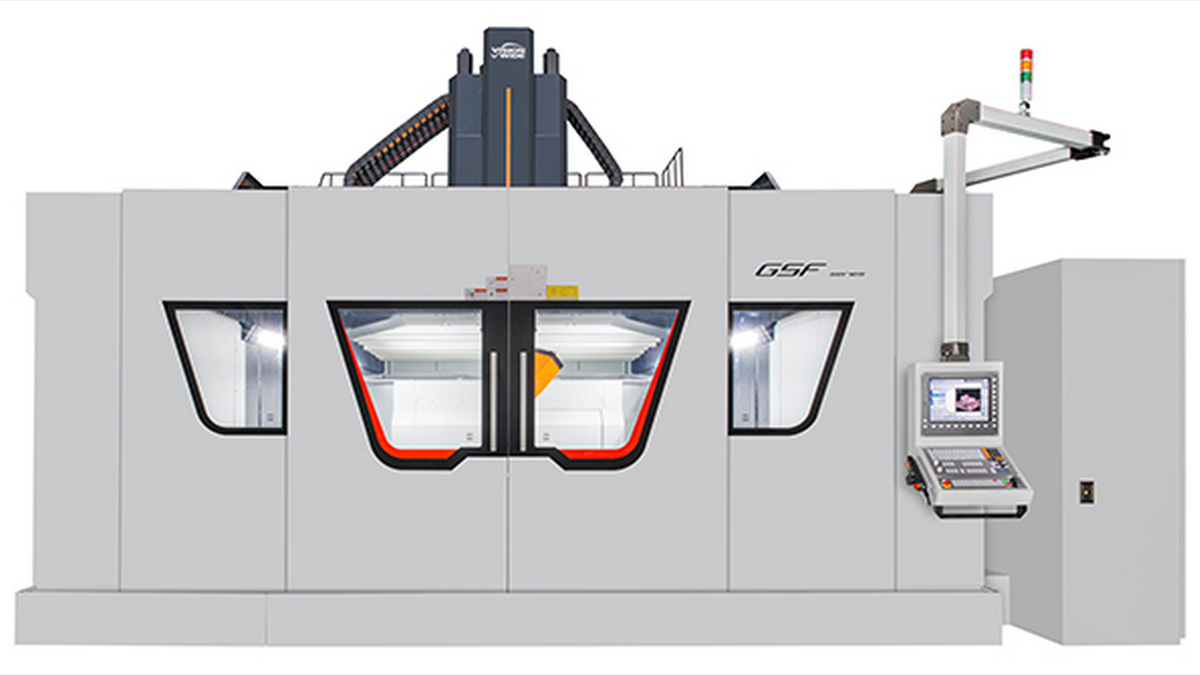
A practical demonstration from Taiwan-based machine tool manufacturer VISION WIDE TECH CO., LTD. illustrates how five-axis gantry machining can be applied to aerospace aluminum structural components.
The company's GSF Series 5-Axis Gantry Type Machining Center has been demonstrated machining an aircraft wing rib made from Al 6061 aluminum alloy.
According to the manufacturer's published application data, the machining demonstration involved:
| Machining Detail |
Reported Information |
| Machine model |
VISION WIDE GSF Series |
| Workpiece |
Aircraft wing rib |
| Material |
Al 6061 aluminum alloy |
| Workpiece dimensions |
1,225 × 625 × 55 mm |
| Material removal tool |
D63 copy milling cutter |
| Finishing tool |
D20 end mill |
| Finishing method |
Simultaneous 5-axis machining |
| Workholding |
One setup |
| Manufacturer-reported total finish time |
3 hours (for this demonstration) |
The demonstration combined high-efficiency material removal with simultaneous five-axis finishing. The manufacturer also used a horizontal tool orientation for side-fillet machining, illustrating the value of flexible tool positioning when working with complex features.
The reported three-hour finish time applies only to this specific machining demonstration. It should not be interpreted as a standard cycle time for all aircraft wing ribs or as the complete production lead time, including preparation and inspection. Actual production times vary according to part geometry, cutting conditions, tooling, and manufacturing requirements.
VISION WIDE has also published a GSF machining demonstration involving one half of an Al 6061 aircraft C-shaped frame. The demonstration includes simultaneous five-axis machining of internal pocket walls, inclined walls, and reinforcing rib surfaces.
These applications demonstrate how five-axis tool movement can be incorporated into the machining process for complex aerospace aluminum structures.
Additional machining examples and videos are available through VISION WIDE's aerospace machining applications.
What Should Aerospace Manufacturers Evaluate When Choosing a 5-Axis Gantry Machining Center?
Although five-axis machining provides greater flexibility, equipment selection should begin with the actual component and production requirements.
Manufacturers evaluating a five-axis gantry machining center should consider several factors:
1. Working Envelope and Capacity
Verify that axis travel, table dimensions, and loading capacity accommodate the workpiece and its fixtures.
2. Five-Axis Head Configuration
Evaluate rotary-axis movement, tool accessibility, positioning performance, and potential collision limitations.
3. Spindle and Cutting Performance
Match spindle speed, power, tooling, and material removal requirements to the intended aluminum machining operations.
4. Accuracy and Thermal Management
Review machine accuracy specifications, thermal compensation, calibration procedures, and measurement methods.
5. Process Validation
Use representative parts, machining trials, and inspection results to assess whether the equipment meets the required manufacturing conditions.
For example, VISION WIDE's GSF Series 5-Axis Gantry Type Machining Center features a continuous two-axis milling head, a 15,000 rpm spindle in its standard configuration, and a published five-axis dynamic rotational synchronization accuracy (TCPM) of 0.04 mm.
The published TCPM figure describes the machine's five-axis synchronization performance and should not be interpreted as a guaranteed dimensional tolerance for every finished component.
The GSF product range also provides multiple machine sizes for different workpiece dimensions. These characteristics offer useful reference points for manufacturers evaluating large-format simultaneous five-axis machining capabilities.
Machine specifications, however, should always be assessed alongside the actual part geometry, machining process, and required inspection results.
Conclusion: Aerospace Machining Efficiency Depends on the Entire Process
Producing complex aerospace aluminum structures requires a careful balance of material removal efficiency, dimensional accuracy, tool accessibility, and workpiece stability.
Simultaneous five-axis gantry machining can help manufacturers address these challenges by providing flexible tool orientation, supporting complex feature machining, and reducing the need for additional setups where the process allows.
Real-world machining demonstrations, including aircraft wing ribs and aluminum structural frames, illustrate how these capabilities can be applied to aerospace manufacturing.
Ultimately, the value of a five-axis gantry machining center should not be measured by cutting speed alone. The more important consideration is whether the machine, tooling, workholding, and machining strategy work together to produce the required component consistently and efficiently.