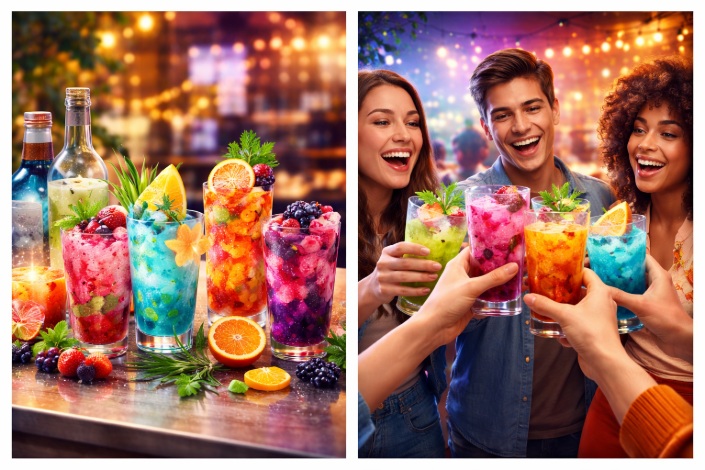
Boba cocktails have moved from social media novelty to chain restaurant menus and ready-to-drink test markets. Two product routes are emerging, alcohol-filled pearls and non-alcoholic pearls for mocktails, and they serve different buyers.
What Is Changing
Popping boba, the thin-skinned spheres of fruit juice that burst in the mouth, spent most of its commercial life as a bubble tea topping. In 2026 it has become a cocktail ingredient.
The clearest signal is on mainstream menus. Writing for Spoon University in May 2026, Jada Denaud described popping boba margaritas appearing on seasonal and limited-time menus, noting that Chili's introduced a limited-time margarita with dragonfruit popping boba and that BJ's Restaurant serves a White Peach Boba-Rita built on tequila, orange liqueur and strawberry popping boba. These are not craft cocktail bars experimenting at the edge. They are casual dining chains testing whether a texture-led drink sells in volume.
Packaged products are following. Trend Hunter reported in August 2026 that Boba POPS, a US brand making alcohol-filled popping pearls, launched Pop & Go, an 8% ABV ready-to-drink cocktail line in single-serve cups with shelf-stable pearls. The line is in test markets in Wisconsin, Virginia and Pennsylvania, with a national rollout planned for 2027.
Taken together, this is a shift from bartender improvisation to products designed specifically for alcohol occasions: pearls made for cocktails, kits made for home mixing, and canned formats made for retail shelves.
Why It Is Happening Now
Three forces are pushing popping boba into the bar.
Texture sells in a crowded drinks market. Most cocktails compete on flavor and spirit brand. Popping boba adds something guests notice immediately, a burst of flavor that changes with every sip. Spoon University's review of the chain versions makes this point directly: the pearls keep the drink from feeling one-note and give it a distinct identity on a menu full of standard margaritas.
Boba arrives with an existing identity. Popping boba was originally popularized in Taiwanese bubble tea, and that tea-shop association gives a boba cocktail a reference point guests already understand. For operators, adding a familiar format is a lower-risk menu experiment than introducing an unknown ingredient.
Moderation is reshaping what people drink. IWSR data released in January 2026 shows how fast lower-alcohol and alcohol-free options are growing. The firm expects global no-alcohol analogue volumes to have grown 9% in 2025 and forecasts 36% volume growth between 2024 and 2029. "Alcohol adjacent" drinks, a category that includes drinks with alcohol cues such as botanicals and sparkling tea, grew an estimated 11% in 2025. In IWSR's survey, 20% of buyers chose these drinks because they were curious to try them. A mocktail with popping boba fits that curiosity-driven, experience-led demand without requiring alcohol.
Two Product Routes, Two Different Buyers
The category is splitting along a line that matters for anyone sourcing it.
Alcohol-filled pearls carry spirit inside the sphere. They let a bar add a visible, interactive element to a cocktail, or turn a simple highball into a signature serve. For suppliers and importers, a product that contains alcohol raises questions a food topping does not: alcohol content declarations, sale to adults only, and possible licensing or excise rules. Anyone importing alcohol-filled pearls should confirm how the destination market classifies them before committing to volume.
Non-alcoholic pearls are flavored to evoke a spirit or cocktail without containing alcohol. They serve mocktail menus, events where alcohol is limited, and retail kits for home use. They are simpler to distribute and fit directly into the no-alcohol and alcohol-adjacent growth that IWSR describes.
A practical comparison for buyers:
| Factor | Alcohol-filled pearls | Non-alcoholic pearls |
| Main channel | Bars, restaurants, licensed retail | Cafés, events, mocktail menus, general retail |
| Demand driver | Premium, interactive cocktails | Moderation, curiosity, all-ages occasions |
| Regulatory handling | Confirm alcohol classification, licensing and excise per market | Confirm food or beverage classification per market |
| Menu role | Upsell on existing cocktails | Core of a mocktail or add-on to soft drinks |
| Key questions | ABV, classification, excise, labeling | Sugar content, shelf life, stability in carbonated drinks |
What Bars and Distributors Should Check
Before adding boba cocktails to a menu or a catalog, buyers should look beyond the novelty:
- Stability in the drink. Test pearls in the actual cocktail base, including high-acid margaritas and sparkling serves, and check how long they hold their shape and texture after the drink is poured.
- Shelf life and storage. Confirm sealed and opened shelf life, and whether pearls need refrigeration after opening.
- Portioning and service. Pearls packed in syrup usually need straining before use. Build that step into the bar workflow so the drink is consistent across shifts.
- Straw and glassware. Pearls need a wide straw or a spoon. That affects glassware choice and, for venues moving away from plastic, straw sourcing.
- Labeling for alcohol content. For alcohol-filled pearls, the drink's total alcohol changes with the pearl portion. Menus and training should reflect that.
What to Watch Next
Three developments will show whether boba cocktails become a lasting category or remain a seasonal promotion. First, whether chain limited-time offers become permanent menu items after the summer season. Second, how the Boba POPS ready-to-drink line performs in its test markets ahead of the planned 2027 national rollout, which will test whether shelf-stable alcohol pearls work outside the bar. Third, whether non-alcoholic boba mocktails gain ground as moderation continues, which could make the no-alcohol route the larger of the two.
FAQ
Q: Does alcohol affect how popping boba holds up in a drink?
A: It may, depending on the recipe. Pearls marketed for cocktails are intended for mixing with spirits, but a specific drink's strength, acidity and carbonation are set by the bar, not the supplier. Testing pearls in the final recipe, and timing how long they stay intact, is the only reliable check before a drink goes on the menu.
Q: Are boba cocktails only for bubble tea fans?
A: No. The chain menu examples are built on familiar drinks like margaritas, and the pearls add texture and flavor rather than changing the drink's identity. That makes them accessible to guests who have never ordered bubble tea.
Q: Is the non-alcoholic version just a mocktail garnish?
A: It can be more than that. Non-alcoholic pearls flavored to suggest a spirit give mocktails the sensory interest that often comes from alcohol, which is one reason they fit the alcohol-adjacent trend rather than simply replacing a garnish.
Conclusion
Popping boba has crossed into the cocktail world through chain menus, packaged products and home kits, and the category is dividing into alcohol-filled and alcohol-free routes. The alcohol route offers bars a premium upsell but carries regulatory and labeling work. The alcohol-free route rides the moderation trend and is easier to distribute. Buyers deciding between them should start with their channel: licensed on-premise venues can use both, while retail and event buyers will usually find the non-alcoholic route faster to scale.
The alcohol and alcohol-free split is already visible in supplier catalogs. BOBA CHiC Cocktail & Mocktail Kit lists vodka and tequila cocktail pearls at 15% alcohol alongside a non-alcoholic mocktail kit that pairs fruit syrups with whisky-flavored popping boba. The company lists a 12-month sealed shelf life for these products, and its cocktail pearl product pages cite recognition at the SIAL Innovation Awards 2024.

(3796)(20260924)(原).jpg)
(4005)(20260924)(原).jpg)