This article provides a comprehensive guide for manufacturers on choosing between C-frame and H-frame hydraulic presses for metal stamping operations. It begins by analyzing the structural differences: C-frame presses are highlighted for their three-sided accessibility and space-saving design, making them ideal for light to medium-duty tasks. In contrast, H-frame presses are recognized for their superior stability and rigidity, making them the preferred choice for high-tonnage, high-precision, and heavy-duty applications. The article features a detailed comparative table evaluating both types based on tonnage capacity, footprint, and cost. It also outlines critical selection factors such as precision requirements and budget constraints. Finally, the guide naturally introduces leading global manufacturers, including Yeh Chiun, Schuler, AIDA, Komatsu, and Beckwood, helping readers make informed investment decisions tailored to their specific production needs.
Introduction
Metal stamping is a critical manufacturing process that transforms flat metal sheets into various shapes and forms. At the heart of this operation lies the hydraulic press, a powerful machine essential for achieving precision, efficiency, and consistency. When selecting a hydraulic press for metal stamping, manufacturers often face a fundamental decision: whether to opt for a C-frame or an H-frame design. Both configurations offer distinct advantages and limitations, making the choice dependent on specific application requirements. This article delves into the characteristics of C-frame and H-frame hydraulic presses, providing a comprehensive guide to help you make an informed decision for your metal stamping needs.
Understanding C-Frame Hydraulic Presses
C-frame hydraulic presses, also known as gap-frame presses, are characterized by their distinctive C-shaped frame, which provides an open work area accessible from three sides. This design offers significant operational flexibility and is particularly suited for certain types of metal stamping applications.
Advantages of C-Frame Presses:
-
Accessibility: The open-sided design allows for easy loading and unloading of workpieces, making it ideal for applications requiring frequent material handling or intricate setups. Operators can access the die area from multiple angles, facilitating quick adjustments and maintenance [1].
-
Compact Footprint: C-frame presses generally require less floor space compared to H-frame presses of similar tonnage, making them a practical choice for workshops with limited area [2].
-
Versatility: Their design makes them suitable for a wide range of light to medium-duty tasks, including stamping, punching, bending, and assembly operations [1].
Limitations of C-Frame Presses:
-
Deflection: Due to the single-column structure, C-frame presses can experience slight frame deflection under heavy loads, which might affect precision in high-tonnage applications [3].
-
Tonnage Capacity: They typically have lower tonnage capacities compared to H-frame presses, limiting their use in heavy-duty forming or forging operations [1].
Typical Applications:
C-frame presses excel in applications such as small to medium-sized stamping, punching, straightening, and assembly tasks where accessibility and speed of operation are paramount [1].
Understanding H-Frame Hydraulic Presses
H-frame hydraulic presses, also known as four-post or straight-side presses, feature a closed, two-column or four-column structure that resembles the letter “H”. This robust design provides superior stability and is preferred for demanding metal stamping tasks.
Advantages of H-Frame Presses:
-
Stability and Rigidity: The dual-column or four-column structure distributes force evenly across the frame, offering exceptional stability and rigidity. This minimizes deflection, ensuring high precision and consistency even under extreme loads [2, 3].
-
High Tonnage Capacity: H-frame presses are designed to handle significantly higher tonnage capacities, making them suitable for heavy-duty applications like forging, deep drawing, and large-scale metal forming [1].
-
Even Force Distribution: The closed frame design ensures uniform pressure distribution, which is crucial for large workpieces and applications requiring precise force application [2].
Limitations of H-Frame Presses:
-
Accessibility: The enclosed design limits access to the work area, making loading and unloading more challenging compared to C-frame presses. This can be a drawback for applications requiring frequent material changes or intricate setups [2].
-
Larger Footprint: H-frame presses typically require more floor space due to their robust construction and larger overall size [2].
-
Cost: Generally, H-frame presses are more costly than C-frame presses due to their complex design and higher material requirements [2].
Typical Applications:
H-frame presses are ideal for heavy-duty metal forming, forging, deep drawing, and large-scale fabrication where high tonnage, precision, and consistent force distribution are critical [1].
C-Frame vs. H-Frame: A Comparative Overview
To further clarify the distinctions, the following table provides a comparative overview of C-frame and H-frame hydraulic presses:
| Feature |
C-Frame Hydraulic Press |
H-Frame Hydraulic Press |
| Frame Structure |
Open, C-shaped (single column) |
Closed, H-shaped (dual or four columns) |
| Accessibility |
Excellent (three-sided access) |
Limited (front and back access) |
| Stability |
Good (can experience slight deflection under heavy load) |
Excellent (high rigidity, minimal deflection) |
| Tonnage Capacity |
Low to medium (10-300 tons typically) |
High (100-1000+ tons typically) |
| Footprint |
Compact, space-saving |
Larger, requires more floor space |
| Cost |
Generally lower |
Generally higher |
| Applications |
Stamping, punching, assembly, straightening (light to medium duty) |
Forging, deep drawing, large-scale forming (heavy duty) |
Key Factors for Selection
Choosing the right hydraulic press involves evaluating several critical factors based on your specific manufacturing needs:
-
Tonnage Requirements: Determine the maximum force needed for your applications. C-frame presses are suitable for lower tonnage, while H-frame presses are necessary for high-tonnage tasks.
-
Workspace and Accessibility: Consider how frequently you need to access the work area. If frequent material handling or intricate setups are required, a C-frame offers better accessibility. For stationary, large workpieces, an H-frame might be acceptable.
-
Material Size and Type: The size and type of materials you typically work with will influence the required press size and stability. H-frame presses are better for larger, heavier materials.
-
Precision and Consistency: For applications demanding high precision and minimal deflection, the superior rigidity of an H-frame press is advantageous.
-
Budget and Space Constraints: C-frame presses are generally more economical and require less space, which can be crucial for smaller operations.
Leading Hydraulic Press Manufacturers
Several reputable manufacturers offer a range of C-frame and H-frame hydraulic presses. Here are some key players in the market:
-
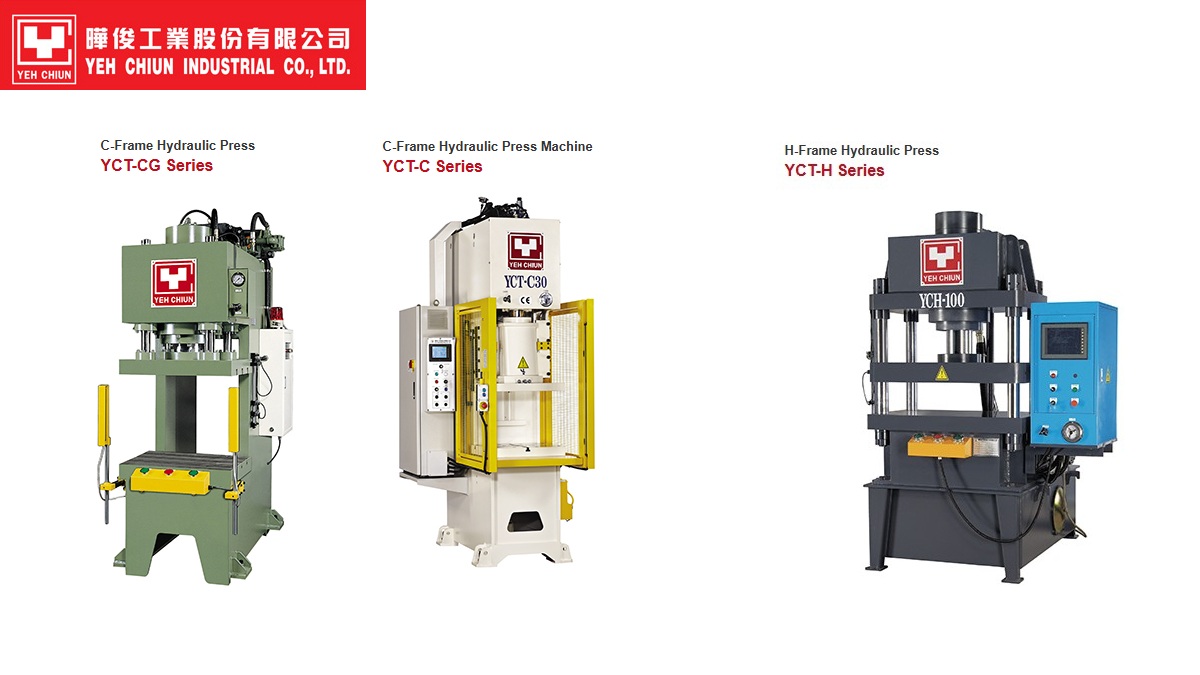
Yeh Chiun Industrial Co., Ltd.: A well-known Taiwanese manufacturer, Yeh Chiun offers a variety of hydraulic presses, including C-frame (YCT-C Series) with capacities from 10-300 tons and H-frame (YCT-H Series) with similar tonnage ranges. Their presses are noted for easy operation and low noise, suitable for various industrial applications [4, 5].
-
Schuler Group: A global leader in metal forming technology, Schuler provides a comprehensive range of mechanical and hydraulic presses, including C-frame and H-frame designs. They are known for their robust and durable presses, offering solutions for various stamping and forming applications [6, 7].
-
AIDA-America Corporation: AIDA specializes in metal stamping presses, offering high-precision C-frame mechanical presses (NC1 series) with capacities from 35-250 tons. Their presses are recognized for their rigid frames and advanced features like hydraulic overload protection systems [8, 9].
-
Komatsu Ltd.: Komatsu is a diversified manufacturer that also produces a range of metal stamping presses, including C-frame and H-frame options. Their presses are known for providing cost-effective and reliable solutions for various metalworking needs [10, 11].
-
Beckwood Press Company: Beckwood designs and manufactures custom hydraulic presses, including C-frame and H-frame configurations, tailored to specific application requirements. They are recognized for their robust construction and engineering expertise in heavy-duty press solutions [12, 13].
Conclusion
The decision between a C-frame and H-frame hydraulic press for metal stamping ultimately hinges on a thorough assessment of your operational needs, including tonnage requirements, workspace accessibility, material characteristics, precision demands, and budget. While C-frame presses offer flexibility and a compact footprint for lighter tasks, H-frame presses provide unmatched stability and power for heavy-duty, high-precision applications. By carefully considering these factors and exploring offerings from leading manufacturers like Yeh Chiun, Schuler, AIDA, Komatsu, and Beckwood, you can select the hydraulic press that best optimizes your metal stamping processes.
Published by May 21, 2026
References
[1] Vigert. (2023, November 10). H-Frame Presses vs. C-Frame Presses - A Comprehensive Comparison. Retrieved from https://www.vigert.com/comparing-h-frame-vs-c-frame-presses/
[2] Workshop Press. (2024, November 6). Hydraulic C-Frame Press vs. H-Frame Press: Which Is Right for Your Workshop?. Retrieved from https://www.workshoppress.co.uk/2024/11/06/hydraulic-c-frame-press-vs-h-frame-press/
[3] RK Metalfab. (2026, March 23). H Frame vs C Frame Hydraulic Press: Which One Do You Actually Need?. Retrieved from https://www.rkmachinery.ca/news/h-frame-vs-c-frame-hydraulic-press-which-one-do-you-actually-need-135.aspx
[4] Yeh Chiun Industrial Co., Ltd. Hydraulic Press Machine Maker. Retrieved from https://www.yehchiun.com/en/Hydraulic-Press.html
[5] Yeh Chiun Industrial Co., Ltd. C-Frame Hydraulic Press | YCT-C Series. Retrieved from https://www.yehchiun.com/en/YCT-C.html
[6] Schuler Group. Engineered manufacturing solutions for every application. Retrieved from https://www.schulergroup.com/major/us/technologien/suche_bauteile_az/index.html
[7] Schuler Group. C-frame presses and stamping presses. Retrieved from https://pdf.directindustry.com/pdf/schuler-mueller-weingarten/c-frame-presses-stamping-presses/13229-670888.html
[8] AIDA-America Corporation. Gap Frame Mechanical Press NC1 Single Point, From 35 - 250 Tons. Retrieved from https://www.aida-global.com/mechanical-presses/single-point-gap-frame-stamping-press-nc1/
[9] Metoree. AIDA-America Corporation. Retrieved from https://us.metoree.com/companies/196440/
[10] Komatsu. Metal Stamping Presses and Cutting Technology. Retrieved from https://www.komatsupress.com/
[11] Hydraulic Press Manufacturers. Komatsu America Industries, LLC. Retrieved from https://hydraulicpressmanufacturers.org/komatsu-america-industries-llc/
[12] Beckwood Press Company. C-Frame Hydraulic Press Configuration. Retrieved from https://beckwoodpress.com/beckwood-custom-hydraulic-press/c-frame/
[13] Beckwood Press Company. Hydraulic Press | Standard or Custom. Retrieved from https://beckwoodpress.com/beckwood-hydraulic-presses/

(4059)(20260924)(原).jpg)
(2367)(20260924)(原).jpg)