The global multi-layer co-extrusion blown film machine market is on a steady growth trajectory, driven by rising demand for high-barrier flexible packaging, sustainability mandates, and rapid capacity expansion across Asia-Pacific. This article breaks down the technology landscape — from 3-layer to 5-layer configurations — the materials and applications shaping investment decisions, and the suppliers competing for position in a market projected to reach USD 2.5 billion by 2033.
Multi-layer co-extrusion blown film machines have quietly become one of the most strategically important pieces of equipment in modern flexible packaging. From vacuum-sealed meat trays to pharmaceutical pouches and heavy-duty agricultural covers, the multilayer films they produce touch almost every industry that moves goods from producers to consumers. This article examines how the technology has evolved, which forces are driving investment, how key material choices are reshaping machine design, and what the competitive landscape looks like as the market heads toward the end of the decade.
What Is a Multi-Layer Co-Extrusion Blown Film Machine?
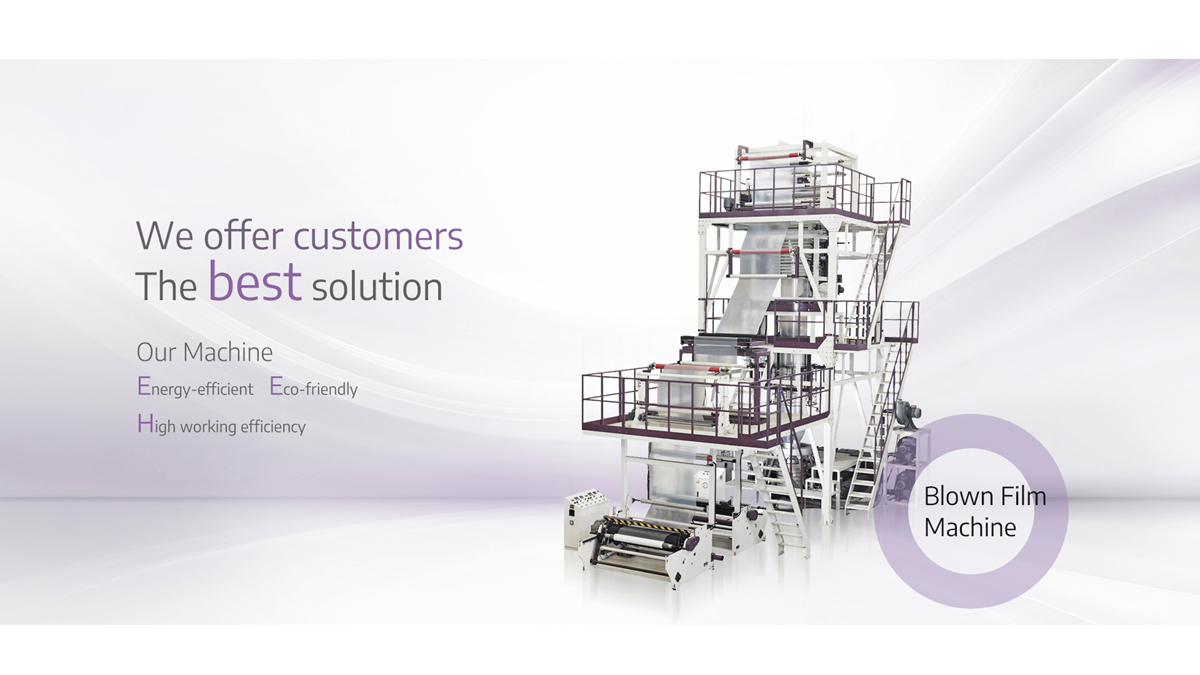
A multi-layer co-extrusion blown film machine is a specialized plastics processing system that simultaneously melts and extrudes two or more polymer resins through a single, concentric annular die. The molten resins merge inside the die head before being inflated into a bubble, cooled, collapsed, and wound into rolls of finished film. Each layer serves a distinct functional purpose — one layer may provide oxygen barrier performance, another contributes heat-sealability, a third adds puncture resistance, and adhesive or "tie" layers bond chemically incompatible polymers together.
The defining difference from single-layer blown film is precisely this ability to combine dissimilar materials in a single pass. The result is a composite film whose total performance far exceeds what any single resin could deliver on its own. A typical food-grade high-barrier structure, for example, might combine polyethylene (PE) skin layers, polyamide (PA) for toughness, ethylene vinyl alcohol (EVOH) as the oxygen barrier core, and adhesion-promoter tie layers between them — all produced in one integrated, continuous process.
From 3-Layer to 11-Layer: The Architecture of Modern Co-Extrusion
The progression of layer count mirrors the industry's hunger for ever-more-precisely engineered films:
-
3-layer (ABA or ABC) — The entry point for co-extrusion. Still widely used for commodity applications such as stretch wrap, shrink film, and agricultural mulch films. The outer skins and core can differ in density, melt index, or additive loading.
-
5-layer — The dominant architecture for many food packaging films. A classic PE/Tie/EVOH/Tie/PE structure delivers high oxygen barrier without sacrificing recyclability potential. Five-layer lines balance capability with manageable mechanical complexity.
-
7-layer — Adds design freedom for demanding applications: frozen food packaging, medical device pouches, or films requiring simultaneous oxygen, moisture, and aroma barriers. Seven-layer lines are the current sweet spot for sophisticated converters.
-
9-layer and 11-layer — Reserved for the most technically demanding end uses where ultra-thin individual layer thicknesses, nano-scale barrier engineering, or the combination of four or more distinct polymer families is required. These lines command premium investment but offer unmatched performance headroom.
The shift toward higher layer counts is not merely incremental — it fundamentally changes what films can do. Thinner individual layers mean less total material per square meter of film while maintaining or improving barrier performance, directly reducing raw material cost and environmental footprint.
Key Applications Driving Demand
Food and Beverage Packaging
Food packaging is the single largest application segment and the primary engine of market growth. Flexible packaging is estimated to account for approximately 60% of the overall packaging market, and multilayer films are at the heart of that share. Vacuum skin packaging for fresh and processed meats, modified atmosphere packaging (MAP) for ready-to-eat meals, stand-up pouches for snacks and liquids, and retort pouches for shelf-stable foods all rely on co-extruded multilayer structures. Extended shelf life, reduction of food waste, and lighter weight versus rigid alternatives are three drivers that resonate with both brand owners and regulators.
Pharmaceutical and Medical
The pharmaceutical industry demands films with validated, reproducible barrier properties and strict regulatory traceability. Blister pack lidding films, sterile medical device pouches, and IV bag films require consistent EVOH or PVDC barrier layers paired with heat-sealable inner layers and tough outer skins. The exacting quality requirements of this segment have pushed machinery manufacturers to invest in precision die technology, online thickness measurement, and fully documented process control systems.
Agricultural Films
Agricultural mulch films, silage stretch films, and greenhouse covers benefit from co-extrusion in a different way: it allows UV-stabilizers, anti-drip additives, and light-diffusing agents to be concentrated in specific layers where they are most effective, rather than compounded uniformly throughout the film. Seven-layer agricultural films can simultaneously control UV transmission for photosynthesis management, reduce water evaporation, and provide mechanical durability — a combination impossible in single-layer structures.
Industrial and Logistics Films
Heavy-duty pallet stretch wrap and collation shrink films for beverage packs are high-volume applications that benefit from co-extrusion's ability to combine stiff core layers with tacky surface layers. Liner films for bulk bags (FIBCs), protective films for construction materials, and geomembranes round out the industrial segment, where performance-per-kilogram-of-resin is the key economic metric.
Materials at the Core: PE, PP, PA, and EVOH
The four polymer families that define modern multilayer film structures each bring distinct value:
Polyethylene (PE) — The workhorse of blown film, available in LDPE, LLDPE, mLLDPE, and HDPE variants. It provides heat-sealability, toughness, and the cost foundation of almost every commercial film structure. Advances in metallocene-catalyzed PE grades have significantly improved puncture resistance and downgauging potential.
Polypropylene (PP) — Used for its stiffness, optical clarity, and heat resistance. PP layers allow film structures to withstand higher temperatures in hot-fill and retort applications.
Polyamide (PA / Nylon) — PA layers contribute exceptional toughness, flex-crack resistance, and moderate oxygen barrier performance. They are a common component of meat packaging and medical film structures.
Ethylene Vinyl Alcohol (EVOH) — The premier oxygen barrier material in co-extrusion. Even at layer thicknesses of just a few microns, EVOH can reduce oxygen transmission by orders of magnitude compared to PE alone. Nine-layer blown film lines and new recyclable EVOH grades are enabling packaging that delivers both high barrier performance and improved end-of-life recyclability — a pivotal step toward circular economy packaging.
Market Size and Growth Outlook
Industry estimates for the multilayer blown film machine market consistently point toward sustained, above-average growth. One set of estimates values the market at approximately USD 1.2 billion in 2024, projecting growth to between USD 1.9 billion and USD 2.5 billion by 2032–2033, representing compound annual growth rates in the range of 5.5% to 9.2% depending on methodology and scope. A parallel estimate for the broader blown film market highlights 4.8 million metric tons of total blown film production in 2023, with a projected 20% rise in multilayer film technology adoption by 2026.
Asia-Pacific leads in both production capacity and installed machine base, accounting for approximately 40% of global market revenue. China drives the majority of Asia-Pacific demand as domestic converters upgrade from single-layer to multilayer lines to serve both export markets and a rapidly growing domestic consumer goods sector. Taiwan plays a distinct role within the Asia-Pacific cluster: its machinery manufacturers — companies such as Matila Industrial, with close to four decades of accumulated blown film engineering — supply multilayer lines to converters across Southeast Asia, the Middle East, and beyond, combining competitive pricing with the technical discipline that export markets require. Europe — particularly Germany, Italy, and the Benelux region — represents the technology leadership cluster, where machinery manufacturers have built decades of multilayer co-extrusion expertise. North America is a mature but innovation-active market, with growth concentrated in sustainable packaging reformulation and pharmaceutical film expansion.
Technology Trends Shaping the Next Generation of Machines
Automation and Smart Process Control
By 2027, an estimated 25% of blown film production facilities globally are expected to implement advanced in-line monitoring systems. Modern multilayer lines increasingly incorporate automatic gauge control (AGC) using ultrasonic or X-ray sensors, closed-loop melt temperature management, and real-time resin consumption tracking. These systems reduce film thickness variation, cut scrap rates, and provide the process traceability demanded by food safety and pharmaceutical regulations.
Modularity and Customization
The market is moving away from generic, one-size-fits-all line configurations. Leading machinery manufacturers now design platforms where extruder count, die head configuration, cooling ring geometry, and winding systems can be specified — or reconfigured — to match a specific material combination or application. This modularity is the engineering prerequisite for cost-effective customization, allowing converters to optimize their lines for PLA, PBAT, high-performance metallocene PE, or EVOH barrier structures without purchasing an entirely new machine.
Biodegradable and Recyclable Material Compatibility
The growth of biobased and compostable polymers — PLA, PBSA, PHB, and their blends — is creating a new category of machine requirements. Processing these materials demands precise temperature control in narrow windows, specialized screw geometries, and corrosion-resistant surfaces. At the same time, the push for mono-material recyclable packaging is driving development of all-PE multilayer structures that maintain high barrier performance while remaining compatible with existing PE recycling streams. By 2025, eco-friendly packaging materials saw an 18% global increase in adoption, a trend that directly translates into demand for machines capable of processing these emerging material systems.
AI-Assisted Process Optimization
By 2026, the application of artificial intelligence to blown film production is transitioning from research concept to commercial reality. AI-driven process models can predict how changes in resin lot-to-lot variation, ambient temperature, or layer thickness targets will propagate through the entire line, allowing operators to make pre-emptive adjustments rather than reacting to quality deviations after they occur. Early adopters report measurable reductions in startup scrap and energy consumption per kilogram of film produced.
Energy Efficiency
Rising energy costs across Europe and Asia are accelerating investment in energy-efficient line designs. Variable-frequency drives on extruder motors, optimized insulation of heated zones, and heat recovery from cooling systems are becoming standard features rather than premium options. For high-output lines running continuously, even modest percentage improvements in specific energy consumption translate into significant annual operating cost reductions.
Key Industry Players
The multilayer co-extrusion blown film machine market spans long-established European engineering houses and a growing tier of technically competitive Asian manufacturers — each carving out distinct positions across application segments, layer-count capability, and geographic reach.
Windmöller & Hölscher (W&H) — Germany-based and widely regarded as a global benchmark for high-output, high-specification multilayer lines. W&H's VAREX II platform has set industry references for barrier film production and recyclable film development.
Macchi SPA — Italian manufacturer specializing in sophisticated multilayer lines for food packaging and medical films, known particularly for precision die head engineering on high-layer-count configurations.
HOSOKAWA ALPINE — German maker of blown film lines, particularly noted for barrier film applications and multi-layer structures up to 11 layers, serving the high-performance end of the food and pharmaceutical segments.
Macro Engineering & Technology — Canadian-based provider with deep expertise in barrier and high-layer-count co-extrusion systems, serving global converters pursuing demanding flexible packaging specifications.
Rajoo Engineers — India's leading blown film machine manufacturer, serving both domestic and export markets with a broad range from 3-layer to 7-layer lines, well-positioned to capture growth in South and Southeast Asian converter markets.
Matila Industrial — A Taiwan-based manufacturer founded in 1988, offering multilayer blown film lines from 3-layer ABA to 5-layer co-extrusion (CT-FL5), with film widths up to 4.8 meters and compatibility across HDPE, LDPE, LLDPE, and PP. Matila also produces plastic waste recycling machines, making it relevant to converters pursuing integrated production and circularity goals.
Polystar Machinery — Another Taiwan-based manufacturer offering multilayer blown film lines with strong market reach across Southeast Asia, serving both new line installations and machine upgrade projects for regional converters.
Challenges and Restraints
Despite a positive demand outlook, the market faces several structural challenges. The capital cost of a full 7-layer or 9-layer line — including ancillary equipment such as gravimetric dosing systems, online quality control, and automatic winders — can represent a significant barrier for smaller converters, particularly in price-sensitive markets. Skilled operators capable of managing the complexity of multilayer co-extrusion are in short supply globally.
Supply chain variability in specialty resins, particularly EVOH and PA, can create production planning difficulties. Geopolitical factors and evolving tariff frameworks affecting cross-border machinery trade — particularly between Asia, North America, and Europe — add additional uncertainty to capital investment decisions.
Regulatory evolution around single-use plastics and packaging recyclability requirements in Europe and North America is creating both opportunity and uncertainty: manufacturers must invest in material flexibility before the final regulatory landscape is fully defined.
Looking Ahead
The trajectory for multi-layer co-extrusion blown film machines is shaped by three converging forces: the relentless pressure to reduce material use while maintaining or improving film performance; the sustainability imperative driving demand for recyclable, compostable, or bio-based film structures; and the digitalization of manufacturing bringing intelligence to lines that were once operated primarily on operator experience.
Converters that invest in modular, automation-ready multilayer lines today are positioning themselves to respond quickly as both material science and regulatory requirements continue to evolve. Machinery suppliers that can deliver not just mechanical capability but process knowledge, material expertise, and digital integration will command the strongest market positions through the early 2030s.
For packaging manufacturers, brand owners, and procurement professionals evaluating flexible packaging supply chains, understanding the capabilities — and the limitations — of multilayer co-extrusion blown film technology is increasingly a prerequisite for competitive decision-making.