A practical guide to how HVLP spray systems improve coating efficiency, reduce waste, and support better cost control.
In coating and finishing work, material efficiency matters almost as much as appearance. Whether the application involves automotive refinishing, woodworking, metal fabrication, or general industrial coating, wasted paint translates into higher operating costs, more cleanup, and greater environmental burden. One technology developed to address these concerns is HVLP, or High Volume Low Pressure, spray application.
HVLP spray guns are designed to atomize coating materials using a relatively high volume of air at low air-cap pressure. In many regulatory and industry contexts, HVLP equipment is associated with air-cap pressures below 10 psi, a condition intended to promote better transfer efficiency and reduce unnecessary overspray. Compared with conventional air spray systems, HVLP systems generally produce a softer spray pattern and can place a greater share of coating material onto the target surface rather than into the surrounding air.
Understanding how HVLP works helps explain why it has become a common choice for users seeking better paint utilization, more controlled finishing, and lower total coating costs.
What HVLP Technology Actually Means
The phrase “High Volume Low Pressure” describes the airflow characteristics of the system. Instead of relying on very high pressure to break up coating material, HVLP spray guns use a larger amount of air moving at lower pressure. This creates atomization while limiting the force with which droplets strike the surface.
That distinction is important. When spray particles travel too quickly, some may bounce back from the workpiece or drift away from the intended target. HVLP equipment is designed to reduce that tendency by propelling material at lower velocity. South Coast Air Quality Management District documents describe HVLP spray equipment as using very low air pressure to atomize and propel coating droplets at low velocity and high volume toward the surface.
In practice, this operating principle can help applicators achieve a more controlled spray process. It does not eliminate waste entirely, since operator skill, nozzle selection, coating viscosity, spray distance, and workpiece geometry all matter. However, it can reduce avoidable losses when compared with less efficient application methods under comparable conditions.
Why Lower Pressure Can Save Paint
Paint savings are closely tied to transfer efficiency, which refers to the proportion of sprayed coating that actually lands on the intended surface. A system with better transfer efficiency wastes less material through overspray, bounce-back, or airborne drift.
HVLP technology was developed in part to satisfy transfer-efficiency requirements in regulated coating environments. Official SCAQMD materials note that HVLP spray guns can meet high transfer-efficiency requirements while operating below 10 psi at the air cap. Graco likewise describes HVLP as a lower-velocity spray method that provides higher transfer efficiency than conventional air spray.
This matters economically. If more of the coating reaches the product, the user may need less paint to complete a given job. The financial impact becomes more noticeable when using expensive primers, basecoats, clearcoats, stains, lacquers, or specialty industrial finishes. Reduced waste can also mean fewer interruptions for refilling cups or reservoirs, less residue deposited on booth walls and filters, and lower cleanup effort over time.
It is best to view HVLP savings as a process advantage, not a guaranteed fixed percentage. Real-world outcomes depend on technique, maintenance, material formulation, and setup. Still, the basic logic remains clear: a spray method that improves material placement can reduce unnecessary paint consumption and related costs.
HVLP vs. Conventional Air Spray
The differences between HVLP and conventional air spray are not simply about “better” or “worse.” Each method serves different finishing priorities. Conventional spray systems are often valued for speed and finish quality, but they may operate with lower transfer efficiency because of the forceful air stream used to atomize material. HVLP emphasizes improved coating utilization and softer material delivery, though it may not always match conventional spray in speed for every application.
| Feature |
HVLP Spray |
Conventional Air Spray |
| Air pressure at the cap |
Low, commonly below 10 psi |
Higher operating pressure |
| Spray velocity |
Lower |
Higher |
| Transfer efficiency |
Generally higher |
Generally lower |
| Overspray tendency |
Usually reduced |
Often greater |
| Typical strength |
Material control and efficiency |
Speed and fine atomization in certain tasks |
This comparison should not be interpreted as a universal rule for all brands and coatings. Modern equipment varies significantly, and some compliant or hybrid systems may offer performance characteristics that overlap with traditional categories. Nonetheless, the table captures the fundamental distinction recognized in industry and regulatory guidance.
How HVLP Can Lower Operating Costs
The cost advantage of HVLP typically comes from several connected areas rather than a single factor.
First, improved paint utilization may reduce material purchasing needs. When a larger fraction of the coating lands on the part, less product is lost to the surrounding environment. Over repeated jobs, that can influence annual consumable spending.
Second, reduced overspray can lessen the burden on ventilation and filtration systems. Spray booths still require proper design and maintenance, but lower coating drift can help reduce unnecessary contamination of surrounding surfaces. This may simplify cleanup and support a more orderly finishing environment.
Third, HVLP can support quality consistency in detail-oriented applications. Since the spray pattern is softer, operators may find it easier to control application on smaller panels, furniture components, trim, and shaped parts. Better control can reduce the risk of excessive film build, uneven coating, or avoidable rework when the system is correctly adjusted.
The strongest savings appear when HVLP technology is paired with good operating practice. A poorly set spray gun, incorrect fluid tip, unsuitable air supply, or inconsistent gun movement can still waste coating. Technology improves the margin for efficiency, but it does not replace process discipline.
Where HVLP Is Commonly Used
HVLP spray equipment is widely associated with finishing tasks where coating control and material economy are important. SCAQMD materials cite applications across automotive coatings, metal coatings, wood coatings, industrial coatings, and marine coatings.
In woodworking, HVLP is often used for lacquers, stains, sealers, and clear finishes where surface appearance is important. In automotive refinishing, it may be used for primers, color coats, and clearcoats depending on the product system and local regulations. In manufacturing, HVLP may be selected for parts that require careful, repeatable coating application without excessive waste.
The suitability of HVLP still depends on production goals. A finishing line prioritizing very high throughput may weigh speed differently from a workshop focused on finish quality and coating savings. For this reason, equipment selection should consider material type, part size, expected output, available air supply, and regulatory requirements.
Factors That Affect HVLP Performance
Even well-designed HVLP equipment must be set up correctly. Several variables influence results:
| Factor |
Why It Matters |
| Air supply |
Inadequate air volume can reduce atomization quality |
| Fluid nozzle size |
Must match the coating type and viscosity |
| Spray distance |
Too far increases drift; too close may cause uneven buildup |
| Gun speed and overlap |
Affect film uniformity and material use |
| Coating viscosity |
Influences atomization and finish quality |
The “high volume” part of HVLP is especially important. A system may operate at low pressure, but it still needs sufficient airflow to atomize coating properly. This is why matching the spray gun to the compressor or turbine system matters.
FAQ
1. Does HVLP always use less paint?
Not automatically. HVLP is designed for improved transfer efficiency and can reduce wasted material, but actual savings depend on setup, operator technique, coating properties, and the shape of the item being sprayed.
2. Is HVLP better than conventional spray for every job?
No. HVLP is often preferred for efficiency and control, while conventional systems may be chosen where production speed or specific finishing characteristics are prioritized. The best choice depends on the application.
3. Why is 10 psi often mentioned with HVLP?
Many regulatory definitions and compliance frameworks associate HVLP with operation at or below 10 psi at the air cap. This low-pressure criterion is central to the technology’s recognized transfer-efficiency profile.
4. Does HVLP reduce overspray?
HVLP is generally associated with lower droplet velocity and improved transfer efficiency, which can reduce overspray relative to conventional air spray in many situations. However, it does not eliminate overspray entirely.
5. Can HVLP be used for professional finishing?
Yes. HVLP technology is used across professional automotive, woodworking, industrial, metal, and marine coating applications, provided the equipment is suitable for the material and process requirements.
6. What causes poor results with an HVLP spray gun?
Common causes include insufficient air volume, incorrect nozzle selection, unsuitable coating viscosity, poor gun distance, and inconsistent movement. These issues can affect atomization, coverage, and finish quality.
7. Is HVLP mainly an environmental technology or a cost-saving technology?
It is both. HVLP emerged partly in response to transfer-efficiency and emissions-related concerns, but the same design principles can also help businesses reduce wasted coating material and improve operating efficiency.
Conclusion
HVLP technology is not merely a spray-gun label; it represents a different approach to coating application. By using high air volume at low pressure, HVLP systems aim to deliver coating material more gently and efficiently to the target surface. This can reduce overspray, improve transfer efficiency, and help control total paint usage.
For users evaluating spray equipment, the practical value of HVLP lies in the balance it offers: dependable finish control, better material utilization, and meaningful potential for cost reduction when paired with sound application technique. It may not be the ideal solution for every coating operation, but it remains one of the most important technologies for painters and manufacturers who want to improve efficiency without sacrificing finish quality.
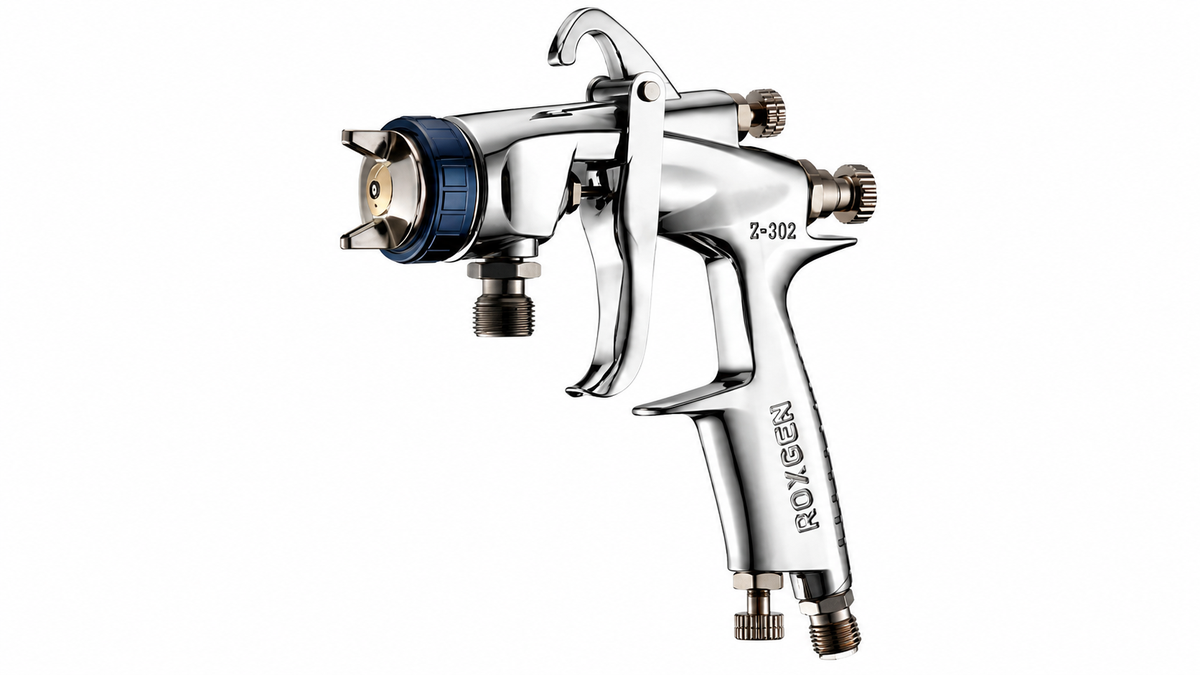
For readers exploring HVLP spray gun options for professional finishing applications, the HVLP Series from T&R ROXGEN INDUSTRIES CO.,LTD. provides a useful starting point for comparing designs intended around low-pressure, high-volume spraying.

(4059)(20260924)(原).jpg)
(2367)(20260924)(原).jpg)