A practical guide to gate valve operation, isolation performance and application considerations in industrial piping.
In industrial piping systems, not every valve is intended to regulate flow continuously. Some valves are selected primarily to establish a clear operating state: fully open or fully closed. Cast steel gate valves are among the most widely used valve types for this purpose, especially in systems that require durable shutoff service, relatively low pressure loss in the open position, and compatibility with demanding process conditions.
A gate valve controls flow by moving a gate-shaped closure element vertically into or out of the fluid path. When the gate is raised, the passage becomes largely unobstructed. When the gate is lowered, it seals against the valve seats to block the line. This operating principle makes gate valves especially suitable for on-off isolation rather than frequent throttling or fine flow adjustment.
Cast steel gate valves are commonly specified in petrochemical, refinery, power, and general industrial piping applications. Standards such as API 600 define heavy-duty steel gate valve requirements for services where full-port openings, strong body construction, and robust stem designs may be important.
What Makes a Cast Steel Gate Valve Different?
The term “cast steel” refers to the manufacturing method and body material rather than the basic valve function. In a cast steel gate valve, the body and bonnet are formed through casting, then machined to meet dimensional and sealing requirements. Compared with lighter-duty valve constructions, cast steel designs are commonly chosen for higher-pressure, higher-temperature, or more mechanically demanding services, depending on the material grade and applicable standard.
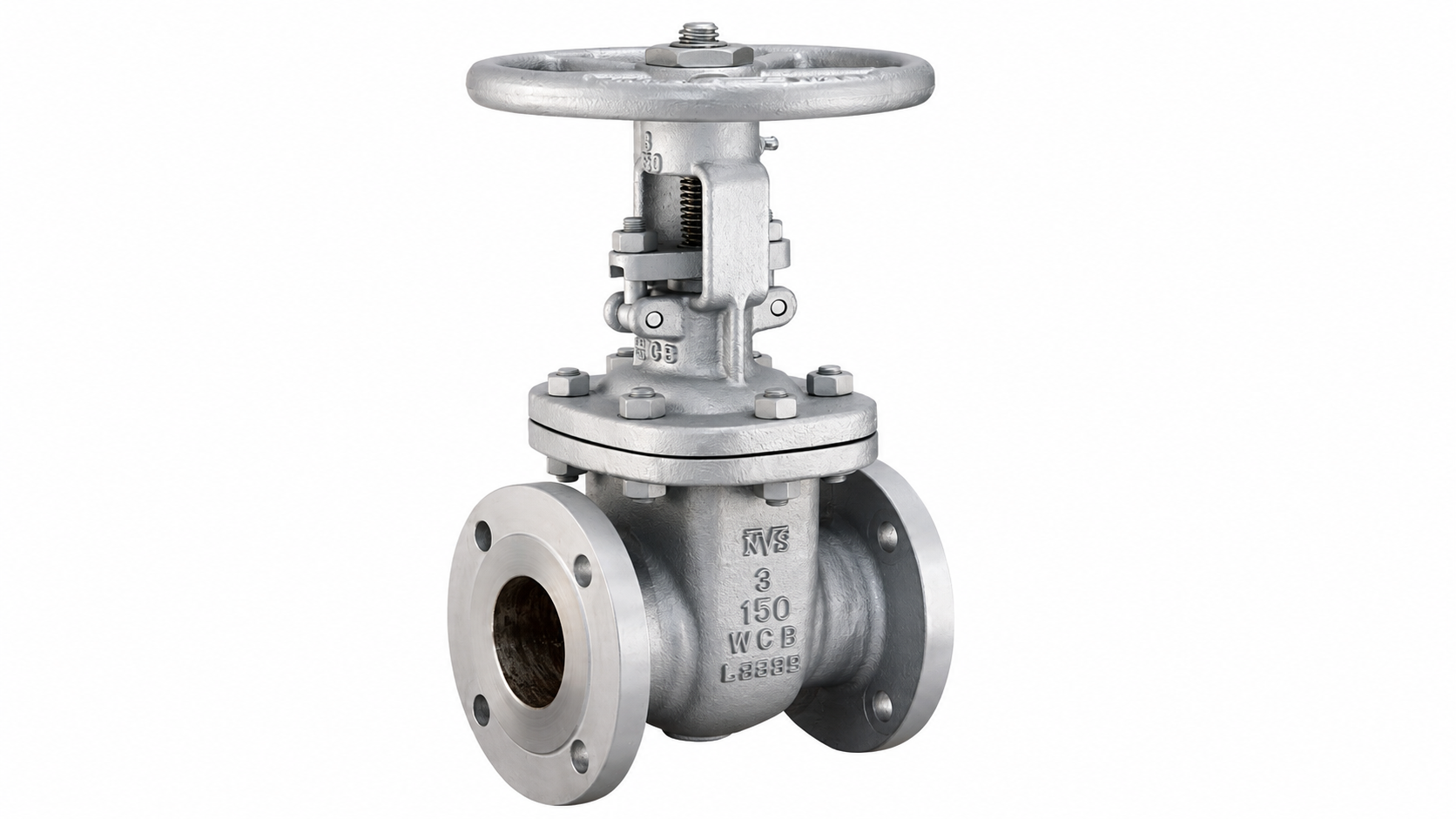
A typical cast steel gate valve includes:
- A valve body that contains the flow passage
- A bonnet that encloses the upper internal parts
- A gate or wedge that opens and closes the passage
- Seat rings that provide sealing surfaces
- A stem that transmits handwheel or actuator motion to the gate
- Packing and gland components that help control leakage around the stem
Many industrial steel gate valves use an outside screw and yoke arrangement with a rising stem. In this configuration, the stem movement provides a visible indication of valve position, which can be useful during inspection and operation. API 600-style designs frequently include bolted bonnets, rising stems, and wedge-type closure elements.
How the Valve Works in On-Off Service
The operating cycle of a cast steel gate valve is mechanically straightforward. Turning the handwheel, or activating a gear operator or actuator, rotates or drives the stem. The stem raises or lowers the gate between the valve seats.
When the valve is fully open, the gate is withdrawn from the flow stream. This creates a relatively direct flow path with comparatively low resistance, which is one reason gate valves are favored for isolation duties in larger pipelines. When the valve is fully closed, the gate presses against the seating surfaces to interrupt flow through the line.
| Valve Position |
Internal Condition |
Typical Function |
| Fully open |
Gate lifted clear of flow path |
Allows line flow with low obstruction |
| Partially open |
Gate remains within the flow stream |
Transitional state, generally not preferred for sustained service |
| Fully closed |
Gate seated against sealing surfaces |
Provides line isolation |
This operating pattern explains why gate valves are normally described as isolation valves or on-off valves. Their strength lies in establishing a clear open or shut condition, not in maintaining intermediate positions for precise process control.
Why Gate Valves Are Usually Not Used for Throttling
Although a gate valve can physically remain partially open, this does not mean it is well suited for throttling. In a partially open position, the gate and seating surfaces may be exposed to high-velocity flow, turbulence, vibration, and erosion. Over time, these conditions can damage seating areas and reduce shutoff performance.
For applications that require routine modulation of flow, engineers generally consider valve types intended for control service, such as globe valves, control valves, or certain characterized ball valves, depending on the process. Gate valves are instead optimized for isolation, especially where the system benefits from low flow restriction when the valve is fully open.
| Application Need |
Gate Valve Suitability |
| Full open/full closed service |
Strong fit |
| Line isolation for maintenance |
Strong fit |
| Minimal obstruction in open position |
Strong fit |
| Frequent fine flow adjustment |
Usually not preferred |
| Sustained throttling |
Usually not preferred |
Key Design Features That Support On-Off Performance
Several design features help cast steel gate valves perform reliably in on-off applications.
1. Full-flow passage
A primary advantage of gate valves is the open flow path available when the gate is retracted. In suitable designs, this reduces permanent pressure loss relative to valve types that keep substantial internal geometry in the flow path even when open.
2. Wedge sealing action
Many industrial gate valves use a wedge-shaped gate. As the gate closes, it seats against matching surfaces inside the body. Flexible wedge designs can help accommodate certain thermal or mechanical effects while supporting sealing performance, though exact design behavior depends on the valve specification and service conditions.
3. Rising stem visibility
A rising stem provides a practical visual cue of valve position. Operators can see whether the valve is moving toward open or closed and estimate its operating state during manual use. This is useful in plants where clear field indication matters.
4. Compatibility with industrial standards
Steel gate valves are commonly associated with standards such as API 600, which covers bolted-bonnet steel gate valves with flanged or butt-welding ends. Pressure-temperature considerations are often evaluated alongside broader standards and material limitations, including those related to ASME B16.34 ratings.
Typical Applications
Cast steel gate valves are used where shutoff capability and open-flow efficiency are more important than rapid cycling or continuous modulation. Common application areas include:
- Refinery and petrochemical process lines
- Steam, water, and utility systems
- Oil and gas pipeline sections
- Power generation facilities
- Industrial service lines that require isolation during maintenance
The precise valve material, trim, pressure class, end connection, and operator type should be selected according to the actual process fluid, temperature, pressure, installation standard, and project specification.
Operational Considerations
A cast steel gate valve can provide long service life when used in the way it is intended. However, valve performance depends on more than basic design. Installation orientation, operating frequency, contamination in the line, stem condition, packing adjustment, and seat integrity all influence field results.
Several practical points are worth noting:
First, gate valves are often slower to operate than quarter-turn valves because the gate must travel through a linear stroke. This is not necessarily a disadvantage in isolation service, but it matters where fast opening or closing is required.
Second, valves intended for infrequent isolation can still benefit from periodic inspection or cycling where plant procedures permit. Long periods without movement may contribute to stiffness, deposits, or maintenance challenges in some services.
Third, a valve’s pressure class alone does not define suitability. Material grade, temperature, end connection, applicable standards, and service media must also be considered before selection.
FAQ
1. What is the main purpose of a cast steel gate valve?
Its main purpose is to provide on-off line isolation by allowing flow when fully open and blocking flow when fully closed.
2. Can a gate valve regulate flow?
A gate valve can pass through partially open positions during operation, but it is generally not recommended for sustained throttling or precise flow regulation.
3. Why are gate valves associated with low pressure drop?
When fully open, the gate is lifted away from the flow path, leaving a relatively unobstructed passage compared with valves that retain more internal restriction.
4. What is the difference between a cast steel gate valve and a cast iron gate valve?
Both use a gate mechanism, but cast steel valves are typically selected for more demanding pressure, temperature, or industrial process environments, subject to design standard and material grade. Cast iron gate valves are more often associated with less severe services.
5. What does API 600 mean in relation to gate valves?
API 600 is a widely referenced standard for steel gate valves with flanged or butt-welding ends and bolted bonnets, commonly used in refinery and related industrial applications.
6. Are cast steel gate valves available with actuators?
Yes. Industrial cast steel gate valves may be available with manual handwheels, gear operators, or actuators, depending on size, torque needs, and plant automation requirements.
Conclusion
Cast steel gate valves remain a practical solution for on-off flow control because their operating principle is simple, their open position offers a relatively clear flow path, and their construction can be adapted to demanding industrial services. They are best understood not as regulating valves, but as isolation components designed to establish dependable full-open or full-closed states.
For engineers, buyers, and plant operators, the important selection questions are not only whether a gate valve can stop flow, but whether its material, pressure rating, end connection, body design, and operating method align with the application. When those factors are properly matched, a cast steel gate valve can be an effective part of a well-designed piping system.
Those who would like to learn more about cast steel gate valve specifications may also refer to the information provided by NICO Valves, including available sizes, pressure classes, design features, and configuration options.

(4059)(20260924)(原).jpg)
(2367)(20260924)(原).jpg)