How tailored jar design, material choices and packaging strategy help beauty brands build stronger shelf appeal and brand identity.
In today’s beauty market, competition is no longer limited to formula performance alone. Consumers often encounter a product first through its packaging, whether on a retail shelf, in an online listing, or in a social media post. Before they read the ingredient list or understand the product claims, they are already forming impressions based on shape, color, finish, and overall presentation.
For skincare products such as face creams, cleansing balms, masks, body butters, and treatment gels, cosmetic jars remain one of the most recognizable packaging formats. Their wide opening, stable structure, and strong visual presence make them practical for both brands and consumers. Yet in a crowded market, a standard jar may not be enough to make a product memorable. This is where OEM and ODM cosmetic jars become strategically important.
By allowing brands to customize packaging appearance, functionality, and market positioning, OEM and ODM jar solutions can help beauty products look more distinctive while still meeting practical packaging requirements.
What OEM and ODM Mean in Cosmetic Jar Packaging
OEM, or Original Equipment Manufacturing, generally refers to packaging developed according to a brand’s own specifications. A company may already know the type of jar it wants, including its dimensions, shape, cap structure, surface treatment, or decorative details. The manufacturer then helps bring that packaging concept into production.
ODM, or Original Design Manufacturing, usually begins with packaging designs or jar series that already exist. Brands can select from these available options and customize them through color, printing, finishing, label design, or other modifications. This allows companies to create a branded result without developing every packaging component from the ground up.
The distinction matters because beauty brands do not all have the same launch goals. Some want faster product development and cost efficiency. Others need packaging that feels more exclusive and closely tied to a long-term brand identity.
| Aspect |
OEM Cosmetic Jars |
ODM Cosmetic Jars |
| Starting Point |
Brand-led specifications |
Existing supplier-developed designs |
| Customization Depth |
Usually higher |
Moderate to high, depending on options |
| Development Time |
Often longer |
Often shorter |
| Tooling Needs |
May require new molds or adjustments |
Usually relies more on existing molds |
| Best Suited For |
Brands seeking stronger exclusivity |
Brands seeking faster market entry |
| Typical Use Case |
Signature jar line for a premium skincare brand |
Customized version of an established jar format |
Neither OEM nor ODM is automatically better. The right choice depends on how much originality the brand requires, how quickly it needs to launch, and how much packaging development complexity it is prepared to manage.
Why Cosmetic Jars Continue to Matter
Cosmetic jars continue to be widely used because they serve many beauty formulas well. Rich creams, balms, exfoliating products, and masks are often easier for consumers to access in a wide-mouth format than in a narrow bottle or tube. The user can see the texture, control the amount applied, and interact with the product in a direct way.
This makes jars especially relevant for products that are meant to feel sensorial or indulgent. A jar of overnight cream or a cleansing balm can communicate softness, richness, and ritual through both the formula and the act of use.
At the same time, jars must perform reliably. They need to protect the formulation, close securely, withstand transportation, and support a positive experience throughout the product’s life cycle. Packaging that looks premium but is difficult to open or prone to leakage ultimately weakens the brand experience. For this reason, strong jar design requires both visual and functional thinking.
How Custom Cosmetic Jars Help Brands Differentiate
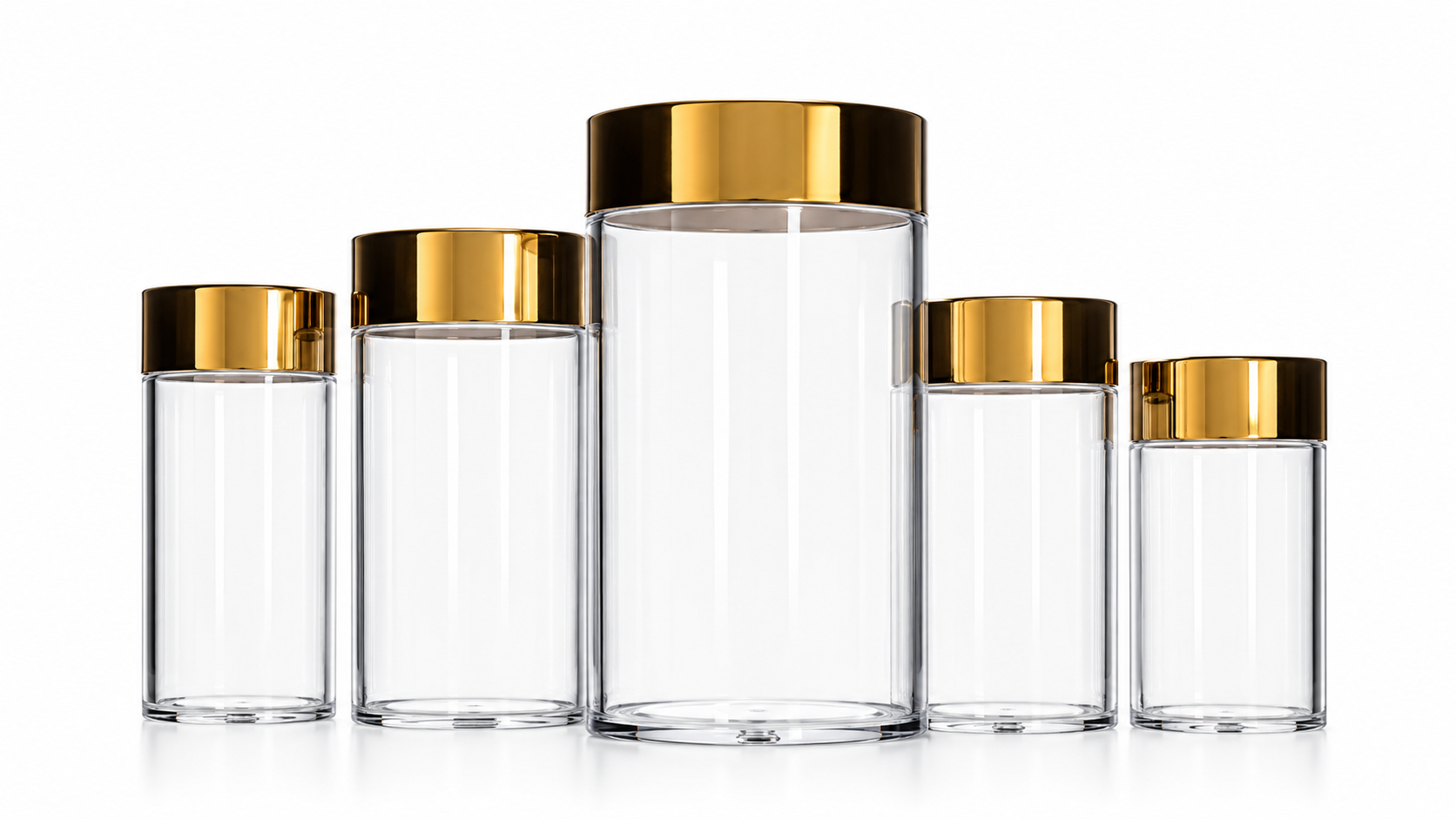
One of the greatest advantages of custom packaging is its ability to make a product feel more intentional. A beauty brand can use jar design to support a specific positioning in the market. A clean, understated jar may fit a dermatological skincare line, while a thick-walled transparent jar with refined finishing may be better suited to a prestige product. A playful brand may use softer shapes or more expressive colors to stand apart from conventional packaging.
These design decisions influence consumer perception in subtle but meaningful ways. Packaging can make a product look more clinical, more luxurious, more natural, or more youthful before any written message is absorbed. In beauty, where visual identity carries significant weight, those first impressions matter.
Custom cosmetic jars also help brands build consistency across a broader collection. When multiple products share a recognizable packaging language, the brand becomes easier to identify. A face cream, eye cream, sleeping mask, and body treatment may use related shapes, lid styles, or decoration choices while still maintaining individual distinctions. This balance between unity and variation helps a product line feel more mature and coherent.
Material Selection as Part of Brand Strategy
The jar material also affects both appearance and performance. Cosmetic packaging commonly uses plastics such as PP, PET, PETG, and acrylic-based structures, each offering different advantages. Rather than treating material selection as a purely technical matter, brands often consider it part of the overall product message.
| Material Direction |
Common Strengths |
Brand Impression Often Supported |
| PP |
Lightweight, practical, durable |
Functional, accessible, everyday |
| PET / PETG |
Good clarity, attractive appearance, lighter than glass |
Clean, modern, premium-looking |
| Acrylic-style structures |
Thick-wall effect, refined presentation |
Luxury, elevated, prestige |
These categories should not be oversimplified. A material that works well for one formula or design may not suit another. Compatibility with the contents, decoration requirements, closure design, and shipping conditions all need to be evaluated. A visually appealing package is only successful when it also protects the product appropriately and performs consistently in real use.
Packaging Differentiation Is Also About User Experience
Custom cosmetic jars do more than help a product stand out visually. They also influence how the consumer experiences the product every day. The feel of the cap, the stability of the base, the width of the opening, and the ease of handling all contribute to whether a package feels well designed.
This is especially important in skincare, where products may be used daily over several weeks or months. Repeated contact with packaging shapes the consumer’s perception over time. A jar that opens smoothly and feels solid can reinforce a sense of quality. A jar that feels awkward or inconsistent can create frustration, even if the formula itself is well received.
In this sense, packaging differentiation is not simply decoration. It is the combination of aesthetics, usability, and brand fit.
OEM and ODM in the Context of Product Development
Beauty brands often operate under pressure to move quickly while still maintaining a distinct market identity. OEM and ODM options help address this tension in different ways.
ODM packaging can be an efficient route for brands that want a polished appearance without beginning from a completely blank slate. By adapting an existing jar design, a company may shorten the time needed for development and sampling while still building a customized presentation.
OEM packaging, by contrast, is often more appropriate for brands making a larger investment in packaging individuality. A custom jar shape or unique structural detail may help a product line become more recognizable over time. However, this typically involves more coordination, including technical review, cost assessment, and production planning.
The best approach is therefore not about choosing one model universally, but about matching the packaging route to the brand’s commercial priorities.
Sustainability and Realistic Packaging Choices
Sustainability is now part of most packaging conversations in the beauty industry. Brands are increasingly expected to think about material reduction, recyclability, refill potential, and unnecessary packaging waste. Cosmetic jars are part of this discussion, but the issue is more complex than simply choosing one material over another.
A package that uses less material but fails to protect the product may create greater waste in the long run. Likewise, recyclability depends not only on the material itself, but also on decoration, local waste systems, and whether consumers can separate the components properly.
For beauty brands, the most credible approach is to make responsible packaging choices that are technically realistic. This may involve simplifying structures where possible, reducing excess, considering refillable concepts where suitable, and avoiding environmental claims that cannot be clearly supported.
Frequently Asked Questions
What is the difference between OEM and ODM cosmetic jars?
OEM jars are generally developed according to a brand’s specific packaging requirements, while ODM jars are based on existing supplier designs that can be adapted through branding and customization.
Which products are most commonly packed in cosmetic jars?
Cosmetic jars are commonly used for face creams, body creams, cleansing balms, sleeping masks, gel creams, scrubs, and hair treatments, especially when the texture is rich or semi-solid.
Are custom cosmetic jars only for premium brands?
No. Custom jars can support brands at many market levels. The degree of customization may vary, but even practical adjustments in color, finish, or decoration can help a product look more distinctive.
Do cosmetic jar materials affect brand perception?
Yes. Transparency, thickness, gloss, weight, and tactile feel can all shape how consumers interpret a product’s quality and positioning.
Why is packaging testing important before mass production?
Testing helps confirm that the jar is compatible with the formulation, seals properly, maintains its appearance, and withstands normal handling, storage, and transportation conditions.
Can cosmetic jars support sustainability goals?
They can, provided that sustainability is considered together with functionality, product protection, realistic recycling conditions, and overall packaging efficiency.
Conclusion
OEM and ODM cosmetic jars have become valuable tools for beauty brands that want to create stronger packaging differentiation. They allow brands to align jar design with product positioning, support a more coherent product line, improve user experience, and make more thoughtful decisions about materials and development strategy.
In a market where visual identity and perceived quality influence buying decisions, the cosmetic jar is more than a container. It is part of how the brand communicates, how the product is experienced, and how differentiation is built over time.
For brands exploring cosmetic jar formats, material options, and customization possibilities, Pin Mao’s cosmetic jar offers a helpful starting point for evaluating packaging directions that can better support product positioning and brand differentiation:
https://www.pinmao-tw.com/cosmetic-jars.htm

(2367)(20260924)(原).jpg)