Knowledge

How to Source Horizontal Badge Holders for Corporate, Event and Distributor Needs

A practical sourcing guide for choosing badge holders that fit standard ID cards, work with common accessories, and support everyday corporate or event use.
Published: May 08, 2026
How to Source Horizontal Badge Holders for Corporate, Event and Distributor Needs

Horizontal badge holders are small accessories, but they play an important role in everyday identification. In offices, conferences, schools, exhibitions, and access-controlled facilities, they help keep ID cards visible, protected, and easy to use.

For buyers, the goal is simple: choose a holder that fits the card, works with the right accessories, and lasts long enough for the intended use.

Why Horizontal Badge Holders Are Widely Used

A horizontal badge holder is designed for landscape-style ID cards. This format is common for employee badges, visitor passes, event credentials, membership cards, and access cards.

Horizontal holders are especially useful when a badge includes a wide company logo, large name field, QR code, barcode, or access-control information. Compared with vertical holders, they often make wide card designs easier to read at a glance.

What to Check Before Ordering

The first thing to confirm is card size and thickness. Many ID cards use the CR80 size, similar to a credit card, but thickness can vary depending on whether the card is PVC, RFID, smart card, or temporary event credential. A holder that fits one card may not fit another, so sample testing is always worth doing before a bulk order.

Material is another important detail. Soft badge holders may work well for short-term events or visitor passes. Rigid badge holders are usually better for daily use because they protect the card from bending, cracking, or wearing out too quickly. For corporate offices, schools, government departments, and security-sensitive workplaces, a stronger holder often provides better long-term value.

Buyers should also look at how securely the card stays inside the holder. If the card slips out easily, it can create replacement costs and access-control problems. A secure fit or locking structure is useful, especially for employee IDs and access cards used every day.

Attachment compatibility should not be overlooked. Most horizontal badge holders are worn with lanyards, badge reels, badge clips, strap clips, swivel hooks, or snap hooks. Before ordering, check that the holder works with the accessories already used by your team or customers.

Matching the Holder to the Use Case

Corporate buyers usually need a professional-looking holder that can support daily use. A clean matte or frosted finish can make employee IDs look more polished, while a rigid structure helps protect cards from damage.

Event organizers often need holders that are easy to distribute and simple for attendees to wear. For short events, cost and speed may matter more. For premium conferences, exhibitions, or VIP credentials, a more durable and refined holder can improve the overall badge experience.

Distributors and resellers should focus on versatility. A good horizontal badge holder for distribution should fit standard card sizes, work with common accessories, and be easy to position for offices, schools, events, and public institutions.

What a Well-Specified Badge Holder Looks Like

When comparing horizontal badge holders, clear specifications make sourcing much easier. Buyers should be able to confirm the card size, card thickness, material, finish, accessory compatibility, and whether sample or customization options are available.

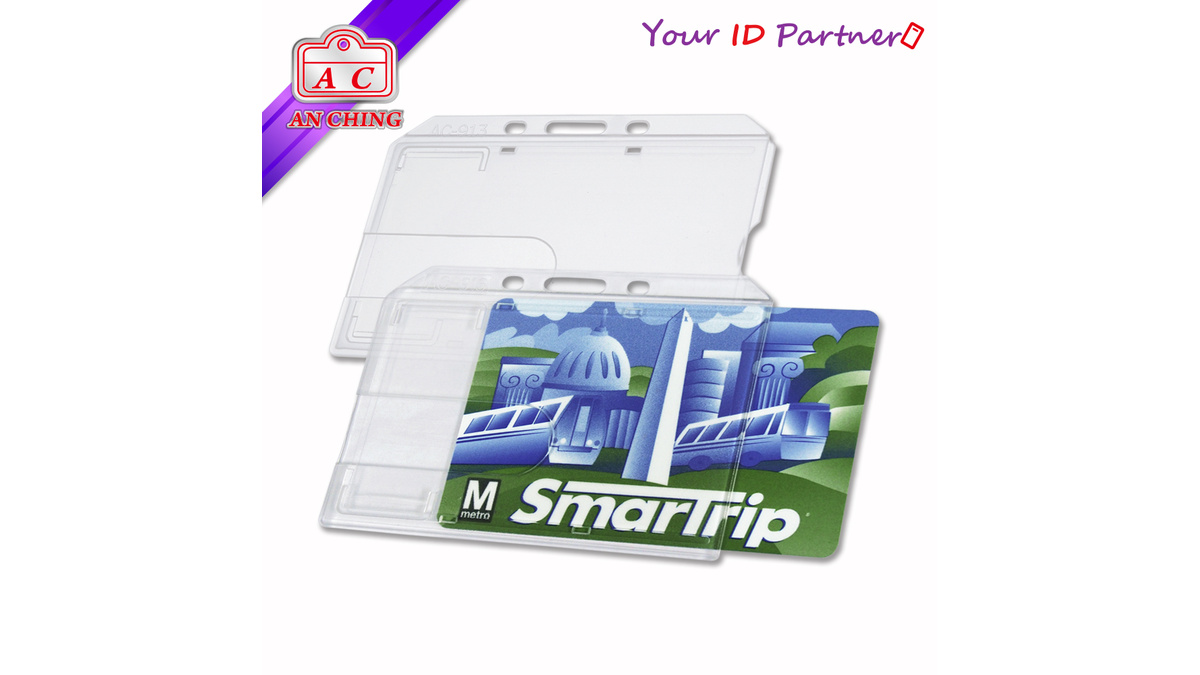
For example, some rigid horizontal badge holders are designed for one CR80 30–35 mil PVC card and include practical features such as a matte finish, back thumb slot, and card-locking structure. These details help buyers understand whether the holder is suitable for daily employee IDs, access cards, or event credentials.

A useful reference is the AC913 horizontal rigid badge holder from An Ching, which lists these specifications clearly and also notes compatibility with badge reels, lanyards, badge clips, strap clips, swivel J hooks, and snap hooks. For procurement teams and distributors, this type of product information can make comparison and sample evaluation more efficient.

Common Sourcing Mistakes

A common mistake is choosing only by unit price. A cheaper holder may work for short-term use, but it may not be the best option for daily employee IDs or access cards.

Another mistake is ordering without testing the actual card. Even if a holder is listed for standard-size cards, the thickness and card type can affect the fit.

Buyers should also avoid treating badge holders and accessories as separate decisions. A holder that does not connect well with existing lanyards or badge reels can create problems during daily use.

FAQ

Q1: What is a horizontal badge holder used for?

It is used to hold and display landscape-oriented ID cards, such as employee badges, visitor passes, access cards, event credentials, and membership cards.

Q2: What size card fits most horizontal badge holders?

Many horizontal badge holders are designed for CR80 cards, which are similar in size to credit cards. Card thickness should still be checked before ordering.

Q3: Are rigid badge holders better than soft badge holders?

Rigid holders are usually better for daily use because they provide stronger card protection. Soft holders may be suitable for temporary events or visitor badges.

Q4: What accessories can be used with horizontal badge holders?

They are commonly used with lanyards, badge reels, badge clips, strap clips, swivel hooks, and snap hooks.

Q5: Should buyers request samples before bulk ordering?

Yes. Samples help confirm card fit, material quality, appearance, and accessory compatibility before placing a larger order.

Final Thoughts

The best horizontal badge holder is the one that fits the card, protects it properly, works with the chosen accessories, and matches the environment where it will be used.

For corporate offices, durability and appearance are important. For events, ease of use and clear display matter most. For distributors, versatility and reliable specifications make the product easier to sell across different markets.

By checking these details before ordering, buyers can avoid common sourcing issues and choose badge holders that perform well in real-world use.

Published by May 08, 2026

References

An Ching. Horizontal Type Rigid Badge Holder AC913). Product specifications, card compatibility, attachment options, and customization information.


Further reading

You might also be interested in ...

Headline
Knowledge
How to Choose the Right Mix of Sea Freight, Air Freight, and Inland Transportation for International Cargo
International shipping decisions are rarely as simple as choosing the cheapest quote. For importers, exporters, sourcing teams, and operations managers, the real challenge is balancing cost, speed, cargo type, supply chain risk, and delivery reliability. In many cases, the best solution is not one transport mode alone, but the right mix of sea freight services, air freight services, and inland transportation services.
Headline
Knowledge
Industrial Ultrasonic Cleaning Machines-Applications, Specifications, and Buyer Selection Guide
An industrial ultrasonic cleaning machine is a precision cleaning system that uses high-frequency sound waves to remove contaminants from surfaces. Unlike manual or spray-based cleaning, ultrasonic systems rely on cavitation the rapid formation and collapse of microscopic bubbles in a liquid medium to dislodge particles from even the most complex geometries.
Headline
Knowledge
Scaling and Corrosion in Plastic Machinery Cooling Systems: Causes, Risks, and Preventive Measures
Scaling and corrosion are persistent risks in plastic machinery cooling systems. This article outlines their causes, their effect on heat transfer and flow stability, and practical maintenance measures manufacturers can use to reduce efficiency loss, blockage risk, and long-term equipment damage.
Headline
Knowledge
Chemical Packaging Lines Evolve as Safety and Precision Demands Increase
As chemical manufacturers face stricter safety regulations and complex material requirements, packaging lines are evolving from standalone machines into fully integrated production systems. This article explores key considerations including filling technology selection, equipment durability under chemical exposure, workplace safety, and the shift toward complete system solutions. Understanding these factors helps manufacturers improve accuracy, ensure safety, and enhance overall production efficiency in hazardous chemical packaging environments.
Headline
Knowledge
Grease Pumps in Maintenance Operations: Types, Applications, and Selection Considerations
A Practical Guide to Grease Pump Applications, Performance, and Selection
Headline
Knowledge
BLDC vs. Induction Motors in Lifting and Hoisting Applications: Efficiency, Safety, and System Cost
What makes BLDC motors a better fit for today’s lifting and hoisting systems.
Headline
Knowledge
Improving Multi-Computer Workflow Efficiency with a 4-Port USB-C KM Switch
How mouse roaming, 10Gbps USB sharing, and flexible control help streamline modern multi-system environments
Headline
Knowledge
What Buyers Should Know Before Choosing a Automatic Plastic Blow Molding Machine
For buyers, factory owners, and packaging manufacturers, selecting an automatic blow molding machine is no longer just a matter of comparing output speed or initial price. In real production environments, the performance of a plastic blowing machine is often determined by the quality and coordination of its core components. A machine may appear competitive on paper, yet still create costly problems once production begins. Uneven wall thickness, unstable parison formation, excessive scrap, slow cooling, and difficult maintenance are all issues that can usually be traced back to the design of several key modules. This is why experienced buyers tend to look beyond catalog specifications and focus instead on the machine’s screw, die head, clamping system, and cooling design. These components do more than support production. They directly influence product quality, material efficiency, energy use, maintenance frequency, and overall return on investment.
Headline
Knowledge
What Buyers Overlook When Choosing a Wire Harness Manufacturer
A practical guide to evaluating engineering support, quality control, customization and sourcing risk
Headline
Knowledge
How High-Efficiency Gear Motors and Brushless Motors Support ESG and Energy Savings
Industrial motor efficiency directly affects a factory’s electricity use, carbon footprint, maintenance burden, and long-term operating cost. For factory owners, procurement teams, and equipment designers, choosing a more efficient gear motor or Brushless Motor is not only a technical upgrade. It is also a practical way to improve ESG performance, reduce energy waste, and strengthen return on investment. In most industrial facilities, motors are among the largest sources of electricity consumption. When motors run continuously in conveyors, packaging lines, automated machinery, food processing systems, and material handling equipment, even a modest improvement in efficiency can produce significant annual savings. That is why motor efficiency is increasingly linked to ESG strategy, cost control, and supply chain competitiveness.
Headline
Knowledge
Die Casting Vs. Forging: How To Choose Based On Strength, Geometry, And Volume
Choosing between die casting and forging affects far more than part cost. It influences structural performance, design flexibility, tooling strategy, machining requirements, lead time, and long-term production efficiency. When the wrong process is selected too early, projects often run into redesigns, extra machining, or higher-than-expected production costs. The right decision depends on how much strength is required, how complex the part geometry is, and whether the target is lower-volume production or stable high-volume output.
Headline
Knowledge
How Material Design Affects Fitness And Rehabilitation Rubber Products
In fitness and rehabilitation products, material design has a direct effect on performance, comfort, durability, hygiene, and long-term user trust. A resistance band that stretches unevenly, a grip that becomes slippery, or a flexible component that tears too early can quickly lead to complaints, returns, and lower confidence in the product. The key challenge is not simply choosing an elastic material. It is selecting and validating a material system that can perform consistently under repeated stretching, skin contact, sweat exposure, and ongoing mechanical stress.
Agree