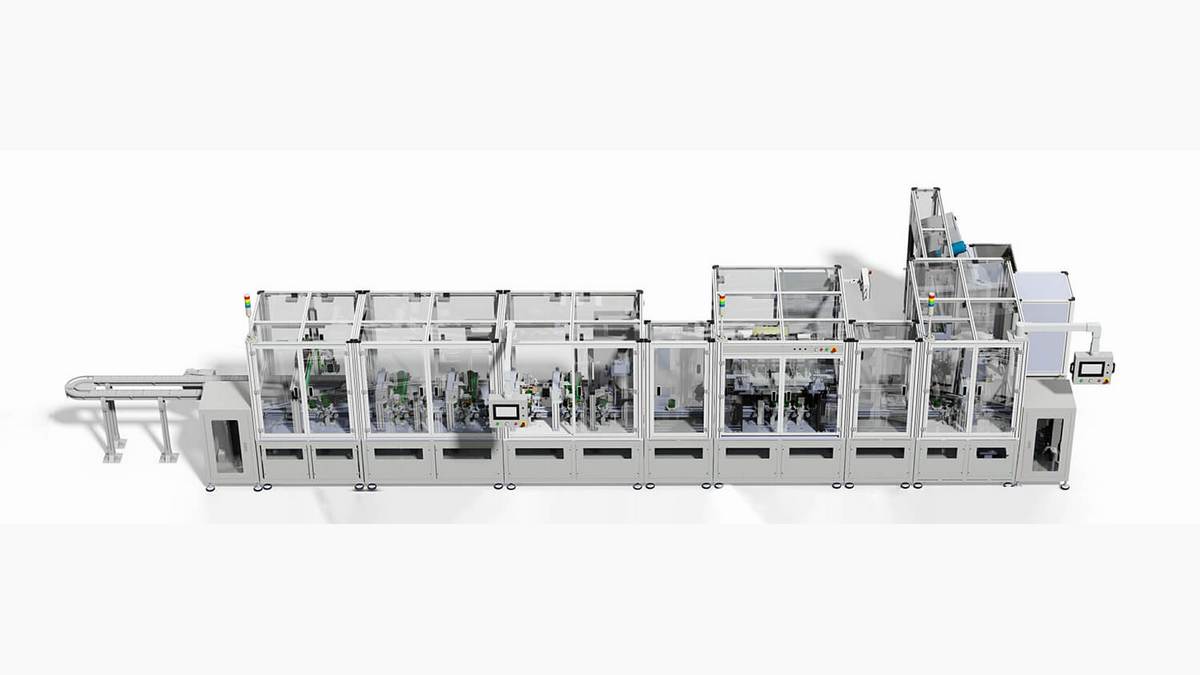
Coil winding automation is moving beyond the performance of individual machines. As production environments become more demanding, many of the most persistent problems no longer come from winding speed alone, but from poor coordination between processes, inconsistent material flow, and production layouts that were never designed to operate as one connected system. Integrated production lines are gaining attention because they address the broader structure of winding operations rather than only improving one isolated step.
Why Standalone Winding Machines Often Reach Their Limits
Standalone winding machines have long played an important role in automation upgrades. They can improve output, reduce manual work at a specific station, and bring more precision to winding processes. However, once production volume grows or process requirements become more complex, the limitations of a standalone approach begin to show.
A machine may perform well on its own, yet the surrounding workflow may still create inefficiencies. Delays between stations, repeated product handling, manual transfer steps, and mismatched cycle times can all weaken the overall value of automation. In practice, this means a facility can invest in advanced winding equipment while still facing unstable throughput, uneven quality flow, or avoidable downtime across the line.
This is one of the main reasons the industry is gradually shifting its focus. The conversation is no longer only about machine capability, but about how every stage of production works together.
The Hidden Cost of Poor Line Integration
In many winding applications, the real bottleneck sits between processes rather than inside the winding unit itself. Feeding, transfer, indexing, inspection, assembly coordination, and output handling all influence how effectively the line performs. When these stages are planned separately, small inefficiencies accumulate and eventually limit the whole operation.
Several integration gaps appear repeatedly in coil winding environments:
- Process mismatch
One station may run faster than the next, creating accumulation, idle time, or unstable takt flow.
- Manual transfer dependency
Even when the winding process is automated, intermediate movement between stages may still rely on manual handling.
- Fragmented control logic
Different machines with disconnected control systems can create data gaps, communication delays, and inconsistent operating rhythm.
- Limited expansion flexibility
A setup built around isolated equipment often becomes harder to scale when output requirements change.
These issues affect more than immediate output. They also influence floor space usage, maintenance planning, line visibility, and long-term operating cost. That is why integrated automation is becoming more relevant in winding production where continuity and predictability matter as much as machine precision.
From Machine Efficiency to System Efficiency
A broader shift is taking place across industrial automation. Instead of asking whether one machine can run faster, many manufacturers are asking whether the entire line can operate with fewer interruptions, better synchronization, and more stable production performance over time.
This shift changes how winding projects are evaluated. The key questions are increasingly tied to system efficiency:
- Can the workflow remain balanced from input to output?
- Will automation reduce unnecessary transfer and handling variation?
- Can capacity be expanded without disrupting the whole line?
- Does the layout support smoother operation across multiple connected stages?
These questions reflect a more mature view of automation. In winding production, the value of automation is not only measured by the output of one machine, but by how well the complete process performs under daily operating conditions.
Standalone Equipment vs. Integrated Production Lines
The difference between these two approaches becomes clearer when viewed from an operational perspective. The table below outlines how planning priorities change when the focus moves from isolated machines to connected production systems.
| Aspect |
Standalone Machines |
Integrated Production Lines |
| Planning focus |
Individual station performance |
Full production workflow |
| Capacity management |
Local machine output |
Line-wide throughput balance |
| Material flow |
Often interrupted or semi-manual |
Coordinated and continuous |
| Expansion method |
Equipment added case by case |
Future integration considered early |
| Control structure |
Separate machine logic |
Connected or unified control logic |
| Operational impact |
Improves one process step |
Improves overall line stability |
This comparison helps explain why more winding projects now begin with process mapping and line planning rather than machine selection alone. When production targets depend on stable throughput and flexible scaling, the structure of the system becomes as important as the specification of the equipment.
Why Turnkey Planning Is Becoming More Relevant
As winding applications become more specialized, production line development is increasingly treated as a planning and integration task rather than a simple equipment purchase. That is one reason turnkey thinking is receiving more attention.
A turnkey approach usually starts with the broader production picture: process sequence, expected capacity, site conditions, automation goals, and future expansion needs. From there, the line is designed as an interconnected system instead of a collection of separate machines. This approach can reduce common planning mistakes, such as overbuilding one section, underestimating actual output requirements, or overlooking how transfer and inspection stages affect total line performance.
In coil winding automation, this planning logic is especially valuable because the efficiency of the line often depends on how well multiple processes are aligned. When the line is designed with workflow continuity in mind, production tends to become easier to stabilize, adjust, and expand.
DETZO Is Strengthening Its Focus on Integrated Winding Solutions
Within this broader industry direction, DETZO is strengthening its turnkey solution capabilities in customized coil winding line development. Based on its published information, the company’s approach connects winding experience, production capacity calculation, planning, and implementation into a more complete automation framework.
DETZO is responding to demand for integrated automation by placing greater emphasis on:
- customized coil winding line solutions
- full-scale automated factory planning
- workflow optimization across production stages
- integration of winding systems with conveyors, robotics, and related automation technologies
- support for more flexible production line configuration and deployment
This positioning is notable because it reflects a wider change in market expectations. Automation providers are increasingly expected to support not only machine delivery, but also the design logic behind how a full production line should operate.
Building More Reliable Winding Operations Over Time
The direction of coil winding automation is becoming clearer: long-term efficiency depends less on isolated machine performance and more on how well the entire production structure works together. Standalone machines remain useful in many situations, but integrated production lines are becoming more important where stable throughput, reduced handling friction, and scalable production planning are required.
DETZO is expanding its focus in this direction by aligning customized winding solutions with broader factory planning and line integration needs. This makes the discussion around winding automation more practical. Instead of asking only which machine to install, more companies are asking how to build a line that can perform reliably, adapt more easily, and support production goals over time.