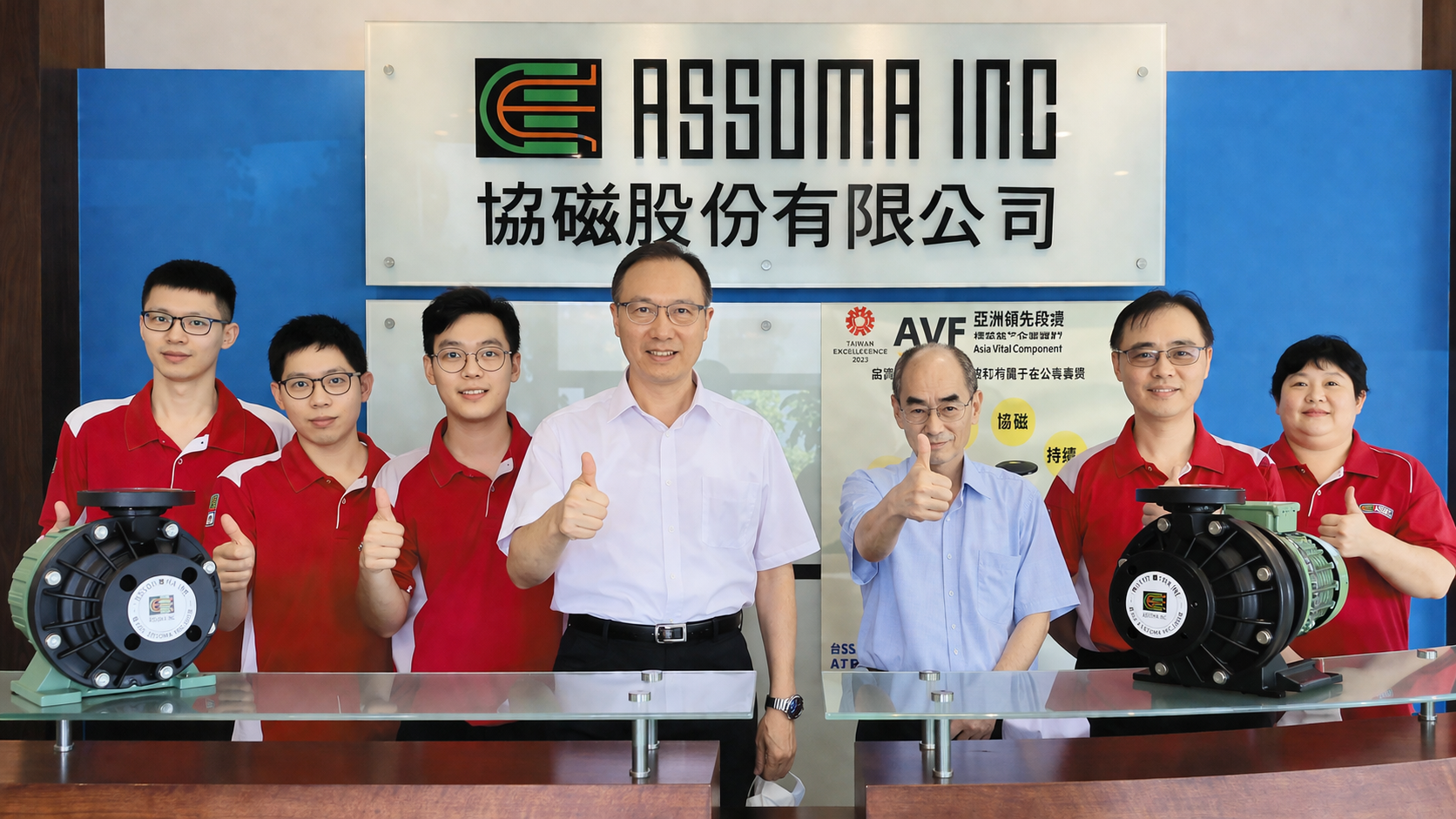
According to the IEK / Commercial Times report, “ASSOMA Receives TCIA Excellence R&D Award,” ASSOMA INC. has drawn industry attention for its high-efficiency engineering plastic chemical centrifugal pump technology and structure. The reported technology is regarded as a notable example of how corrosion-resistant chemical pumps are evolving toward higher efficiency. For users in chemical processing, PCB manufacturing, surface treatment, and environmental fluid handling systems, the value of this report goes beyond the recognition itself. It speaks directly to a continuing industrial challenge: as electricity costs, energy-saving pressure, ESG expectations, and reliability requirements rise, how should chemical pumps be evaluated to balance efficiency, chemical resistance, and total cost of ownership (TCO)?
What Does the Report Highlight?
According to the report, ASSOMA has long invested in the development of high-efficiency pump technology, with energy-saving and green design serving as key development directions. The technology highlighted in the report centers on the design and structure of a high-efficiency engineering plastic chemical centrifugal pump, especially improvements in hydraulic impeller design and manufacturing capability intended to address a common limitation in traditional engineering plastic chemical centrifugal pumps: lower efficiency.
Public information on ASSOMA’s official website also notes that the technology has been extended into its AVF-X series industrial pumps for aggressive liquids, and that the series was tested by a TAF-accredited laboratory, with pump efficiency exceeding the MEI = 0.7 high-efficiency reference level associated with EU No 547/2012. For industrial buyers, this matters because it points not only to a product claim, but to measurable efficiency performance backed by testing.
Why Does This Report Still Matter to Buyers and Plant Operators?
Pump Efficiency Directly Affects Energy Cost and Operating Expense
The IEK / Commercial Times report cites industry data indicating that pump operation can account for a significant share of industrial electricity use. For factories that require continuous circulation, chemical transfer, or corrosion-resistant fluid handling, pumps are not merely auxiliary equipment. They are closely tied to daily energy consumption, process stability, and long-term maintenance spending.
If procurement decisions are made primarily on purchase price without sufficient attention to efficiency and actual operating conditions, the resulting cost pressures may include:
- Increased electricity expense
- Higher maintenance and replacement cost
- Greater system load
- Higher risk of downtime or abnormal operation
- Additional pressure from ESG and decarbonization requirements
Corrosion Resistance and High Efficiency Are Increasingly Expected Together
In PCB, chemical processing, and surface treatment applications, engineering plastic pumps have long been valued for corrosion resistance and chemical compatibility. However, in practice, corrosion-resistant equipment that lacks strong efficiency performance can still create long-term operating cost pressure.
That is one reason this report remains relevant: it does not simply document a company recognition. It highlights an issue that continues to matter to industrial buyers—how engineering plastic chemical pumps can maintain corrosion resistance while also improving energy efficiency and operating performance.
High-Efficiency Equipment Better Supports ESG and Energy Management Goals
The report also notes that under net-zero and energy-saving policy trends, equipment users may face not only higher electricity costs but also added expenses related to carbon fees, carbon taxes, and renewable electricity procurement. From this perspective, the value of a high-efficiency pump is not limited to reduced power consumption. It may also contribute to a company’s broader energy management and sustainability goals.
For plant owners and procurement teams, equipment that combines:
- corrosion resistance,
- stable operating performance,
- verifiable efficiency data, and
- stronger long-term energy-saving potential
will naturally carry greater evaluation value than equipment promoted on only a single performance claim.
What Should Buyers Look at When Evaluating High-Efficiency Chemical Pumps?
For procurement professionals, maintenance managers, and process engineers, the evaluation of high-efficiency chemical pumps should still come back to real operating conditions, material compatibility, and long-term operating cost. When upgrading chemical pumps or corrosion-resistant fluid handling systems, buyers should prioritize the following:
1. Is there verifiable efficiency evidence?
Beyond catalog specifications, buyers should confirm whether third-party testing, efficiency benchmarks, or clear operating-condition data are available.
2. Does it fit the actual process requirements?
Chemical type, concentration, temperature, flow rate, head, and material compatibility all affect real-world performance.
3. Can it reduce total cost of ownership (TCO)?
In addition to purchase price, buyers should evaluate electricity use, maintenance frequency, spare-part replacement cycles, downtime risk, and system stability.
4. Can it support energy-saving and sustainability goals?
Equipment with more complete efficiency and test documentation is usually more useful in ESG programs, energy-saving initiatives, and customer audit requirements.
Conclusion
The IEK / Commercial Times report, “ASSOMA Receives TCIA Excellence R&D Award,” remains relevant because it addresses long-standing industrial concerns rather than a short-lived news topic. At its core, the report points to several issues that continue to matter to chemical equipment users: energy use, corrosion resistance, efficiency, and operating cost.
For companies handling corrosive liquids over long operating hours while also seeking better energy performance and stable system operation, technology cases such as ASSOMA’s high-efficiency engineering plastic chemical pump remain useful points of reference in equipment evaluation and upgrade planning.