Comparing NBR, FKM, and silicone to optimize chemical compatibility, thermal limits, and long-term sealing performance in custom rubber gaskets.
Choosing the wrong compound rarely causes a gasket to fail on day one; it tends to fail months later through swelling, hardening, or lost compression. This article compares how NBR, FKM, and silicone behave under heat, fluid exposure, and sustained load, so the material choice can be made before tooling starts, not after a field failure.
Introduction
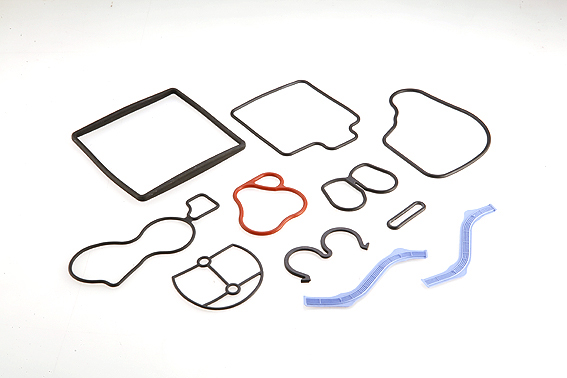
When an engineer requests a custom rubber gasket instead of pulling one from a catalog, the shape is usually the easy part. Matching an outside diameter, bolt pattern, or cross-section to a flange is routine tooling work. The harder decision, and the one that determines whether the part seals for years or fails within months, is which rubber compound goes into the mold. Nitrile (NBR), fluorocarbon (FKM, often sold under the Viton trade name), and silicone (VMQ) account for most custom gasket requests, yet their properties diverge sharply once temperature, fluid contact, or repeated compression cycles enter the picture. What follows is a practical look at how these three compounds differ, and where each one is the sensible default rather than a compromise.
Temperature Range and Chemical Resistance by Compound
Temperature is usually the first filter applied to a compound decision, and it is also where the three materials separate most clearly. NBR is generally suited to continuous service from roughly -40°C up to somewhere between 100°C and 120°C, with the exact ceiling depending on the acrylonitrile content and cure system of the specific formulation. FKM standard grades typically span about -26°C to 204°C, and some specialty FKM compounds extend further in either direction. Silicone covers the widest range of the three, often rated from around -115°C up to roughly 230°C in dry heat, though that headline number can be misleading if the application also involves sustained fluid contact rather than air or intermittent exposure.
Chemical resistance follows a similar pattern of trade-offs rather than one material winning outright. NBR handles mineral oils, many fuels, hydraulic fluid, and water well, but it degrades in contact with brake fluid, ketones, strong oxidizers, and ozone. FKM holds up against fuels, mineral and many synthetic oils, and a broad range of acids and halogenated hydrocarbons, which is why it shows up so often in fuel systems and high-temperature oil paths. Silicone tolerates dry heat, ozone, UV, and general weathering better than either alternative, and many grades are formulated for food or medical contact, but it is a poor choice for continuous immersion in most fuels, mineral oil at elevated temperature, or steam.
The table below summarizes these tendencies. Exact figures shift with the specific compound grade, filler package, and cure system a manufacturer uses, so it should be read as a starting filter rather than a substitute for a datasheet on the actual material being quoted.
| Property | NBR (Nitrile) | FKM (Fluorocarbon) | Silicone (VMQ) |
| Typical continuous temperature range | About -40°C to 100-120°C | About -26°C to 204°C (specialty grades wider) | About -115°C to 230°C in dry heat |
| Strongest resistance | Mineral oils, fuels, hydraulic fluid, water | Fuels, mineral/synthetic oils, many acids and halogenated hydrocarbons | Dry heat, ozone, UV, weathering, many food-grade oils |
| Weak points | Ozone, brake fluid, ketones, strong acids | Certain ketones and brake fluids, grade-dependent steam limits | Most fuels, sustained mineral oil at heat, steam, abrasion |
| Typical relative cost | Lowest of the three, a commodity elastomer | Highest, often a multiple of NBR's raw material cost | Moderate, rising for food, medical, or platinum-cured grades |
Read together, the table explains why so many custom gasket conversations start with temperature and fluid contact rather than price. A compound that is cheap but chemically incompatible with the working fluid will not save money once warranty and downtime costs are included.
Compression Set and Long-Term Sealing Performance
Temperature and chemical resistance describe whether a compound survives its environment. Compression set describes whether it keeps sealing while doing so. Compression set is the percentage of deflection a compressed gasket fails to recover once the load and heat are removed, and it is tested under standardized methods such as ASTM D395, referenced within the ASTM D2000 rubber classification system that many custom compound specifications are written against. A gasket with high compression set effectively goes flat under sustained bolt load and heat cycling, which lets clamping force relax and opens a leak path even though the material itself has not visibly failed.
This is where compound family alone stops being a reliable guide, because compression set behavior depends heavily on the specific cure package, durometer, and filler system a manufacturer chooses, not just whether the base polymer is NBR, FKM, or silicone. As a general tendency, FKM compounds formulated for heat resistance tend to hold their compression set performance well even near the upper end of their rated temperature range, which is part of why they are favored in engine-adjacent and long-service hydraulic applications. General-purpose NBR run near its own temperature ceiling for extended periods can show a more noticeable rise in compression set over time. Standard silicone gaskets can likewise see meaningfully higher compression set under sustained heavy compression at high heat unless the grade has been specifically formulated to resist it, so a request for the actual compression set data on the quoted grade, rather than a generic assumption about silicone as a family, is worth the extra step before tooling is committed.
Cost and Performance Trade-offs
NBR remains the default low-cost option, and when an application's temperature and chemical exposure fit comfortably within its envelope, it usually wins on total delivered cost without giving up performance. FKM carries a real price premium: the raw polymer costs materially more than NBR, and that difference compounds across production volume, so it tends to appear where its chemical or thermal resistance is actually needed rather than as a blanket upgrade. Silicone sits in a wider cost band. General-purpose industrial grades are moderately priced, but food-contact, medical, or platinum-cured grades carry additional certification, testing, and traceability costs that can push the per-part price above FKM in some cases.
The more useful comparison is not raw material cost per kilogram but the cost of a mismatch. A gasket specified in NBR for a hydraulic circuit that occasionally sees higher operating temperatures than assumed, or a silicone gasket specified for a joint that turns out to contact fuel during maintenance, can cost far more in field returns, downtime, and requalification than the price difference between compounds would have been at the quoting stage. Custom gasket sourcing decisions hold up better when they are framed around total cost of an in-spec seal over the expected service life, rather than the unit price on a quote sheet.
Matching the Compound to the Application
A few recurring patterns make the selection process more concrete. In automotive and general hydraulic equipment exposed to mineral oil-based fluids at moderate operating temperature, such as engine covers, transmission pans, and gearbox housings, NBR is usually adequate and the more economical choice. Once operating temperatures push past roughly 120°C, or the fluid includes synthetic or ester-based components, FKM becomes the safer default because it holds both chemical resistance and thermal margin at the same time.
For food, beverage, and medical or pharmaceutical equipment, silicone (particularly platinum-cured, FDA-compliant, or USP Class VI grades) is generally preferred. Its wide temperature swing tolerance suits steam sterilization cycles and cold storage alike, and its low extractable profile matters where product contact is a regulatory concern. That said, silicone's limited resistance to fuels and mineral oil means it is rarely the right choice for the hydraulic or lubrication sections of the same piece of equipment, which may still call for NBR or FKM even within a food-grade machine. For static gaskets exposed mainly to outdoor weathering, ozone, and UV rather than oil contact, silicone often outperforms NBR, though EPDM is also commonly considered in that specific use case even though it sits outside the scope of this comparison.
FAQ
Q: Can a custom gasket combine two compounds, for example a silicone body with an FKM-faced sealing bead?
A: Yes. Co-molded or bonded multi-material gaskets are a recognized approach when one zone of a joint needs the wide temperature tolerance of silicone and another zone needs FKM's fluid resistance. It adds tooling and process complexity, so it is generally reserved for applications where a single compound genuinely cannot satisfy both zones.
Q: What does durometer rating actually tell you about a gasket's sealing performance?
A: Less than most buyers assume. Durometer measures hardness, not sealing capability. A higher durometer gasket resists extrusion and handles better under high clamp load, but it also needs a smoother flange surface and more bolt force to conform and seal effectively. A softer, lower-durometer compound of the same family often seals a rough or slightly warped flange more reliably at lower torque, so durometer is one input among several rather than a standalone quality signal.
Q: How can a buyer confirm the compound actually used in production matches what was quoted?
A: Ask for a material certificate that references the ASTM D2000 or SAE J200 line callout for the compound, along with batch-level durometer and, where relevant, compression set test data. Compound names alone (such as "silicone" or "FKM") cover a wide range of formulations, so the callout and test data are what actually pin down the performance being purchased.
Conclusion
The core decision principle is to filter by temperature range and fluid compatibility first, then use compression set behavior and cost as the second-stage filter once the material family has been narrowed to one or two realistic candidates. Defaulting to whichever compound a shop happens to keep in stock, or choosing purely on unit price, is the most common way a custom gasket program ends up with an avoidable field failure.
That principle shifts under a few conditions. Regulatory requirements such as food or medical contact narrow the field toward silicone regardless of cost. Dynamic or high-cycle joints put more weight on compression set data than static, low-movement joints do. And low production volumes can make the cost gap between compounds less significant relative to the engineering time spent qualifying a cheaper option. Before committing to tooling, it is worth requesting the actual test data, not just the compound family name, for the specific grade being quoted, and specifying the material by its ASTM D2000 or SAE J200 callout in the RFQ so there is no ambiguity between what was discussed and what gets molded.
Custom gasket suppliers vary in which compound families they actually mold in-house rather than simply list on a website. Lian Yu Oil Seal, a Taiwan-based rubber parts manufacturer, names NBR, EPDM, FKM, and silicone (VMQ) among the materials it offers for custom rubber seals and gaskets, with selection guided by the same operating temperature and chemical compatibility considerations outlined above.

(4059)(20260924)(原).jpg)
(2367)(20260924)(原).jpg)