A practical comparison of transfer efficiency, finish quality, air demand, workflow, and compliance considerations for automotive refinishing shops.
Subtitle: A practical comparison of transfer efficiency, finish quality, air demand, workflow, and compliance considerations for automotive refinishing shops.
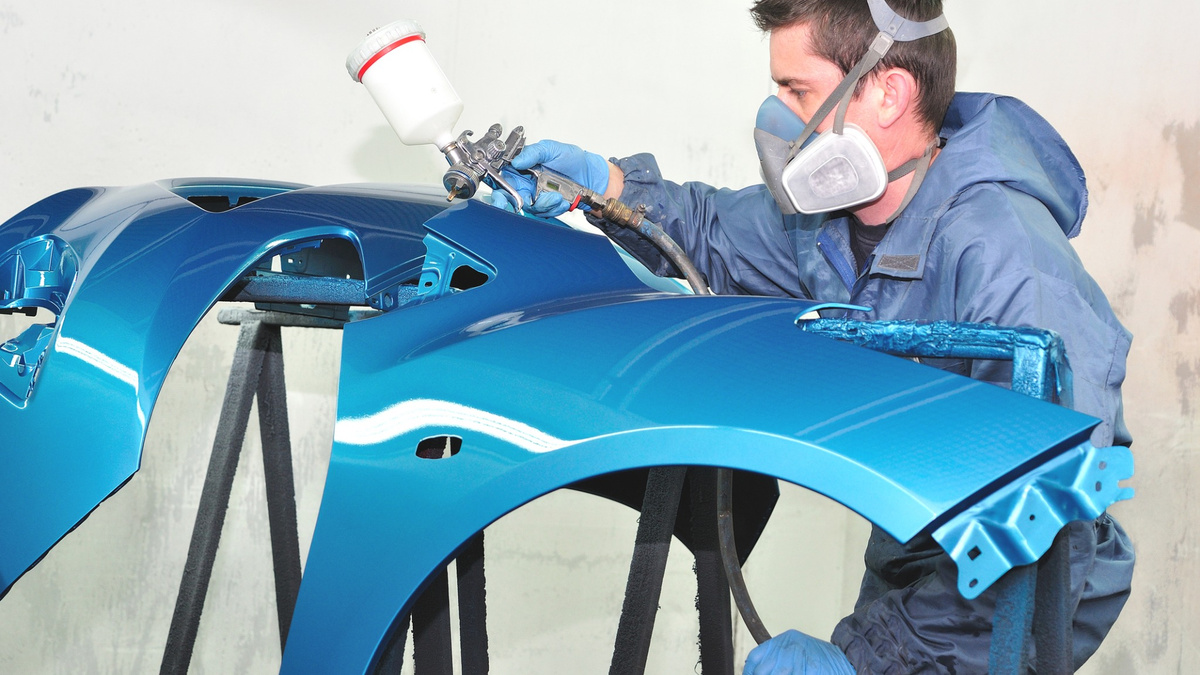
Choosing a spray gun is not simply a matter of deciding which technology is “better.” In automotive refinishing, the right choice depends on the coatings being applied, the shop’s compressor and booth setup, painter technique, production targets, and local environmental requirements. High-volume, low-pressure (HVLP) guns are widely used because they can reduce overspray and improve transfer efficiency. Conventional air-spray guns, however, remain relevant where fine atomization, familiar handling, or specific application characteristics are priorities.
The better question is: which system best fits the way your shop works?
How HVLP and Conventional Spray Guns Differ
Both systems use compressed air to atomize liquid coating, but they do so differently. Conventional guns typically use higher air pressure to create a fast-moving, finely atomized spray. That can support smooth application, but the higher particle velocity can also increase bounce-back and overspray.
HVLP guns use a greater volume of air at lower pressure at the air cap. The lower spray velocity is intended to put more coating onto the panel rather than into booth filters or surrounding air. South Coast AQMD defines transfer efficiency as the proportion of coating solids that adhere to the object compared with the amount used.
| Factor |
HVLP |
Conventional Air Spray |
| Atomization |
High air volume, lower pressure |
Higher pressure, higher spray velocity |
| Transfer efficiency |
Generally higher when correctly set up |
Generally lower for traditional high-pressure systems |
| Overspray |
Typically reduced |
Typically greater |
| Air supply |
Often needs substantial airflow |
Varies by gun design |
| Regulatory fit |
Commonly accepted |
May require approved equivalent technology |
Finish Quality: The Gap Has Narrowed
Conventional guns built their reputation on fine atomization, especially where painters wanted a very smooth wet coat. Older HVLP systems could feel slower or less refined, particularly with clearcoat. EPA case material from the automotive refinishing sector documented similar early concerns when shops transitioned from conventional equipment to HVLP.
Modern equipment has narrowed that gap. With the correct nozzle, air cap, inlet pressure, coating viscosity, and technique, an HVLP gun can deliver professional basecoat and clearcoat finishes. In practice, setup quality often matters as much as the technology label.
“Conventional” also covers a broad range of designs. Modern high-efficiency or reduced-pressure guns may behave differently from older high-pressure models, and some non-HVLP guns have received regulatory approval as equivalent to HVLP based on transfer-efficiency testing. EPA and South Coast AQMD both maintain examples of approved equivalent technologies.
Material Use and Operating Cost
For many shops, paint and clearcoat costs make transfer efficiency one of the strongest arguments for HVLP. More coating landing on the vehicle means less material lost as overspray. EPA guidance has long promoted HVLP as a way to reduce paint use and pollution.
Those savings are not automatic. Excessive gun distance, incorrect pressure, poor overlap, worn components, unsuitable reducers, or insufficient compressor capacity can reduce the advantage. Shops should consider the whole operating system: gun price, air consumption, coating usage, booth filters, cleaning time, rework, and training.
A high-volume collision shop may value material savings and repeatability most. A restoration or specialty shop may place more emphasis on a particular spray feel or finish characteristic.
Air Supply and Shop Infrastructure
“Low pressure” does not mean low compressor demand. HVLP guns can require substantial airflow, and a compressor that supplies enough pressure but not enough cubic feet per minute can cause pressure drop, inconsistent fan patterns, and poor atomization. EPA guidance on HVLP setup has also highlighted the importance of adequate hose size and maintaining the correct pressure at the gun.
Before changing gun technology, check the manufacturer’s airflow specification, hose diameter, regulator capacity, moisture control, and pressure at the gun while air is flowing. This matters especially when several technicians use air tools at the same time.
Conventional guns may suit some existing air systems more easily, but the decision should be based on measured air capacity and production demand rather than pressure ratings alone.
Compliance, Overspray, and Worker Protection
Environmental rules increasingly favor efficient coating application. Under the U.S. EPA’s Auto Body Rule, covered motor-vehicle and miscellaneous surface-coating operations must use HVLP, electrostatic, airless, air-assisted airless, or another approved technology with comparable transfer efficiency. State and local requirements may be stricter.
Equipment choice is only one part of safe refinishing. OSHA requirements for spray-finishing operations address ventilation and control of flammable vapors, mists, and residues. Shops should therefore treat the spray gun, booth, ventilation, respiratory protection, coating safety information, and technician training as one integrated system.
So, Which Is Right for Your Shop?
HVLP is often the logical starting point for a shop focused on transfer efficiency, overspray reduction, material control, and alignment with modern refinishing rules. It is especially well suited to routine collision repair and production environments where coating cost and repeatability matter.
A conventional or non-HVLP high-efficiency gun may still make sense where a painter prefers a particular atomization pattern, where a coating system performs best with a specific setup, or where an approved equivalent is permitted. The key is to evaluate the specific gun, not just the category name.
Before buying, test the gun with the coatings you actually use. Confirm compressor capacity, nozzle recommendations, pressure settings, local compliance requirements, and parts availability.
FAQ
1. Does HVLP always use less paint?
Not automatically. HVLP is designed for higher transfer efficiency, but actual paint use depends on setup, technique, coating viscosity, panel shape, and application conditions.
2. Can HVLP produce a high-quality clearcoat finish?
Yes. Modern HVLP guns can produce professional clearcoat finishes when properly matched and adjusted. Fluid delivery, nozzle selection, coating preparation, and painter technique remain important.
3. Is a conventional spray gun illegal for automotive refinishing?
Not universally. Regulations vary. In the United States, EPA rules for covered operations allow several technologies, including approved alternatives with transfer efficiency comparable to HVLP.
4. Does HVLP need a larger compressor?
It can. Many HVLP guns require substantial airflow, so compressor capacity should be checked against the manufacturer’s CFM requirement.
5. Which type is better for beginners?
HVLP is often a practical starting point because it supports controlled application and reduced overspray, but training matters more than the label. Beginners still need to learn pressure, fan control, overlap, distance, and gun speed.
6. Should one gun be used for primer, basecoat, and clearcoat?
It can be, with suitable nozzle changes and thorough cleaning, but many professional shops dedicate guns or setups to different materials to improve consistency and reduce contamination risk.
Conclusion
The shift toward HVLP reflects broader trends in automotive refinishing: tighter material control, reduced overspray, stronger environmental expectations, and greater attention to process consistency. Still, the best spray gun is the one that matches the coating system, technician, air supply, production volume, and regulatory environment.
For shops comparing current automotive spray-gun options, reviewing different configurations side by side can make it easier to identify the right fit for a particular refinishing process. Explore the Roxgen automotive spray gun range to see available options and compare them against your shop’s technical and workflow requirements.