Why IP67 is only part of the story, and how to verify electrical, thermal, and corrosion protection specs when specifying breakers for harsh marine environments.
Salt water finds its way into places engineers do not expect, and a circuit breaker rated for a dry industrial panel will not survive long in a boat's electrical compartment, a dock power pedestal, or an offshore control cabinet exposed to spray and humidity. Marine and offshore electrical systems demand protection ratings and construction standards that go well beyond general-purpose overcurrent devices, and understanding what those ratings actually guarantee, and what they don't, is essential for anyone specifying circuit protection for equipment that will see water exposure.
What an IP67 Rating Covers, and What It Doesn't
The Ingress Protection scale defines two things with its two digits: the first digit rates protection against solid objects such as dust, and the second rates protection against water. An IP67 rating means the enclosure is completely dust-tight and protected against temporary immersion in water, typically defined as up to one meter of depth for a limited duration, which is why the rating is sometimes described as protection against "temporary immersion" rather than continuous submersion. This distinguishes it from IP68, which covers continuous immersion and is generally reserved for components genuinely intended to operate underwater rather than merely tolerate an occasional splash or dunking. For most marine circuit breaker applications, mounted in engine compartments, helm stations, or exposed deck panels, IP67 provides a meaningful margin against spray, rain, and washdown without implying the device is designed to sit submerged indefinitely.
It is worth being precise about what an IP rating does not certify. IP67 addresses sealing against dust and water ingress; it says nothing on its own about corrosion resistance of terminals and studs, vibration tolerance, or the breaker's actual current-interrupting performance under fault conditions. A breaker can carry an IP67 enclosure rating while still using base materials that corrode quickly in a salt air environment, which is why marine-grade circuit breakers typically combine the IP67 seal with separate corrosion-resistant construction, such as stainless steel studs and a bakelite or thermosetting plastic body, rather than relying on the ingress rating alone to signal suitability for marine use.
How ABYC Standards Fit Alongside IP Ratings
In North American recreational and small commercial marine markets, the American Boat and Yacht Council's E-11 standard is the primary reference for AC and DC electrical systems on boats, and marine-grade circuit breakers are commonly built to comply with ABYC E-11 alongside SAE marine electrical standards such as SAE J1171 for ignition protection. Ignition protection matters specifically for breakers installed near fuel systems or in engine compartments, since a device that is not ignition-protected can, in theory, spark in a way that ignites explosive vapors in a poorly ventilated space; SAE J1171 and equivalent UL certifications test specifically for this failure mode. A circuit breaker's marketing copy claiming "marine grade" is not a substitute for confirming which specific standards, ABYC E-11, SAE J1171, UL certification, or an equivalent, the product has actually been tested against, since "marine grade" itself is not a regulated or standardized term.
Corrosion, Testing, and What a Genuinely Marine-Rated Breaker Should Demonstrate
Beyond ingress protection and ignition safety, marine and offshore circuit breakers operate in an environment that actively degrades ordinary metal hardware over time through salt spray and humidity cycling. Manufacturers building for this environment typically run accelerated salt-spray corrosion testing on terminals and housings, often to a standard measured in tens or hundreds of hours of continuous salt fog exposure, as a proxy for years of real-world marine service. Mechanical durability matters just as much: a breaker installed on a vessel will be cycled, reset after nuisance trips, exposed to vibration underway, and handled in wet conditions, so mechanical life testing (repeated actuation cycles) and torque testing on terminal connections are both relevant indicators of whether a breaker will hold up beyond its first season.
| Requirement | What it addresses | What to ask a supplier to confirm |
| IP67 ingress rating | Dust-tight sealing and temporary water immersion tolerance | Independent test certification, not just a datasheet claim |
| ABYC E-11 compliance | North American marine electrical system safety standard | Whether the specific model, not just the product line, is tested to E-11 |
| SAE J1171 ignition protection | Safety in fuel vapor-prone compartments | Applicability to breakers near engines, fuel systems, or bilges |
| Salt-spray corrosion testing | Long-term resistance to marine atmosphere | Test duration and pass criteria used |
| Terminal and stud material | Corrosion resistance independent of enclosure sealing | Stainless steel vs. plated steel hardware |
| Mechanical/actuation cycle testing | Durability under repeated reset and vibration | Rated number of mechanical life cycles |
Matching Breaker Selection to the Actual Installation Environment
Not every marine electrical circuit needs the same level of protection, and over-specifying can add unnecessary cost while under-specifying creates a real reliability and safety risk. A breaker mounted inside a sealed, climate-controlled electronics enclosure below deck faces a very different exposure profile than one mounted on an open helm panel exposed to direct spray, or one used on a trolling motor, winch, or bilge pump circuit that sits in a wet bilge environment continuously. Buyers should map each circuit's actual exposure, direct spray, occasional splash, high humidity without direct water contact, or continuous wet environment, against the breaker's rated protection level rather than defaulting to the highest-rated part everywhere, since amperage rating, voltage class, and reset behavior (manual versus automatic reset) also need to match the specific circuit's protection requirements, not just its water exposure.
Frequently Asked Questions
Q: Is a manual reset or auto-reset circuit breaker better for marine use?
A: It depends on the circuit. Manual reset breakers require a physical reset after tripping, which forces an operator to investigate the cause before restoring power, a safety advantage on circuits like winches, anchors, or high-current accessories where an unexpected automatic restart could be hazardous. Auto-reset breakers restore power once the overload clears, which suits circuits like bilge pumps where uninterrupted protection against nuisance trips may matter more than forcing manual intervention.
Q: Does IP67 mean a circuit breaker can be permanently mounted underwater, such as inside a flooded bilge?
A: No. IP67 covers temporary immersion, generally understood as up to about one meter of depth for a limited time, not continuous submersion. A breaker intended for permanent underwater mounting would need an IP68 rating and a completely different sealing and mounting approach; IP67-rated marine breakers are designed for spray, splash, and occasional temporary immersion, not sustained underwater operation.
Conclusion
Specifying circuit protection for marine and offshore equipment means looking past a single IP67 badge and confirming the fuller picture: ingress protection for dust and water, a recognized electrical safety standard such as ABYC E-11, ignition protection where fuel vapor is a risk, corrosion-resistant hardware independent of the enclosure seal, and mechanical durability data appropriate to a vibrating, frequently-reset marine environment. None of these checks are optional extras; each addresses a failure mode that a generic industrial breaker, even a nominally water-resistant one, is not built to survive over a multi-year service life on the water.
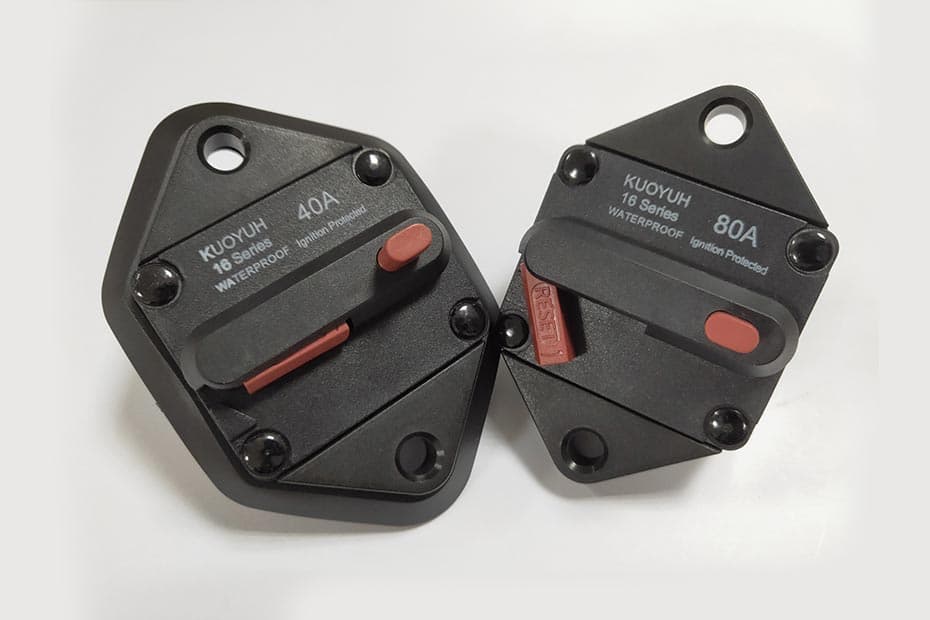
Among suppliers building to this checklist, KUOYUH offers its IP67 waterproof marine circuit breakers with UL certification, stainless steel terminal studs, and compliance with ABYC E-11 and SAE J1171 ignition protection, spanning a 30A to 300A range for marine, RV, and offshore power protection circuits.

(4059)(20260924)(原).jpg)
(2367)(20260924)(原).jpg)