How PoE simplifies cabling and management while introducing new considerations for power budgets, resilience, and cybersecurity.
Access control has moved from isolated electrical hardware toward network-connected building infrastructure. Modern control boards communicate with management software, readers, sensors, alarms, and building systems. As connectivity grows, power delivery becomes a design decision rather than a minor installation detail.
Power over Ethernet, or PoE, carries data and low-voltage DC power over compatible Ethernet cabling. It can remove the need for a nearby AC outlet or separate adapter, simplifying deployment and management. Yet PoE is not automatically right for every door; its value depends on power demand, backup strategy, cabling, cybersecurity, and downstream hardware.
Why PoE Fits Modern Access Control
A conventional installation separates communications and power: Ethernet connects the controller, while a local supply powers the board and sometimes door hardware. This supports substantial loads but adds components and maintenance points.
PoE combines both functions through a standards-based link. A switch or midspan injector supplies power, while the controller receives it. Compliant equipment performs detection and classification before normal power delivery.
The IEEE PoE family supports several power levels. Type 1, associated with IEEE 802.3af, provides up to 15.4 watts from the source; Type 2, associated with 802.3at, provides up to 30 watts. IEEE 802.3bt raises source power to 60 or 90 watts, although many access control boards remain within the af/at range. The key question is therefore not merely whether a switch supports PoE, but whether its standard, per-port output, and total power budget match the controller.
| Consideration |
Separate local power |
PoE-powered board |
| Cabling |
Network plus power wiring |
One cable for board data and power |
| Backup |
Local battery or UPS planning |
Central UPS can support the PoE switch |
| Servicing |
Power handled at the panel |
Port power may be monitored or cycled remotely |
| Capacity |
Flexible for larger local loads |
Limited by PoE class and switch budget |
| Failure scope |
Often limited to one panel |
A switch fault may affect several panels |
Practical Benefits
The clearest benefit is installation simplicity. Fewer cable runs and local outlets can save enclosure space and make controller placement less dependent on electrical locations. This is useful in retrofits, distributed facilities, and sites where adding AC circuits would be disruptive.
PoE can also improve operational consistency. Managed switches may expose port status, power faults, and remote restart controls. A UPS supporting the switch can keep several controllers operating during a short outage, reducing scattered adapters and backup devices. This still does not replace a complete continuity or life-safety design.
A planned structured-cabling system can also make controllers easier to add, relocate, and document across buildings.
PoE Does Not Power Everything Automatically
A common misunderstanding is that a PoE-powered board automatically powers every component at the door. Electric strikes, magnetic locks, readers, sensors, request-to-exit devices, and auxiliary relays can have different voltage and current requirements. Locking hardware may draw considerably more power during activation than the controller itself.
Some panels power selected peripherals, while others require a separate lock supply. Fire release behavior, fail-safe or fail-secure operation, battery capacity, and local codes may dictate a dedicated arrangement. Installers should calculate the complete door load and verify which outputs the board can power.
Design Risks and Planning Priorities
PoE shifts critical dependency toward the network closet. When several access control boards share one switch, that switch becomes part of the physical security system’s availability chain. Higher-security sites may justify redundant network equipment, properly sized UPS capacity, spare ports, power prioritization, and documented recovery procedures.
The total PoE budget matters as much as one port’s rating. A switch may not supply maximum output to every port simultaneously, so designers should total demand, include headroom, and consider peak loads.
Cabling quality also affects performance. Higher-power PoE can increase heat in large cable bundles, especially in warm rooms or enclosed pathways. Appropriate cable construction, connector quality, bundle management, and compliance with applicable cabling standards help limit power loss and preserve reliability.
Finally, a networked access control board is both a physical security component and an IT asset. It should use an appropriately segmented network, strong credentials, controlled administrative access, current firmware, and event monitoring. PoE simplifies power delivery; it does not replace cybersecurity.
Frequently Asked Questions
1. Is PoE reliable enough for access control?
Yes, when the switch, cabling, UPS, and controller are properly selected and maintained. Reliability depends on the complete architecture rather than PoE alone.
2. Does PoE eliminate battery backup?
Not necessarily. A backed-up PoE switch may keep the controller online, but locks, fire interfaces, or regulations may still require separate batteries or supplies.
3. Can any Ethernet switch power a control board?
No. The switch or injector must support a compatible PoE standard and provide sufficient per-port and total power.
4. Is PoE safer than a local AC adapter?
Standards-based PoE uses controlled low-voltage delivery and device detection. It can reduce the need for local mains wiring, but equipment ratings and installation rules still apply.
5. Can PoE restart a controller remotely?
Many managed switches allow authorized users to disable and restore port power. This helps troubleshooting, although access to that function should be restricted.
6. What should buyers verify before choosing a PoE panel?
Check the PoE standard, input demand, peripheral and lock loads, backup requirements, security features, environmental rating, mounting method, and software integration.
Conclusion
PoE aligns access control boards with the direction of modern buildings: connected, centrally managed, and supported by shared digital infrastructure. A single cable can reduce installation complexity, improve serviceability, and support centralized backup. At the same time, it concentrates risk in switches, power budgets, and cabling pathways.
The best results come from treating PoE as part of a complete system design. When controller demand, door hardware loads, resilience, cybersecurity, and code obligations are evaluated together, PoE can provide a practical foundation for new installations and carefully planned upgrades.
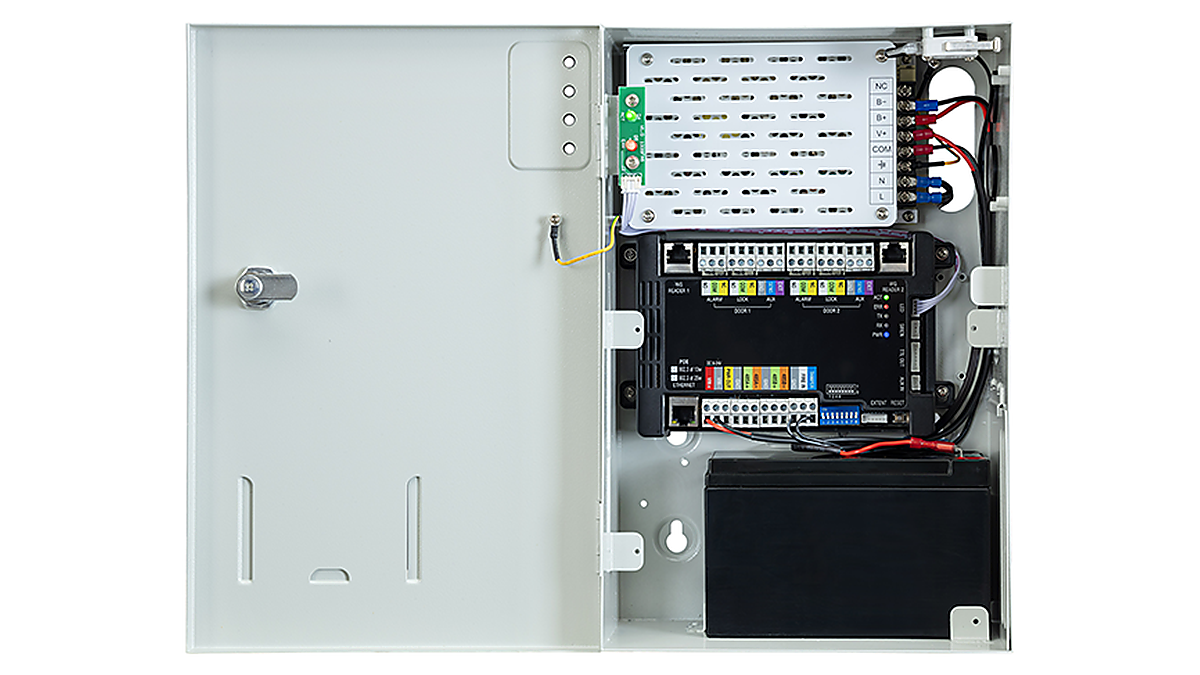
For teams comparing current two-door controllers, the Chiyu SEMAC CP202 door control panel provides a useful example of optional IEEE 802.3af/at PoE, web-based management, and OSDP/Wiegand connectivity in a modern access control board.