The performance of popping boba depends on encapsulation chemistry: the gel membrane has to deliver the intended bite while remaining compatible with the product's storage, filling, and processing conditions.
Why Popping Boba Technology Became a Global F&B Trend
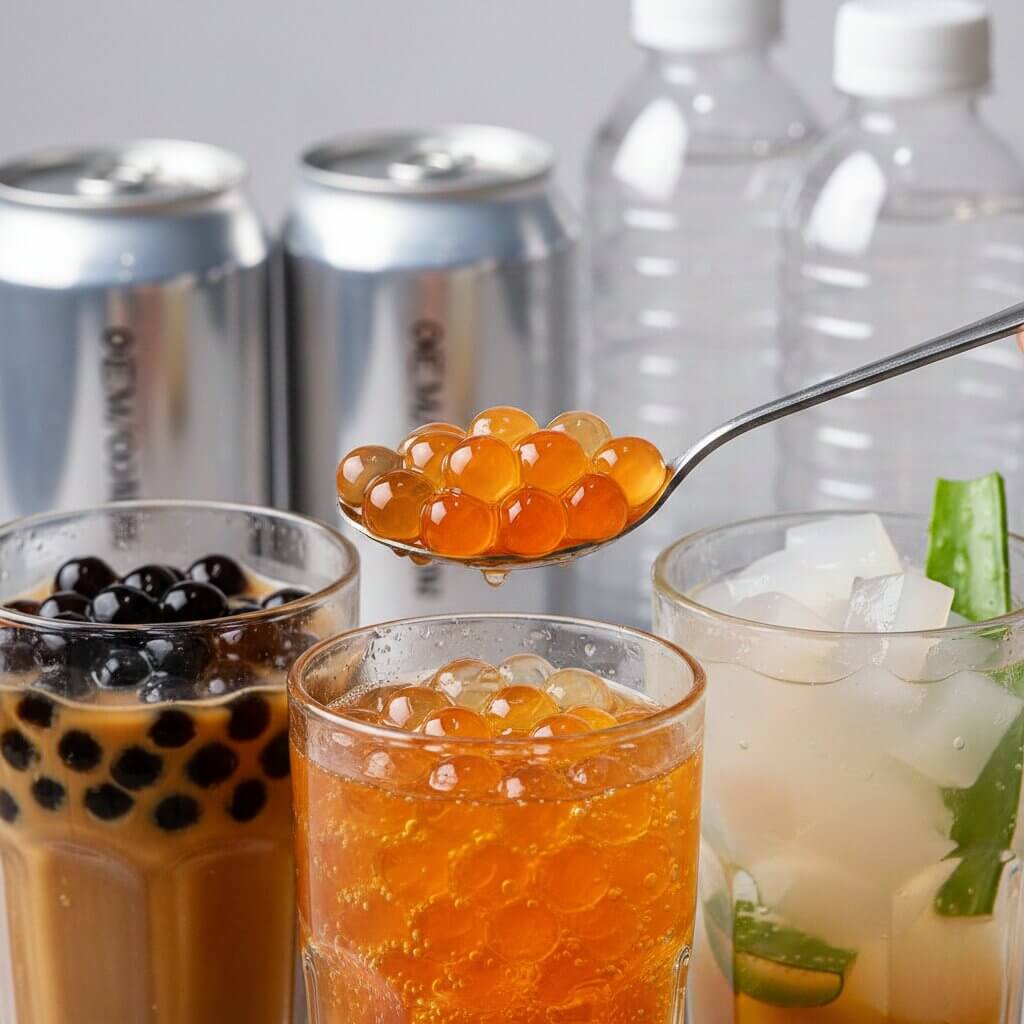
Popping boba originated in modernist cuisine and is now used in bubble tea, desserts, yogurt products, cocktails, and some beverage development programs. Its defining feature is a liquid center enclosed by a thin gel membrane, creating a burst rather than the chew of a tapioca pearl. For F&B buyers, the relevant question is not simply whether the format is popular, but whether a supplier can reproduce its texture, appearance, and stability for the intended channel.
A 2023 Grand View Research estimate placed the global bubble tea market at roughly USD 2.75 billion in 2022 and projected it to reach USD 5.42 billion by 2030, at a CAGR of about 8.9 percent. That is a measure of the broader bubble tea market, not popping boba specifically. It provides market context, but it should not be treated as direct evidence of popping boba demand or factory capacity.
Social platforms have increased the visibility of popping boba, but B2B sourcing decisions depend on repeatability rather than virality. Manufacturers need to control burst behavior, appearance, shelf life, and compatibility with the buyer's filling and distribution process. Understanding the encapsulation science therefore helps buyers ask better technical questions before approving a supplier or SKU.
Encapsulation Science 101: How the Gel Membrane and Liquid Center Form
Popping boba is made using spherification, an encapsulation technique that forms a gel membrane around a liquid. A common base material is sodium alginate, a polysaccharide derived from brown seaweed. When alginate encounters calcium ions, ionic gelation cross-links the polymer chains. This structure is commonly described as the "egg-box model." The rate and extent of gelation depend on the calcium source, alginate concentration, exposure time, pH, and composition of the filling liquid; these variables are documented in research on alginate-based caviar spherification (Lee and Rogers, 2013).
There are two common ways to run the reaction. In direct spherification, a flavored liquid containing sodium alginate is dropped into a calcium bath, and the shell forms from the outside in. In reverse spherification, calcium is incorporated into the flavored liquid and the droplet is placed in an alginate bath. The choice affects how quickly the membrane forms and how its thickness changes during holding. Commercial formulations may use variations of either method, so buyers should ask the supplier to identify the process and explain how it controls membrane growth during storage.
Four variables decide whether a batch performs well after it leaves the factory:
-
Membrane thickness and elasticity. A thin membrane bursts easily under light bite pressure, the "pop" consumers expect, but the same thinness makes it fragile against transport pressure, filling equipment, or heat.
-
Gelation time and calcium concentration. Too little contact time leaves an unstable shell; too much produces a membrane that will not burst cleanly.
-
Fill liquid viscosity and clarity. The juice or syrup inside needs enough viscosity to hold its shape without clouding or separating during storage.
-
Thermal and pressure tolerance. Standard popping boba is not automatically suitable for retort or other high-heat processes. Storage and transport conditions are product-specific, while reinforced formulations may be developed for ambient distribution or a defined retort cycle. BOBA EMPIRE's 2026 technical guide describes a 121°C retort process and a 12-to-18-month ambient shelf-life claim for its own retort-grade toppings; those figures should not be generalized to every popping boba product.
For buyers, the practical distinction is between a formulation qualified for foodservice use and one validated for a specific RTD or export process. A standard alginate membrane may not withstand the heat, pressure, acidity, or residence time of a retort cycle. A reinforced membrane can be designed for a defined process, but the validation belongs to the formulation, packaging, and cycle together:
| Format | Handling | Typical Shelf Life |
| Standard popping boba | Foodservice or non-retort applications; not retort-qualified by default | Product- and package-specific |
| Reinforced/retort-grade | Validated for a defined retort cycle when supported by supplier data | Product- and process-specific; supplier data required |
Sourcing Popping Boba: What F&B Brands and Distributors Should Evaluate
For buyers, popping boba should be treated as a formulation-dependent ingredient rather than a fully interchangeable commodity. Because finished texture depends on controlled chemistry and handling, sourcing decisions should go beyond price and flavor catalog. A few areas are worth checking before committing to a supplier.
Shell composition and documentation matter first: confirm the alginate source, whether the product is vegan, and whether allergen statements and ingredient declarations meet the regulations of your target market.
Certifications and traceability come next. HACCP, Halal, and other food-safety documentation may be required depending on the target market and channel. Ask for the supplier's certification scope, product coverage, and current validity, not just a logo on the website.
Burst consistency and QC data deserve close attention too. Request batch-to-batch texture data and the test method, not just a sample box. A supplier that can describe its acceptance range, gelation process, and sampling plan in specific terms gives buyers a stronger basis for approving volume production than one that only markets flavor variety.
Ambient handling versus thermal-process fit is one of the most common sourcing risks in this category. Clarify upfront whether the product is intended for foodservice use, ambient distribution, refrigeration after opening, or a defined retort cycle. A standard popping boba product should not be placed into a canned RTD line unless the supplier has validated the formulation, package, and sterilization process together.
Shelf life and flavor-retention data should be requested in writing, not estimated. Some suppliers publish 12-to-18-month ambient shelf-life claims for specific retort-grade toppings, but the result depends on formulation, packaging, process conditions, and whether the claim applies to the topping before or after incorporation into the finished beverage.
OEM and private-label flexibility matters for brands building a differentiated product: ask about custom flavor development, minimum order quantities, packaging formats, and whether the manufacturer supports private-label production.
Finally, run a pilot batch. Because filling equipment, nozzle pressure, formulation, package geometry, and sterilization parameters vary between production lines, test a small batch through the intended equipment before committing to a full production order. Record the process conditions and evaluate membrane integrity, appearance, flavor, and shelf-life performance after processing.
A Supplier-Specific Retort Claim: What Buyers Still Need to Verify
BOBA EMPIRE's April 2, 2026 technical guide describes a reinforced heat-stable popping boba for RTD applications. The guide states that its retort-grade toppings maintain structural integrity through a 121°C commercial sterilization process and can support a 12-to-18-month ambient shelf life. These are supplier-specific claims about defined products and conditions, not general properties of popping boba.
The same guide explains why standard popping boba is not automatically suitable for retort: a membrane designed to rupture during consumption may fail under heat and pressure. That is a useful product-development hypothesis, but it does not replace a buyer's own validation. The supplier guide itself recommends testing the formulation on the buyer's equipment and confirming the sterilization time and F0 value.
For any supplier making a similar claim, buyers should request the exact SKU specification, retort cycle, F0 target, packaging configuration, microbiological validation, shelf-life protocol, and batch-level texture data. BOBA EMPIRE's public product pages list standard popping boba for foodservice applications, but they do not by themselves establish retort performance for every flavor or package size.
FAQ
Q: What is the difference between popping boba and tapioca pearls?
A: Tapioca pearls are starch-based and are cooked to develop a chewy texture throughout. Popping boba contains a liquid center enclosed by a gel membrane, so it bursts rather than chews. Their storage and processing behavior also differ: tapioca texture changes as cooked starch ages, while popping boba performance depends on membrane integrity and the stability of the encapsulated liquid.
Q: Does popping boba need to be refrigerated?
A: Not necessarily. Storage requirements depend on the formulation, packaging, and supplier instructions. The more important distinction for RTD development is whether the product has been validated for the intended heat, pressure, acidity, and residence time. A standard popping boba product should not be assumed to be retort-compatible, and a retort-grade claim should be checked against the exact SKU and process.
Q: Can popping boba be used outside of bubble tea?
A: Yes. Popping boba is used in desserts, yogurt products, shaved ice, cocktails, and beverage applications. RTD canned or bottled use requires additional validation because the membrane must tolerate the product's acidity, filling process, packaging, and any thermal treatment.
Conclusion
Popping boba combines a liquid center with a gel membrane that is designed to rupture during consumption. At commercial scale, performance depends on more than the visual effect: buyers need to understand how the membrane is formed, how it responds to storage and handling, and whether it is compatible with the target filling or thermal process. For F&B brands and distributors, popping boba sourcing should therefore be treated as an ingredient specification exercise. Request the formulation and process information, documented shelf life, test conditions, and handling requirements rather than selecting only by flavor and appearance.
Brands and distributors evaluating popping boba for a specific application should request the supplier's certification scope, batch texture data, shelf-life protocol, and process compatibility documentation, then schedule a pilot batch before full production.

.jpg)
.jpg)