The Principle of Electrical Discharge Machining Is So Simple, Its Role And Importance In Machining
Knowledge

The Principle of Electrical Discharge Machining Is So Simple, Its Role And Importance In Machining

The principle of electrical discharge machining is simply a thermal processing method that converts electrical energy into heat energy of the work piece to quickly melt the work piece.
Published: May 20, 2020
The Principle of Electrical Discharge Machining Is So Simple, Its Role And Importance In Machining

Definition of Electrical Discharge Machining

Electrical Discharge Machining (EDM) is a manufacturing process that generates sparks by discharge to make the workpiece into the desired shape. The dielectric liquid separates the two electrodes and applies a voltage to produce a rapidly and periodically changing current discharge to process the material. One of the electrodes is called a tool electrode, or pole head, and the other electrode is called a workpiece electrode, or simply a workpiece. In the process of electrical discharge machining, there will be no actual contact between the tool electrode and the workpiece electrode.

When the potential difference between the two electrodes increases, the electric field between the two electrodes also increases until the electric field strength is higher than the dielectric strength. At this time, dielectric breakdown occurs, and current flows through the two electrodes. This phenomenon is the same as the capacitor collapse, removing part of the electrode material. When the current stops, the new dielectric will flow into the electric field between the electrodes, excluding solid particles, and the insulation of the dielectric is restored. After the current flows, the potential difference between the two electrodes will return to before the dielectric breakdown, so that a new dielectric breakdown can be repeated.

Machining Process

Electric discharge machining is commonly used in mold processing: EDM and wire cutting. The electrical discharge machining referred to here mainly refers to wire cutting, although the same is an electrical discharge, the efficiency is very different.

The working principle of electrical discharge machining is: between the machine tool and the workpiece (positive and negative electrodes), a method of machining to remove excess material by electrical corrosion during electrical discharge to achieve the size and shape quality of the remaining workpiece. Take discharge as an example:

Electrode:The electrode selection material needs good conductivity, high melting point, easy processing, and corrosion-resistant materials. Common materials are copper, graphite, copper-tungsten alloy, and molybdenum. Copper and molybdenum wire are the main wire cutting materials. When processing, the electrode and the product will be corroded at the same time, but because of the characteristics of the electrode, the degree of corrosion is much smaller than the amount of erosion of the workpiece, which can be almost ignored.

Liquid Coolant:The main function of the liquid coolant is not cooling, but as a discharge medium, which plays a role in cooling and chip removal during processing. The requirements are low viscosity, high melting point, and relatively stable, non-volatile materials, common are: kerosene, deionized water, and emulsion.

After the pulse voltage is applied between the machine tool electrode and the workpiece, once there is a proper gap between the workpiece and the electrode, the current will break the medium between the workpiece and the electrode, and a connected discharge channel appears.
The discharge channel will instantly generate high temperatures, causing the surface of the workpiece to melt or even vaporize. It rapidly shrinks and explodes at the discharge gap. A small part of the surface of the workpiece is eroded and thrown out, and a huge electrical pit appears.
After the completion of one electrical discharge machining, the two electrodes will quickly return to a safe distance, relying on the dielectric to restore insulation. In this way, the surface of the workpiece is gradually eroded by the pulse voltage repeatedly acting on the workpiece and the electrode, but this process is very slow.

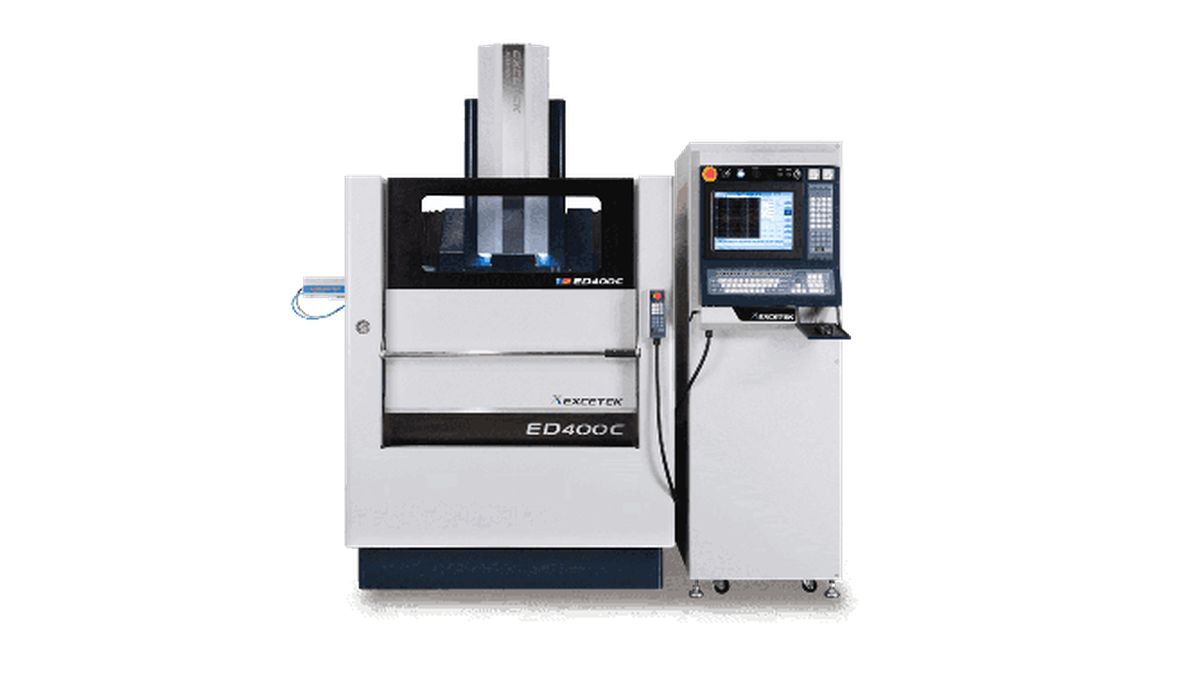
Electric Discharge Machine

Electrical Discharge Machine(EDM), Die-sinking EDM, also called cavity type EDM or volume EDM consists of an electrode and workpiece submerged in an insulating liquid such as more typically, oil or, less frequently, other dielectric fluids. The electrode and workpiece are connected to a suitable power supply. The power supply generates an electrical potential between the two parts. As the electrode approaches the workpiece, dielectric breakdown occurs in the fluid, forming a plasma channel, and a small spark jumps.
These sparks usually strike one at a time because it is improbable that different locations in the inter-electrode space have identical local electrical characteristics which would enable a spark to occur simultaneously in all such locations. These sparks happen in huge numbers at seemingly random locations between the electrode and the workpiece. As the base metal is eroded, and the spark gap subsequently increased, the electrode is lowered automatically by the machine so that the process can continue uninterrupted. Several hundred thousand sparks occur per second, with the actual duty cycle carefully controlled by the setup parameters. These controlling cycles are sometimes known as "on time" and "off-time." The on-time setting determines the length or duration of the spark. Hence, a longer on time produces a deeper cavity for that spark and all subsequent sparks for that cycle, creating a rougher finish on the workpiece. The reverse is true for a shorter time. Off time is the period of time that one spark is replaced by another. A longer off time, for example, allows the flushing of dielectric fluid through a nozzle to clean out the eroded debris, thereby avoiding a short circuit. These settings can be maintained in microseconds. The typical part geometry is a complex 3D shape, often with small or odd-shaped angles. Vertical, orbital, vectorial, directional, helical, conical, rotational, spin, and indexing machining cycles are also used.

Some of the advantages of EDM include machining of:

  1. Complex shapes that would otherwise be difficult to produce with conventional cutting tools.
  2. Extremely hard material to very close tolerances.
  3. Very small workpieces where conventional cutting tools may damage the part from excess cutting tool pressure.
  4. There is no direct contact between tool and workpiece. Therefore delicate sections and weak materials can be machined without any distortion.
  5. A good surface finish can be obtained.
  6. Very fine holes can be drilled.

Some of the disadvantages of EDM include:

  1. The slow rate of material removal.
  2. Potential fire hazard associated with use of combustible oil-based dielectrics.
  3. The additional time and cost used for creating electrodes for ram/sinker EDM.
  4. Specific power consumption is very high.
  5. Power consumption is high.
  6. Electrically non-conductive materials can be machined only with specific set-up of the process.

Published by May 20, 2020 Source :wikipedia Source :kknews Source :yawjet

Further reading

You might also be interested in ...

Headline
Knowledge
Scaling and Corrosion in Plastic Machinery Cooling Systems: Causes, Risks, and Preventive Measures
Scaling and corrosion are persistent risks in plastic machinery cooling systems. This article outlines their causes, their effect on heat transfer and flow stability, and practical maintenance measures manufacturers can use to reduce efficiency loss, blockage risk, and long-term equipment damage.
Headline
Knowledge
Chemical Packaging Lines Evolve as Safety and Precision Demands Increase
As chemical manufacturers face stricter safety regulations and complex material requirements, packaging lines are evolving from standalone machines into fully integrated production systems. This article explores key considerations including filling technology selection, equipment durability under chemical exposure, workplace safety, and the shift toward complete system solutions. Understanding these factors helps manufacturers improve accuracy, ensure safety, and enhance overall production efficiency in hazardous chemical packaging environments.
Headline
Knowledge
Grease Pumps in Maintenance Operations: Types, Applications, and Selection Considerations
A Practical Guide to Grease Pump Applications, Performance, and Selection
Headline
Knowledge
BLDC vs. Induction Motors in Lifting and Hoisting Applications: Efficiency, Safety, and System Cost
What makes BLDC motors a better fit for today’s lifting and hoisting systems.
Headline
Knowledge
Improving Multi-Computer Workflow Efficiency with a 4-Port USB-C KM Switch
How mouse roaming, 10Gbps USB sharing, and flexible control help streamline modern multi-system environments
Headline
Knowledge
How Anti-Static And Protective Films Reduce Surface Damage In Sensitive Manufacturing
In sensitive manufacturing, many costly defects do not begin with machine failure or operator error. They begin with static charge, airborne particles, micro-scratches, adhesive residue, and unnoticed surface contamination. These issues are often underestimated because they appear as scattered defects rather than one major failure. Yet in electronics, optics, display processing, and coated surface production, even small flaws can reduce yield, increase rework, slow inspection, and weaken final product quality.
Headline
Knowledge
What Buyers Should Know Before Choosing a Automatic Plastic Blow Molding Machine
For buyers, factory owners, and packaging manufacturers, selecting an automatic blow molding machine is no longer just a matter of comparing output speed or initial price. In real production environments, the performance of a plastic blowing machine is often determined by the quality and coordination of its core components. A machine may appear competitive on paper, yet still create costly problems once production begins. Uneven wall thickness, unstable parison formation, excessive scrap, slow cooling, and difficult maintenance are all issues that can usually be traced back to the design of several key modules. This is why experienced buyers tend to look beyond catalog specifications and focus instead on the machine’s screw, die head, clamping system, and cooling design. These components do more than support production. They directly influence product quality, material efficiency, energy use, maintenance frequency, and overall return on investment.
Headline
Knowledge
What Buyers Overlook When Choosing a Wire Harness Manufacturer
A practical guide to evaluating engineering support, quality control, customization and sourcing risk
Headline
Knowledge
How High-Efficiency Gear Motors and Brushless Motors Support ESG and Energy Savings
Industrial motor efficiency directly affects a factory’s electricity use, carbon footprint, maintenance burden, and long-term operating cost. For factory owners, procurement teams, and equipment designers, choosing a more efficient gear motor or Brushless Motor is not only a technical upgrade. It is also a practical way to improve ESG performance, reduce energy waste, and strengthen return on investment. In most industrial facilities, motors are among the largest sources of electricity consumption. When motors run continuously in conveyors, packaging lines, automated machinery, food processing systems, and material handling equipment, even a modest improvement in efficiency can produce significant annual savings. That is why motor efficiency is increasingly linked to ESG strategy, cost control, and supply chain competitiveness.
Headline
Knowledge
Die Casting Vs. Forging: How To Choose Based On Strength, Geometry, And Volume
Choosing between die casting and forging affects far more than part cost. It influences structural performance, design flexibility, tooling strategy, machining requirements, lead time, and long-term production efficiency. When the wrong process is selected too early, projects often run into redesigns, extra machining, or higher-than-expected production costs. The right decision depends on how much strength is required, how complex the part geometry is, and whether the target is lower-volume production or stable high-volume output.
Headline
Knowledge
How Material Design Affects Fitness And Rehabilitation Rubber Products
In fitness and rehabilitation products, material design has a direct effect on performance, comfort, durability, hygiene, and long-term user trust. A resistance band that stretches unevenly, a grip that becomes slippery, or a flexible component that tears too early can quickly lead to complaints, returns, and lower confidence in the product. The key challenge is not simply choosing an elastic material. It is selecting and validating a material system that can perform consistently under repeated stretching, skin contact, sweat exposure, and ongoing mechanical stress.
Headline
Knowledge
Choosing the Right Coating for Paper Cups and Food Containers
Selecting the right coating for paper cups and food containers affects far more than leak resistance. For foodservice brands, importers, product teams, and packaging decision-makers, coating choice directly shapes heat resistance, grease performance, sealing behavior, disposal options, compliance risk, and overall cost. A paper cup or food container may look similar on the outside, but the coating often determines whether it performs well in real service conditions or creates problems after launch. That is why coating specifications should be defined early rather than treated as a minor detail after size, structure, or artwork are approved.
Agree