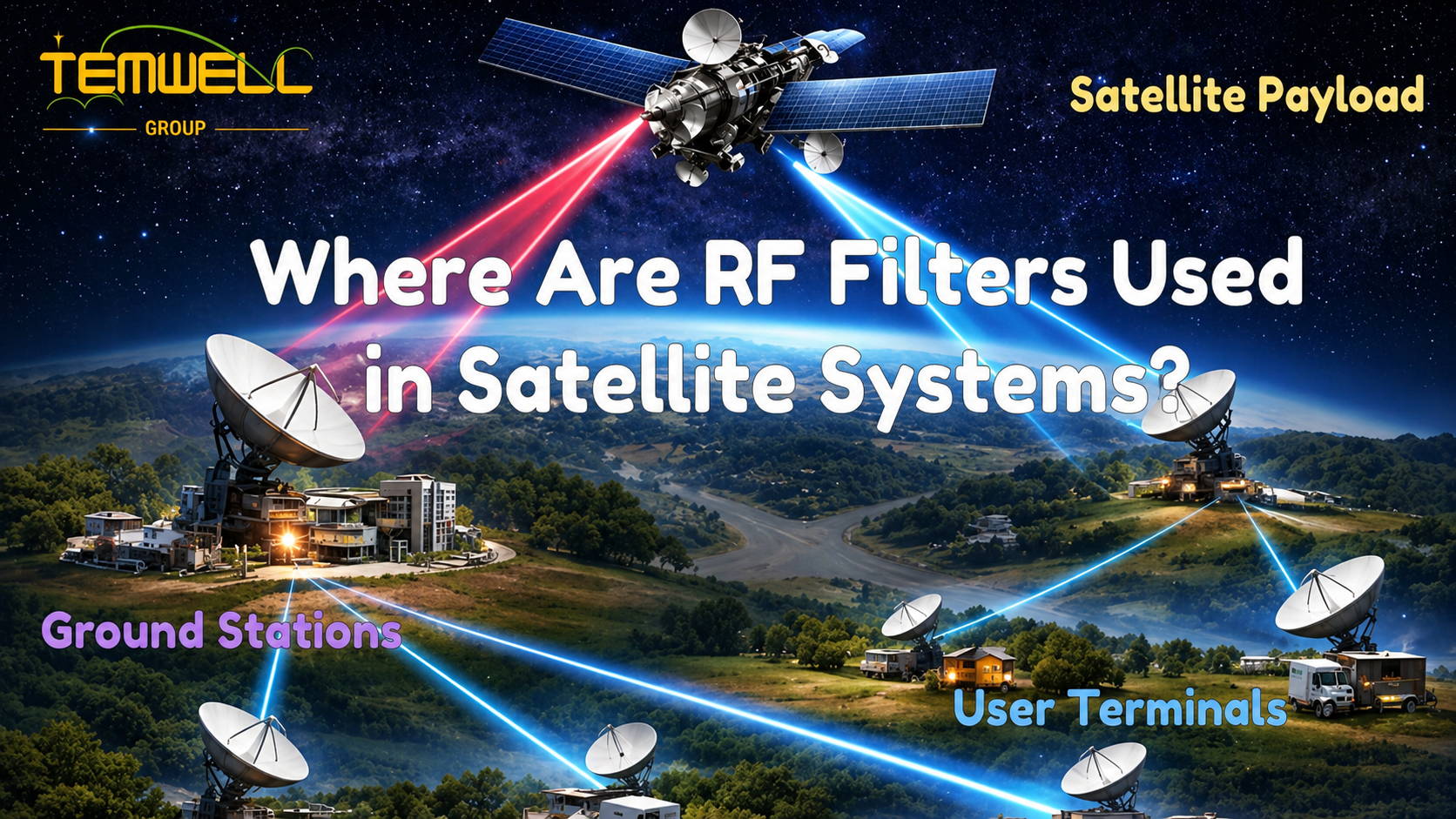
As the global satellite communications industry continues to expand beyond 2026, competition is no longer defined only by the number of satellites in orbit. Buyers, project owners, system integrators, and engineering teams are now paying closer attention to link quality, interference control, spectrum efficiency, and long-term system reliability. In this context, RF filters are evolving from basic supporting components into critical decision points in satellite system design and procurement. Recent industry signals show that several forces are reshaping demand at the same time: the continued growth of LEO constellations, the development of 5G NTN, stronger expectations for resilient communications, and a more crowded spectrum environment. Together, these trends are increasing the strategic importance of RF front-end design, especially RF filters.
LEO growth and 5G NTN are reshaping RF filter demand
One of the clearest developments after 2026 is the deeper integration between satellite systems, terrestrial networks, and non-terrestrial communications. As satellite connectivity becomes more closely linked with 5G, IoT, aviation, maritime, and emergency communications, signal purity and spectrum control become more important than ever.
This is why RF filters are no longer viewed simply as signal-passing components. In modern satellite systems, they are expected to support frequency selection, out-of-band rejection, system isolation, interference suppression, and front-end protection. For procurement teams, an unsuitable filter can create serious downstream issues, including unstable communication quality, higher insertion loss, module interference, and increased maintenance costs.
Why procurement teams should pay more attention to RF filters after 2026
Satellite communications are facing three major pressures at once: denser spectrum usage, smaller equipment footprints, and higher expectations for reliable connectivity. Each of these trends makes RF filter selection more important.
First, crowded spectrum environments increase the risk of adjacent-channel interference and unwanted noise. If a filter does not provide sufficient rejection performance, the entire system may suffer in real operating conditions. Second, smaller terminals and more compact modules mean buyers must evaluate size, weight, and power constraints in addition to frequency performance. Third, whether the application is commercial communications, defense, emergency response, or critical infrastructure backup, reliability is becoming a core requirement. That makes consistency, environmental stability, and long-term supply support more valuable than before.
What should buyers evaluate when selecting RF filters for satellite systems?
In satellite system projects, RF filters should not be evaluated only by unit price or basic datasheet claims. A better approach is to assess them based on total system risk and long-term integration value.
| Evaluation Factor |
Why It Matters |
Procurement Focus |
| Center frequency and bandwidth |
Determines signal selection accuracy |
Match actual link requirements |
| Insertion loss |
Affects link efficiency |
Prioritize low-loss designs |
| Out-of-band rejection |
Affects interference control |
Review rejection performance in multi-band environments |
| Size and packaging |
Impacts module integration |
Check SMD and compact design options |
| Consistency and stability |
Impacts production and maintenance risk |
Confirm testing and quality control capability |
The key idea is simple: the real cost of an RF filter is not just its component price, but its effect on system stability, maintenance burden, and integration efficiency.
Which RF filter types deserve more attention after 2026?
Demand for customized rf filter solutions is expected to rise as satellite-related applications become more specialized. Many next-generation projects cannot rely entirely on standard off-the-shelf parts. When systems have specific requirements for center frequency, bandwidth, size, power handling, or environmental performance, customized solutions often reduce overall integration risk.
At the same time, saw filter solutions remain relevant in selected applications, especially where compact size, scalable production, and consistent performance are important. However, buyers should not assume that every saw filter is suitable for every satellite-related subsystem. Frequency range, power tolerance, system architecture, and mission conditions still need to be reviewed carefully.
For applications that require higher isolation or stronger selectivity, cavity filters and similar high-performance solutions are also likely to remain important, especially in ground infrastructure, mission-critical communications, and demanding RF environments.
How can buyers identify the right RF filter supplier?
From a procurement perspective, the best supplier is not simply the one offering a catalog product. The better partner is the one that helps reduce technical and commercial risk. Buyers should confirm whether the supplier can support custom development, provide clear performance data, understand satellite or high-reliability communication scenarios, support multiple filter types and RF components, and maintain stable lead times over the long term.
In high-demand satellite system projects, these capabilities often matter more than a low initial quote.
FAQ
1. Why are satellite systems becoming more dependent on RF filters?
Because crowded spectrum, multi-band coexistence, and growing reliability requirements make RF filters essential for signal quality, interference suppression, and receiver protection.
2. What are the most important RF filter specifications in satellite system procurement?
The most important factors usually include center frequency, bandwidth, insertion loss, out-of-band rejection, size, environmental stability, and supply consistency.
3. When is a customized rf filter a better choice than a standard part?
A customized rf filter is usually a better choice when the system has special frequency requirements, size constraints, interference challenges, or multi-module integration needs.
4. Is a saw filter suitable for satellite systems?
In some applications, yes. But suitability depends on frequency, power handling, system architecture, and operating conditions. It should be evaluated case by case.
5. Why do RF filters affect total procurement cost?
Because poor filter selection can increase tuning time, reduce system stability, raise maintenance needs, and delay deployment, making the total cost much higher than the component price alone.
Conclusion
Looking ahead, satellite system development after 2026 will continue to push RF front-end performance higher. For buyers, project owners, and system integration teams, RF filters are no longer secondary parts. They are essential components that influence signal quality, reliability, and project success. Building a stronger filter evaluation standard early can help reduce deployment risk, shorten development cycles, and improve final system performance.
Based on publicly available information, Temwell Corporation provides RF filter, saw filter, cavity filter, SMD filter, and customized RF Filter solutions for a range of communication applications. Readers who want to explore customized rf filter options and related products can visit the webpage. For purchasing or project inquiries, can also contact Temwell now.